

What if you could secure a place on a top-tier accounting and finance degree birmingham for the 2026 intake without the constant anxiety of shifting UCAS requirements or rising living costs? If you're currently staring at a list of entry criteria and feeling overwhelmed by the sheer number of institution choices in the West Midlands, you're certainly not alone.
We agree that the journey to a professional career often feels blocked by complex bureaucracy and financial hurdles. You deserve a clear, expert assessment of your options that removes the guesswork from your UCAS application. This guide reveals how to qualify for your chosen course while you maximize your maintenance loan and tuition fee grant eligibility. We'll break down essential ACCA and CIMA accreditations, explain core modules in detail, and provide a simplified, step-by-step path to your 2026 enrolment.
Key Takeaways
- Understand why pursuing an accounting and finance degree birmingham positions you at the heart of the UK’s largest regional financial hub for the 2026 intake.
- Identify the core modules and professional exemptions from ACCA, CIMA, and ICAEW that will accelerate your path to becoming a qualified accountant.
- Learn how Foundation Year pathways provide a reliable entry route if you are concerned about meeting standard UCAS point requirements.
- Uncover the essential funding details for 2026, including how to secure Tuition Fee Loans and Maintenance Loans to support your studies and living costs.
- Discover how an expert assessment can help you navigate the UCAS application process and secure your place with professional guidance.
Why Pursue an Accounting and Finance Degree in Birmingham in 2026?
If you're planning your career path for 2026, choosing an accounting and finance degree birmingham puts you at the heart of the UK's most significant regional economy. This BSc (Hons) qualification is a rigorous, professional-track degree. It doesn't just teach you how to manage ledgers; it provides a direct route toward chartered status with prestigious global bodies like ACCA, CIMA, and ICAEW. By the time you graduate, you'll possess the technical expertise and the strategic mindset required to navigate the complexities of global markets.
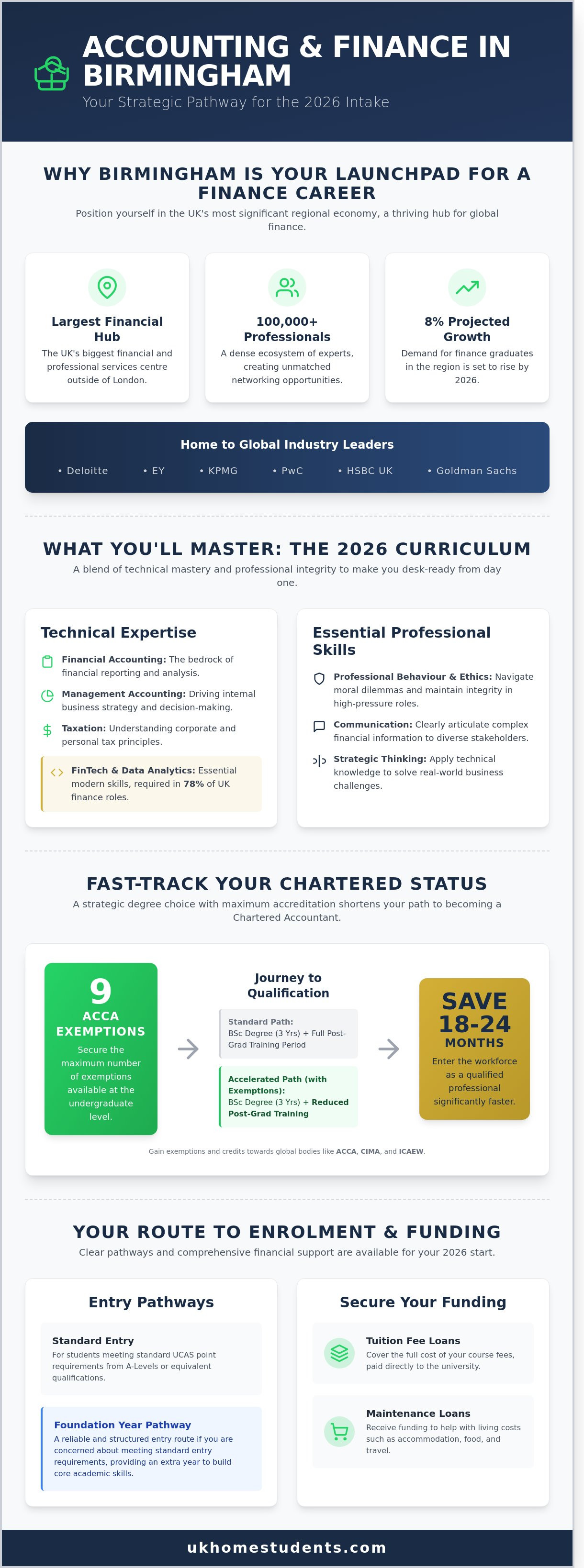
Birmingham currently stands as the UK’s largest financial and professional services hub outside of London. The city centre is home to more than 100,000 professionals working in this sector. This density creates a unique ecosystem for students. You aren't just studying in a classroom; you're living within walking distance of the "Big Four" firms: Deloitte, EY, KPMG, and PwC. These global giants, along with major international banks like HSBC UK and Goldman Sachs, have established massive operations here, creating a high demand for local talent.
Studying in this environment offers networking advantages that smaller university towns simply can't match. Your lecturers are often practitioners with direct links to the Colmore Business District. You'll have opportunities to attend industry events, join professional societies, and meet recruiters long before you submit your final dissertation. It's about building a professional profile while you're still a student.
The Strategic Advantage of the Birmingham Financial District
The Colmore Business District is the engine room of the West Midlands. Its continued growth has transformed Birmingham into a "decentralisation" success story. By 2026, the demand for finance graduates in the region is projected to grow by 8% as more firms move operations away from the high costs of London. Most local universities capitalise on this by organising mandatory or optional placement years. These 12-month stints at firms like Deutsche Bank or Grant Thornton allow you to apply your classroom knowledge to real-world audits and tax strategies, often leading to a direct job offer upon graduation.
Academic Excellence and Research-Led Teaching
Birmingham hosts several world-class business schools, each offering a distinct approach to the curriculum. You'll find a choice between research-heavy institutions that focus on the "why" of economic theory and industry-focused universities that prioritises the "how" of practical application. It's vital to choose a programme that balances these two. In 2026, employers will expect you to be proficient in industry-standard software like Sage, SAP, and Bloomberg Terminals. Top-tier Birmingham courses integrate this practical training into their core modules, ensuring you're desk-ready from day one. If you're looking for a competitive edge, look for programmes that offer "exemptions" from professional exams, which can shave years off your journey to becoming a fully qualified accountant.
Key Modules and Professional Accreditations to Look For
Selecting the right accounting and finance degree birmingham requires a close look at the underlying syllabus. You'll spend your first two years mastering the three pillars of the industry: Financial Accounting, Management Accounting, and Taxation. These core modules provide the technical vocabulary and analytical framework needed for any high-level boardroom role. By 2026, the most competitive courses have moved beyond basic spreadsheets. They now prioritise FinTech and data analytics, reflecting the fact that 78% of UK finance roles now require advanced digital literacy and the ability to interpret complex data sets.
Technical expertise is only half the battle in the modern workplace. You shouldn't overlook the importance of "Soft Skills" modules that are now integrated into the 2026 curriculum. Units such as Professional Behaviour and Ethics are essential for your long-term career security. They teach you how to maintain professional integrity and navigate the moral dilemmas often found in high-pressure financial environments. This focus on character and communication is exactly why Birmingham graduates remain highly sought after by global consultancy firms.
Maximising Professional Exemptions
A strategic degree choice can significantly shorten your journey to becoming a Chartered Accountant. If you select a programme with maximum accreditation, you could secure up to 9 exemptions from ACCA exams or significant credit toward ICAEW and CIMA qualifications. This effectively reduces your post-university training period by 18 to 24 months. You must verify that your specific module choices meet the current requirements of these professional bodies, as accreditation status can change. If you're looking to clarify your eligibility for specific funding or courses, you can secure an expert assessment to ensure your path is clear before the next UCAS deadline.
Specialisations and Elective Pathways
Electives allow you to customise your degree to suit the specific demands of the Birmingham job market. With the city hosting major regional hubs for firms like PwC, KPMG, and Goldman Sachs, choosing modules in Forensic Accounting, Corporate Finance, or Investment Management can give you a distinct competitive edge. Look for programmes that offer hands-on experience with the Bloomberg Terminal or Sage accounting software. Since 2024, these practical certifications have become a standard expectation for entry-level analysts working within the city's thriving financial district.
Entry Requirements and Foundation Year Pathways
Securing your place on an accounting and finance degree birmingham involves meeting specific academic benchmarks, though the 2026 entry cycle offers various routes to success. Most universities in the city expect between 96 and 120 UCAS points for direct entry into the first year. This usually means achieving grades ranging from CCC to BBB at A-level, or a Merit profile in a BTEC Level 3 Extended Diploma. You'll also need a Grade 4 (C) or higher in GCSE English and Maths as a standard prerequisite for these quantitative programmes.
If you're weighing up your options, you'll find that a business management degree in Birmingham often has similar point requirements. However, the accounting path is significantly more technical. Mature students who lack recent qualifications shouldn't feel discouraged. Many Birmingham institutions value professional experience. If you've spent three to five years working in a clerical, retail, or supervisory role, you can often apply via the Accreditation of Prior Experiential Learning (APEL) route. This process allows your practical knowledge to stand in place of traditional UCAS points, provided you can demonstrate the motivation to succeed in a demanding academic environment.
The Foundation Year: A Fresh Start for Home Students
The "Year 0" approach is a strategic choice if you don't have the standard A-levels or if you've been out of education for a decade. This four-year pathway incorporates an initial year designed to bridge the gap between your current skills and the rigours of a finance degree. You'll study introductory modules in business mathematics, academic writing, and digital literacy. It's fully funded by Student Finance England as part of your degree package. Progression to the full BSc (Hons) status is usually guaranteed once you achieve a pass mark, typically set at 40% or 50% depending on the specific provider. This year ensures you're fully prepared for the technical financial reporting modules that follow.
Flexible Learning and Attendance Models
Birmingham is a leading hub for flexible education, catering to students who need to balance their studies with a job or family commitments. Many providers in the city now offer compressed timetables where your face-to-face lectures are grouped into two-day blocks. For instance, you might attend campus only on Tuesdays and Wednesdays from 9:00 am to 5:00 pm. This leaves the rest of the week free for part-time employment or independent study.
- Blended Learning: This model combines these intensive on-campus sessions with high-quality online resources and recorded webinars.
- Campus Benefits: While remote study offers convenience, attending an accounting and finance degree birmingham in person gives you access to specialized computer labs equipped with industry-standard software like Sage, QuickBooks, and Bloomberg terminals.
- Professional Networking: Being physically present in Birmingham allows you to attend local career fairs and networking events with the "Big Four" accounting firms, which have a massive presence in the city's Colmore Business District.
Student Finance and Funding Your Birmingham Finance Degree
Securing your place for an accounting and finance degree birmingham requires a clear financial strategy. For the 2026 entry cycle, the Tuition Fee Loan remains the primary method for covering the £9,250 annual cost of your course. This loan is non-means tested, which means your household income does not affect your eligibility for this specific portion. Student Finance England pays this money directly to your university, so you never have to manage the tuition payments yourself. You only start repaying this debt once you graduate and your annual income exceeds the £25,000 threshold under the current Plan 5 regulations.
To qualify for UK Home Student status and access this funding, you must typically hold settled status or British citizenship and have resided in the UK for at least three years before the first day of your course. If your residency history is complex or you have recently moved to the West Midlands, our Student Finance in Birmingham guide provides a detailed breakdown of specific eligibility scenarios and evidence requirements.
Calculating Your Maintenance Loan
Your Maintenance Loan provides the cash you need for rent, food, and textbooks. Unlike the tuition loan, this amount is means-tested based on your household income. Students from households earning under £25,000 usually qualify for the maximum support, which is projected to be approximately £10,500 for the 2026/27 academic year for those living away from home. If you have children or a registered disability, you can apply for the Childcare Grant or Disabled Students' Allowance (DSA), which provide extra funding that you do not have to pay back. For 2026, the interest rate for new student loans is set at the Retail Price Index (RPI) rate, meaning the loan balance only grows in line with inflation.
Managing Living Costs in the West Midlands
Birmingham offers a significant financial advantage when compared to London-based finance degrees. Average student rent in popular areas like Selly Oak or the city centre typically ranges between £550 and £820 per month, which is roughly 35% cheaper than equivalent accommodation in the capital. A monthly student travel pass for the West Midlands bus and tram network costs approximately £55, allowing for affordable commuting across the city.
To balance a demanding accounting and finance degree birmingham with your personal finances, you should follow these practical steps:
- Use a dedicated banking app to categorise your spending on groceries and socialising.
- Pay your termly rent as soon as your Maintenance Loan instalment arrives in September, January, and April.
- Take advantage of student discounts at major retailers in the Bullring and Grand Central.
- Look for part-time work within the university's student union to keep your commute costs at zero.
How to Secure Your Place with UK Home Students
Applying for an accounting and finance degree birmingham is a competitive process that requires more than just meeting the minimum grade requirements. You need a strategic approach to stand out among thousands of applicants targeting the city's top-tier business schools for the 2026 intake. At UK Home Students, we provide a comprehensive expert assessment service designed to bridge the gap between your current qualifications and a successful university offer. We act as your professional advocate, offering the "inside track" to Birmingham’s premier institutions by ensuring every technical detail of your application is flawless.
Our consultancy takes the anxiety out of the UCAS process. Navigating complex academic and financial regulations is difficult, but having a dedicated mentor provides the reassurance you need. We verify your "Home" student status early, which is vital for securing the correct fee status and avoiding the higher costs associated with international rates. This clarity allows you to move forward with confidence, knowing your eligibility for both the course and the necessary funding is fully confirmed.
Our Step-by-Step Application Support
Our vetting process begins by checking your specific academic profile against the 2026 institutional requirements of your chosen Birmingham university. We don't just look at your A-Levels or BTECs; we evaluate your entire background to ensure you meet the criteria for a "Home" student tuition fee. Our support includes:
- Personal Statement Tailoring: We help you craft a narrative that highlights your analytical skills and passion for financial markets, specifically for the accounting and finance sector.
- UCAS Management: Our consultants manage the technicalities of the UCAS portal, ensuring your five choices are strategically selected to maximise your chances of an offer.
- Financial Setup: We guide you through the Student Finance England application, helping you secure tuition fee loans and maintenance grants that can exceed £10,227 for the 2025/26 academic year, depending on your household income.
Start Your Journey to a Finance Career Today
The path to a high-earning career in the UK’s second-largest financial hub shouldn't be defined by paperwork and stress. Graduate salaries for finance roles in Birmingham often start between £26,000 and £33,000, making an accounting and finance degree birmingham a lucrative long-term investment. By using a professional education consultant, you remove the guesswork from the process. We ensure your enrolment is hassle-free, allowing you to focus on your future studies rather than bureaucratic hurdles. If you're ready to secure your future, our mentors are standing by to verify your eligibility and fast-track your admission.
Take the Next Step Toward Your 2026 Finance Career
Choosing to study an accounting and finance degree birmingham is a strategic move for your professional future. With the city serving as the UK's second-largest financial hub, you'll be positioned to access over 100,000 professional services roles. You've now seen how specific modules and accreditations from bodies like ACCA or CIMA can accelerate your career progression. Navigating the application process and securing your maintenance loan doesn't have to be a stressful experience.
If you're a mature student or a home learner looking for flexibility, UK Home Students provides the expert assessment you need. We offer direct partnerships with flexible Birmingham institutions that cater to diverse schedules. Our team delivers specialised support for mature UK home students to ensure you meet all Student Finance England eligibility criteria for the 2026/27 academic year. We've helped thousands of applicants secure their funding and university placements through our methodical guidance.
Secure your place on a Birmingham Finance Degree today and start your journey with confidence. Your future in the financial sector is within reach.
Frequently Asked Questions
What are the typical entry requirements for an accounting and finance degree in Birmingham?
Entry requirements for an accounting and finance degree in Birmingham generally range from 112 to 136 UCAS tariff points. For 2026 entry, this typically means achieving grades between BBC and AAB at A-level. You'll also need at least five GCSEs at grade 4 or C, including English Language and Mathematics. Some institutions, like the University of Birmingham, may require a grade 6 or 7 in GCSE Maths if you aren't taking it at A-level.
Can I study accounting and finance in Birmingham without a Maths A-level?
Yes, you can study an accounting and finance degree birmingham without a Maths A-level at several highly-regarded universities. While some Russell Group institutions prefer it, universities such as Aston University and Birmingham City University accept students with a strong GCSE Maths grade, usually a 6 (B) or higher. If you have a BTEC Level 3 Extended Diploma in Business with Distinction grades, you'll also find many pathways available to you without traditional A-level Mathematics.
How much can I get for a maintenance loan if I study in Birmingham in 2026?
For the 2026/27 academic year, students living away from home in Birmingham can expect a maximum maintenance loan of approximately £10,544. This figure is a projected estimate based on the 2024/25 maximum of £10,227 plus annual inflationary adjustments. Your specific funding amount depends on your household income. If your family earns less than £25,000 per year, you'll likely qualify for the full amount to help cover your rent and living costs.
Which Birmingham universities offer ACCA exemptions for their finance degrees?
Aston Business School, Birmingham City University, and the University of Birmingham all offer significant ACCA exemptions, often covering up to 9 fundamental papers. This includes exemptions from Business and Technology (BT), Management Accounting (MA), and Financial Accounting (FA). By choosing an accredited accounting and finance degree birmingham, you can cut your post-graduate study time by up to 2 years, allowing you to reach chartered status much faster than graduates from non-accredited programmes.
Is it better to study accounting and finance or business management?
An accounting and finance degree is the better choice if you want a technical, professional qualification with a clear path into regulated roles like auditing or investment banking. Business management is a broader degree that focuses on leadership and marketing rather than technical fiscal analysis. Data from the Graduate Outcomes Survey indicates that finance graduates often secure starting salaries roughly £3,000 higher than those on general business tracks due to their specialised skill sets.
What jobs can I get in Birmingham after graduating with a finance degree?
You can secure prestigious roles at "Big Four" firms like PwC, Deloitte, KPMG, and EY, which all operate major regional hubs in Birmingham's Colmore Business District. Other graduates find employment as investment analysts at Deutsche Bank or tax consultants within the 500 financial services firms located in the city centre. Birmingham's financial sector currently employs over 50,000 people, making it the largest insurance and financial services hub in the UK outside of London.
Are there flexible or part-time accounting degrees available for mature students?
Birmingham City University and University College Birmingham provide flexible study options, including part-time routes and foundation years specifically designed for mature learners. If you're over 21 and have relevant work experience but lack traditional A-levels, you can often gain entry through an "Access to Higher Education" diploma. These programmes are structured to allow you to balance your studies with existing employment or family commitments while still qualifying for full Student Finance support.