

What if the only thing standing between you and a more rewarding profession in 2026 is the myth that you're "too old" to retrain? You likely feel that returning to university is a major financial risk, particularly if you're worried about losing your current income or navigating the complex eligibility criteria for a second degree. It's a common anxiety, but the UK higher education system offers specific, funded pathways designed for mature students who need to balance their studies with existing responsibilities.
If you're looking to pivot, this guide will help you identify a career change degree uk that leads directly to a new job. You'll discover how to secure a maintenance loan to support your household and find courses with flexible, 2-day-a-week attendance schedules. We'll provide a clear roadmap through the UCAS application process and the latest Student Finance regulations to ensure you can retrain with complete confidence and financial security.
Key Takeaways
- Differentiate between undergraduate retraining and postgraduate conversion courses to find the most direct path into your new profession.
- Identify high-growth sectors like Tech and Health to ensure your career change degree uk choice aligns with the 2026 job market and salary expectations.
- Explore how flexible 2-day attendance models empower mature students to balance university study with full-time work or family life.
- Master the complexities of the ELQ rule and Student Finance to secure the tuition fee loans and maintenance grants you need for retraining.
- Learn how to use foundation years as a gateway to your new career, even if you lack traditional A-level qualifications.
What is a Career Change Degree in the UK?
A career change degree uk is a strategic academic qualification specifically designed to help you transition into a new professional field, regardless of your previous background. It's more than just a certificate. It's a comprehensive retraining path that provides the industry-recognised accreditation necessary to compete for high-level roles. While short courses offer basic skills, a full degree ensures you meet the professional standards required by regulatory bodies in sectors like nursing, law, or engineering.
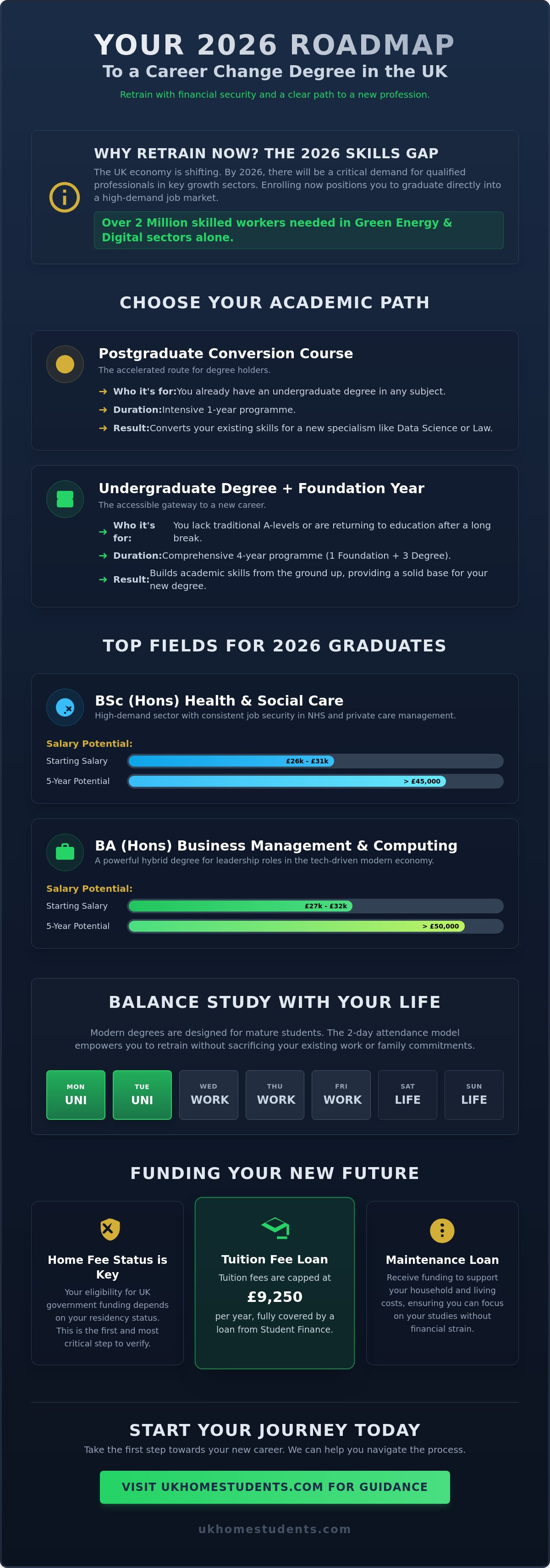
2026 is a pivotal year for this transition. The UK government's focus on the "skills gap" means that by 2026, many industries will face acute shortages in specialized roles. Economic forecasts suggest a demand for over 2 million highly skilled workers in the green energy and digital sectors alone. Enrolling in a career change degree now positions you to graduate exactly when these sectors are most desperate for qualified professionals. You aren't just getting a piece of paper; you're securing a competitive advantage in a shifting economy.
The Two Main Routes: Conversion vs. Foundation
If you're looking to pivot, you'll likely choose between two distinct pathways based on your existing education. A Postgraduate Conversion course is ideal if you already hold an undergraduate degree in an unrelated subject. These intensive programmes, often lasting one year, "convert" your existing academic skills into a new discipline such as Psychology or Data Science. If you don't have a prior degree or your previous qualifications are from a different era, the Undergraduate route is your best option. Many universities now offer a four-year programme that includes a Foundation Year. A Foundation Year acts as a gateway year for mature students returning to education. If you're wondering What is a mature student?, it generally refers to anyone over the age of 21 who may require a different entry route than a typical school leaver.
Why Home Student Status Matters
Your residency status determines your financial journey. If you qualify for "Home Fee" status, your tuition fees are capped at £9,250 per year, whereas international students often pay double or triple that amount. Securing this status is essential for accessing Student Finance England's maintenance loans and tuition fee grants. Eligibility usually depends on having "settled status" and living in the UK for at least three years before your course starts. It's a complex area where small details can change your funding outcome. You can use resources like UK Home Students to verify your status and ensure you aren't overcharged. Understanding these regulations early helps you maximize your budget and reduces the stress of returning to university as an adult.
Top Career Change Subjects for the 2026 Job Market
Choosing a career change degree uk involves more than just picking a subject you enjoy. It's about aligning your future with sectors that show resilient growth. By 2026, the UK labor market expects a demand for over 1.2 million additional workers in digital, healthcare, and management roles. Modern degrees have evolved to meet this need through a vocational approach. You won't just sit in lecture halls; you'll engage in "learning by doing" through industry simulations and work-based projects.
When you evaluate a potential subject, you must weigh the length of study against the salary potential. A three-year degree is a significant commitment, but the financial upside is measurable. For instance, graduates in business or health management often enter the workforce with starting salaries between £26,000 and £31,000. Within five years, many professionals in these sectors see their earnings exceed £45,000. If you are concerned about how to fund this transition, you should review the official government guidance on student finance to see what maintenance loans you can access.
BSc (Hons) Health and Social Care
This remains the primary choice for career changers who prioritize job security. The NHS and private care providers face a consistent shortage of qualified managers. If you have a background in retail or hospitality, your skills in communication and conflict resolution are highly transferable to professional care management. This degree path allows you to step into leadership roles rather than entry-level positions. You can explore the specific requirements in our BSc (Hons) Health and Social Care Degree Birmingham: The 2026 Guide for UK Home Students.
BA (Hons) Business Management and Computing
Business Management is often called the "universal" degree because it fits almost any corporate leadership role. It's the ideal pivot if you want to move from manual or administrative work into a strategic office environment. Adding a computing focus allows you to fast-track into the tech sector without needing years of prior coding experience. Most 2026 curriculums focus on digital transformation and data literacy, which are the most sought-after skills in the current economy. For a deeper look at this route, see our Business Management Degree Birmingham: The Complete 2026 Guide for Home Students.
Success in a career change degree uk depends on identifying which of your current skills, such as time management or team leading, will give you a head start in your new field. To find out which course best suits your background, you can speak with an expert advisor for a personalized assessment.
The 2-Day Attendance Model: Balancing Work and Study
Pursuing a career change degree uk in 2026 doesn't require you to sacrifice your financial stability or family life. The modern "Flexible Degree" concept has transformed how universities deliver education to mature learners. Instead of the traditional five-day university week, many institutions now offer compressed timetables. This means you spend two intensive days on campus, usually between 9:00 and 17:00, rather than spreading three-hour blocks across the entire week.
This model is specifically designed for students who need to maintain a part-time income. By having three clear weekdays free, you can work 16 to 24 hours a week while still qualifying for a full maintenance loan. This balance is often supported by blended learning. You'll attend in-person seminars for collaborative work, but you'll access recorded lectures and digital resources remotely. If you already hold an undergraduate qualification, you may find that postgraduate conversion courses offer similar flexibility, allowing you to retrain in a new field in just one year.
Managing Your Schedule as a Mature Student
Returning to academic writing after a long break can feel daunting, but time management is your greatest tool. A flexible schedule requires discipline; you're trading campus time for independent study. It's vital to remember that "flexible" doesn't mean "easy." The academic rigour remains high to ensure your degree is respected by employers. One major benefit is the cohort itself. You'll likely study alongside other career changers who share your professional drive, providing a supportive network that understands the pressures of adult life.
Finding Flexible Courses Nationally
When searching for your career change degree uk, you must look beyond the course title. Check the "Mode of Study" section in course descriptions for terms like "compressed hours," "evening and weekend options," or "blended delivery." Many universities don't advertise these specific timetables on their main landing pages. This is where an expert assessment from an educational consultant becomes invaluable. They can filter through hundreds of institutions to find the specific attendance patterns that fit your existing lifestyle and financial needs.
Funding Your Career Change: Loans, Grants, and ELQ Rules
The most common question we hear from prospective students is: "Can I get Student Finance if I’ve studied before?" For many, this is the primary barrier to pursuing a career change degree uk. Understanding the financial landscape is vital to ensure your transition is sustainable and stress-free. If you've already spent years in the workforce, you need clear answers on how the UK's funding system treats returning learners.
The UK government generally applies the Equivalent or Lower Qualification (ELQ) rule. This regulation prevents students from receiving funding for a second qualification that's at the same or a lower level than one they already hold. If you have a Bachelor’s degree in Marketing, Student Finance England (SFE) usually won't fund a second degree in History. However, the system contains specific loopholes designed to fill national skills gaps. It's not a closed door; it's a gate that requires the right key to open.
Securing the Maximum Maintenance Loan
Your maintenance loan helps cover rent, food, and travel. While the Tuition Fee Loan goes straight to the university, this money lands in your bank account. The amount you receive depends heavily on your household income and where you live while studying. Mature students often find they qualify for higher support levels. SFE classes you as an "independent student" once you turn 25, or if you've been self-supporting for three years. This means parental income is no longer a factor, which often results in a larger loan award.
If you live in the West Midlands, you can find a detailed breakdown of these thresholds in our Student Finance in Birmingham: A Complete Guide for 2026. For retraining parents, additional support is available. You might qualify for the Childcare Grant, which can cover up to 85% of your costs, or the Parents’ Learning Allowance, which provided up to £1,915 per year in the 2024/25 academic cycle. These are grants, not loans, so you don't have to pay them back.
Exceptions to the "Second Degree" Rule
The government prioritizes certain sectors to address workforce shortages. Subjects like Nursing, Midwifery, Social Work, and some Teacher Training courses are exempt from the ELQ rule. Even if you have a degree, you might still qualify for a second loan in specific STEM or healthcare fields. These "exception" subjects allow you to access both tuition fee loans and maintenance support regardless of your previous academic history. This policy is a lifeline for those moving into high-demand roles.
Understanding these rules is complex. An incorrect application can lead to an immediate rejection, potentially derailing your plans before they begin. The importance of an expert assessment cannot be overstated. You need to ensure your specific circumstances align with current SFE policy to avoid application rejection.
Unsure if your chosen course qualifies for funding? Contact UK Home Students for an expert assessment of your eligibility today.
How to Apply: The Path to Your New Career Starts Here
Changing your professional direction requires a methodical approach to university entry. You need to map your target industry against the specific qualifications required by 2026 standards. If you don't have recent A-levels or traditional UCAS points, foundation years are a vital resource. These four-year programmes bridge the gap between your professional history and higher education, providing the academic grounding necessary for success. It's a strategic entry point for anyone pursuing a career change degree uk who has been out of the classroom for several years.
Your personal statement shouldn't simply list past roles. You must translate your professional skills into academic potential. If you've managed a team of ten or handled a £100,000 budget, these are indicators of leadership and analytical capacity. Universities value the maturity that older students bring to the lecture hall. Simultaneously, securing your funding is a priority. Applying for a maintenance loan or tuition fee grant through Student Finance England (SFE) can be complex. You should start this process at least six months before your course begins to ensure your finances are in place for a stress-free start.
Why Use an Education Consultant for Your Career Change?
Applying for a career change degree uk as a mature student involves more than just a basic form. Expert vetting ensures you don't waste your limited UCAS choices on institutions that won't value your professional background. Consultants handle the intricate bureaucracy of Student Finance England on your behalf, ensuring your residency and "Home" student status are correctly identified. They also offer an "insider track" on which universities provide flexible attendance models, such as evening classes or condensed two-day timetables, which are essential for those balancing studies with existing responsibilities.
Get Your Expert Assessment Today
A free eligibility check is the most effective way to gain clarity before you commit to a course. UK Home Students supports your journey from the initial application right through to your final enrolment. We provide a professional assessment to confirm you meet the specific residency and academic criteria required for funding. This removes the guesswork and provides a clear roadmap for your transition. You can book your free career change assessment with UK Home Students to secure your place and start your new career with confidence.
Take the First Step Toward Your 2026 Career Transformation
Transitioning into a new industry doesn't have to mean pausing your income or your life. By choosing a career change degree uk, you can leverage flexible 2-day attendance models designed specifically for mature students who need to balance lectures with existing commitments. Navigating the 2026 job market requires more than just ambition; it demands a clear understanding of Student Finance England eligibility and ELQ regulations to ensure your tuition fees and maintenance loans are fully secured. UK Home Students specializes in these complex funding rules, providing the clarity you need to move from uncertainty to enrollment.
Our team acts as your dedicated partner, offering expert guidance for mature learners and connecting you with university partners that prioritize flexibility. Don't let bureaucracy stand in the way of your professional growth. Secure your future with an expert assessment from UK Home Students and gain the competitive advantage you need to succeed. Your new career path is within reach, and we're here to help you navigate every step of the journey with confidence.
Frequently Asked Questions
Can I get a student loan for a second degree in the UK if I am changing careers?
Yes, you can often secure funding for a second degree if your chosen subject is on the list of ELQ exempt courses. Under current Student Finance England regulations, subjects such as Nursing, Midwifery, and certain STEM pathways qualify for tuition fee loans even if you already hold a degree. If you're pursuing a career change degree uk in these priority sectors, you'll also be eligible to apply for a maintenance loan to support your living costs.
What is the best degree for a career change at 30 or 40?
The best degree for a career change at 30 or 40 focuses on high demand sectors like Nursing, Cyber Security, or Data Science. These fields prioritize practical skills and professional maturity over age, making them ideal for adult learners. According to 2024 UK government skills shortage data, healthcare and digital technology remain the most resilient paths. Choosing a vocational degree ensures your transition leads directly into a stable, well paid role within three years.
Do I need A-levels to start a career change degree as a mature student?
You don't necessarily need A-levels to start a degree as a mature student. Most UK universities accept an Access to Higher Education Diploma, which is a Level 3 qualification specifically designed for adults returning to education. If you have relevant work experience, some institutions use the Accreditation of Prior Experiential Learning (APEL) to assess your eligibility. This allows your professional background to count towards your application, securing your place without traditional school-leaver qualifications.
How much is the maintenance loan for a mature student in 2026?
For the 2025/26 academic year, the maximum maintenance loan for students living away from home outside London is £10,544. If you're studying in London, this figure increases to £13,762 to account for higher living costs. These amounts are means tested based on your household income. As a mature student, your eligibility for the maximum loan depends on whether you're classified as an independent student, which usually applies if you've supported yourself for three years.
Can I work full-time while studying for a career change degree?
Working full-time while pursuing a full-time degree is extremely difficult because a standard course requires approximately 1,200 hours of study per year. Most students find that a part-time degree or a distance learning program is more manageable for their schedule. If you're committed to a full-time career change degree uk, we recommend limiting your employment to 15 hours per week. This ensures you maintain a healthy balance and meet all your academic requirements.
What is a postgraduate conversion course and how does it differ from a standard Masters?
A postgraduate conversion course is an intensive program designed for graduates who want to switch to a completely different field, such as Law or Psychology. Unlike a standard Masters, which deepens your existing knowledge, a conversion course provides the foundational skills needed for a new profession. These programs typically last 12 months and are recognized by professional bodies. They're a faster, more direct route for career changers who already hold a Level 6 qualification.
Is it worth changing careers through a degree in 2026?
Changing careers through a degree in 2026 is a strategic move if you target sectors with documented skills gaps. Graduate labor market statistics show that individuals with degree level qualifications earn significantly more over their lifetime compared to those without. With the UK economy shifting towards green energy and advanced technology, retraining now positions you for long term success. It's an investment that pays off through increased job security and much higher salary potential.
How long does it take to complete a career change degree?
A standard full-time undergraduate degree takes three years to complete in England and Wales. If you choose to study part-time, the duration typically extends to four or six years depending on your module load. For those who already have a degree, a postgraduate conversion course can be finished in just one year of full-time study. Accelerated degrees are also an option at some universities, allowing you to complete a full 360-credit program in two years.