

What if your residency status or a decade-long break from the classroom wasn't a barrier, but actually your strongest starting point for a health and social care degree? You likely recognise that the UK care sector is currently managing a shortfall of 152,000 professional roles as of late 2024, yet the fear of "International" fee traps or the complexity of Student Finance England often holds talented people back. It's common to feel overwhelmed by eligibility rules or the prospect of balancing a degree with existing family commitments.
This 2026 guide is designed to replace that confusion with absolute clarity. You'll discover how to secure your place on a flexible programme, access full government funding including maintenance support, and launch a rewarding career without the weight of financial uncertainty. We will provide an expert assessment of the "Home Student" criteria and a clear roadmap to professional roles within the NHS or local authorities. This ensures you have the inside track to success in the UK care sector.
Key Takeaways
- Understand how this multi-disciplinary BSc (Hons) programme equips you with essential expertise in safeguarding and law to support vulnerable individuals across the UK.
- Discover how to secure your place on a health and social care degree Birmingham using the Foundation Year pathway if you currently lack traditional UCAS entry requirements.
- Learn how to navigate the 2026 Student Finance system to access full Tuition Fee Loans and Maintenance Loans to support your studies and living costs.
- Identify the diverse career pathways available after graduation, including roles in family support and the necessary steps to transition into professional social work.
Table of Contents
- What is a Health and Social Care Degree in Birmingham?
- Core Modules and Skills: What You Will Study
- Entry Requirements and Foundation Year Entry Pathways
- Securing Student Finance and Maintenance Loans for 2026
- Career Pathways and Professional Development
What is a Health and Social Care Degree in Birmingham?
A BSc (Hons) health and social care degree birmingham is a multi-disciplinary academic programme that blends sociology, psychology, and social policy to prepare you for a vital role in the UK’s care sector. This degree doesn't focus on clinical medical procedures like a nursing qualification. Instead, it develops your expertise in social care leadership, management, and the coordination of services. You'll learn how to navigate the complex legal and ethical frameworks surrounding Social care in England, ensuring that vulnerable individuals receive the dignity and support they require throughout their lives.
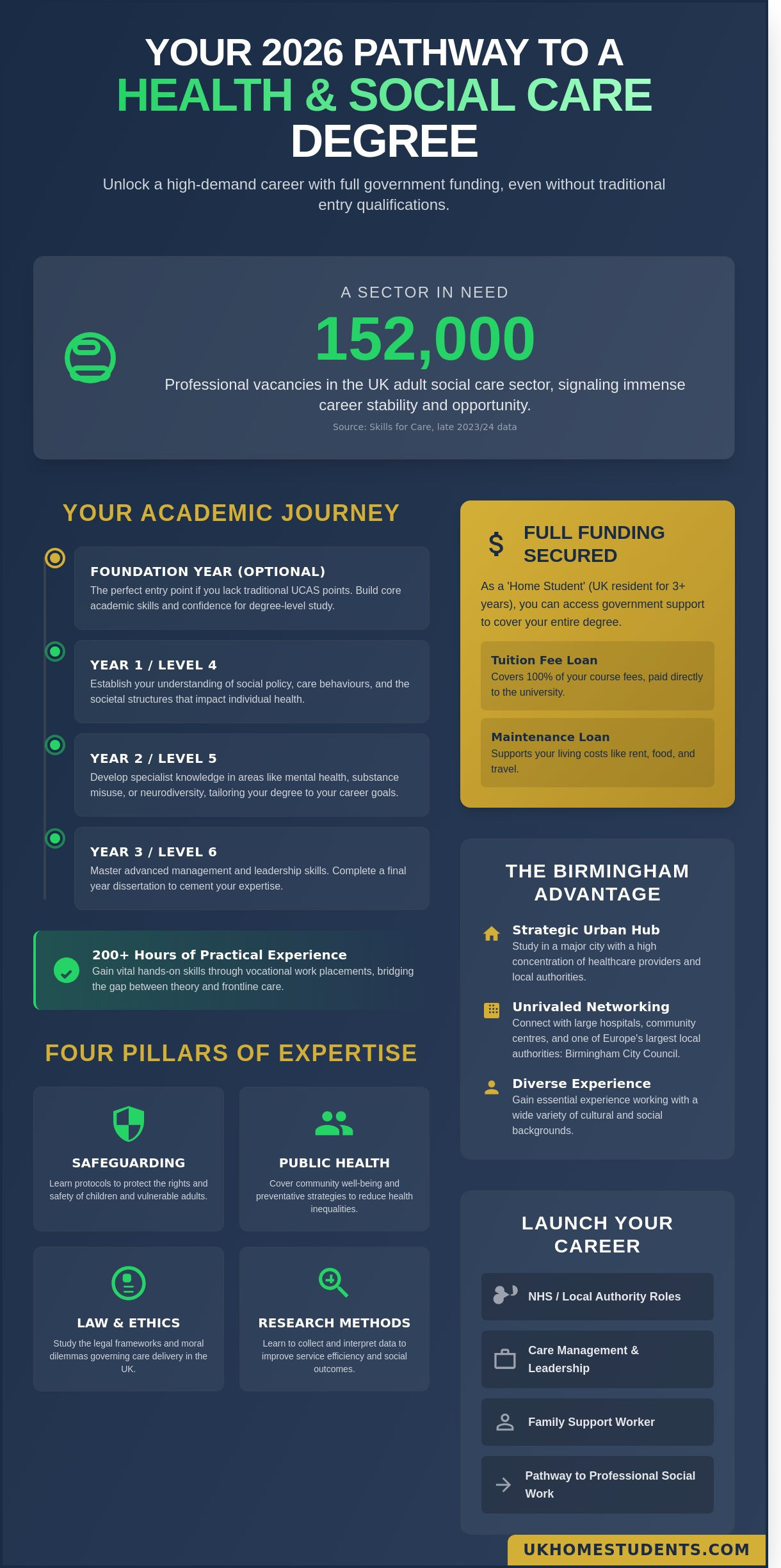
The demand for qualified professionals in this field is at an all-time high. Recent data from Skills for Care shows that the adult social care sector faced approximately 152,000 vacancies in 2023. This significant shortage means that securing a health and social care degree birmingham provides you with a direct path into a stable, high-growth career. It's a qualification designed for those who want to make a tangible difference in the lives of the elderly, children, and individuals with disabilities or mental health challenges.
The Core Purpose of Social Care Education
This degree equips you with the practical tools to support individuals with complex needs. You'll explore the shift towards integrated care systems, where health and social services collaborate to provide seamless support for service users. The curriculum focuses on empowering individuals and protecting their rights within the modern welfare state. If you've lived in the UK for at least three years prior to the start of your course, your 'Home Student' status is the key to accessing domestic tuition rates and Student Finance England funding.
Why Birmingham is a Strategic Hub for Care Studies
Choosing Birmingham for your studies places you at the centre of the West Midlands, a region with a high concentration of healthcare providers and local authorities. Birmingham City Council is one of the largest local authorities in Europe, offering a vast landscape for potential placements and future employment. Studying in such a major urban centre gives you a competitive advantage through diverse networking opportunities in large hospitals, community centres, and private care organisations. These real-world environments allow you to build a professional reputation before you graduate, making the transition into a management or leadership role much smoother. The city’s diverse population also ensures you gain experience working with a wide variety of cultural and social backgrounds, which is essential for any modern care professional.
Core Modules and Skills: What You Will Study
Choosing a health and social care degree birmingham ensures you're equipped with the theoretical knowledge and practical expertise required for the modern care sector. The curriculum isn't just about reading textbooks. It's designed around the 'Expert by Experience' model, where service users and carers contribute directly to the teaching process. This provides you with an authentic perspective on how care is received, which is vital for developing genuine empathy and professional resilience.
Your studies focus on four primary pillars that form the foundation of professional practice:
- Safeguarding: You'll learn the protocols for protecting the rights and safety of children and vulnerable adults.
- Public Health: This module covers community well-being and the preventative strategies used to reduce health inequalities.
- Law and Ethics: You'll study the legal frameworks and moral dilemmas that govern care delivery in the UK.
- Research Methods: This teaches you how to collect and interpret data to improve social outcomes and service efficiency.
Year-by-Year Academic Progression
The BSc programme follows a structured three-year path designed to build your confidence. At Level 4, you'll explore social policy and the foundations of care behaviour, focusing on how societal structures impact individual health. Moving into Level 5, your focus shifts to specialist areas. You'll study mental health, substance misuse, or neurodiversity, allowing you to tailor your expertise to specific community needs. By Level 6, you'll complete a final year dissertation and study advanced management. This prepares you to oversee care settings and lead diverse teams effectively.
The Role of Work Placements
Practical experience is the backbone of a health and social care degree birmingham. Most programmes require you to spend at least one day per week in a vocational setting, often totalling 200 hours of practice across the academic year. These placements bridge the gap between sociology theories and the reality of frontline care. If you're exploring the vast range of NHS health and social care careers, you'll find that Birmingham's universities align their modules with these professional standards.
Hands-on experience helps you develop transferable skills like crisis management, critical analysis, and active listening. Placements are also essential for building a professional network, as detailed in our Top Reasons to Study Health and Social Care: A 2026 Career Checklist. If you need help identifying which university in the West Midlands offers the best placement opportunities for your specific interests, you can book a consultation with our advisors to secure your future.
Entry Requirements and Foundation Year Entry Pathways
Securing a place on a health and social care degree birmingham requires meeting specific academic or professional criteria. For direct entry into a three-year honours programme, most universities set their UCAS tariff point requirements between 80 and 112 points. This range usually equates to grades such as BBC or BCC at A-level, or a Merit/Pass profile in a relevant BTEC Extended Diploma. You'll also need to demonstrate a solid foundation in core subjects. A GCSE Grade C/4 in English Language is a non-negotiable requirement for UK Home Students to ensure you can handle the academic rigour of reports and placements.
If you don't meet these standard benchmarks, the path to a degree isn't closed. Many institutions provide alternative routes that prioritise your potential over past exam results. This flexibility is vital for the local workforce, particularly for those looking to transition from frontline care roles into management or specialised social work.
Applying as a Mature Student
If you're over the age of 21 at the start of your studies, you qualify as a mature student. Birmingham’s universities take a holistic view of these applications. Instead of focusing solely on UCAS points, admissions tutors look for evidence of life experience and transferable skills. Your personal statement needs to be a persuasive document. It should highlight your resilience, communication skills, and any relevant work history in the healthcare sector. If you're unsure if your background meets the criteria, using an educational consultancy can help you get an expert assessment of your eligibility before you submit your UCAS forms.
The Foundation Year Advantage
The Foundation Year, often called Year 0, is a strategic choice if you lack traditional qualifications or have been out of the classroom for several years. It acts as an introductory year designed to build your academic confidence and study skills. You'll learn how to reference correctly, structure essays, and engage with social science theories before starting Year 1 of your degree.
- Seamless Funding: Student Finance England covers the tuition fees and maintenance loans for the foundation year as part of your full degree package.
- Simple Application: You don't need to make a separate application. You simply select the four-year "with Foundation Year" option directly on UCAS.
- Guaranteed Progression: Successfully completing Year 0 typically guarantees your spot on the full health and social care degree birmingham without further interviews.
This pathway reduces the pressure of returning to education. It ensures you have the support needed to succeed in a demanding professional field. Whether you're coming from school or the workplace, there's a clear, funded route available to help you reach your career goals.
Securing Student Finance and Maintenance Loans for 2026
Funding your health and social care degree in Birmingham involves a two-part system designed to remove the immediate financial burden of higher education. The first component is the Tuition Fee Loan. This covers the full cost of your course fees, which are currently capped at £9,250 per year for standard undergraduate programmes. You don't need to find this money upfront. The Student Loans Company pays this amount directly to your university, so it never enters your personal bank account. This ensures you can focus on your studies without worrying about quarterly invoices from the finance office.
The second component is the Maintenance Loan, which helps with your day-to-day living costs like rent, food, and transport. Unlike the tuition loan, this money is paid directly into your bank account in three instalments at the start of each term. The amount you receive is calculated based on your household income. If you're under 25, this usually refers to your parents' income; if you're an independent student or over 25, it may be based on your own or your partner's earnings. Students from lower-income backgrounds qualify for higher loan amounts to ensure equity of access across the city's institutions.
If you have children or adult dependants, you can access non-repayable grants that sit on top of your standard loan package. The Childcare Grant can cover up to 85% of your weekly childcare costs, while the Parents' Learning Allowance provides extra help with course-related books and travel. These grants are essential for mature students transitioning into a new career path within the Birmingham healthcare sector.
Eligibility for UK Home Students
To qualify for "Home" fee status and full funding in 2026, you generally need to have been "ordinarily resident" in the UK for at least three years before the first day of your course. This means you've lived here legally and not solely for the purpose of full-time education. For EU students, the landscape has changed. You must hold either "Settled" or "Pre-Settled" status under the EU Settlement Scheme to access the same funding as British citizens. If you're unsure about your specific residency category, you should consult the Student Finance in Birmingham guide for detailed deadline information and evidence requirements.
Maximising Your Funding Package
Don't overlook the Disabled Students' Allowance (DSA) if you have a long-term health condition, mental health challenge, or a learning need like dyslexia. DSA isn't a loan, so you don't pay it back, and it can fund specialist equipment or 1-to-1 support. Many Birmingham universities also offer internal bursaries or cost-of-living allowances for students entering health-related fields. UK Home Students can secure up to £13,000 per year in maintenance support depending on their circumstances. This total often combines the standard loan with supplemental grants for those with high financial need or dependants.
Ready to start your journey? You can apply for an expert assessment to clarify your funding eligibility and secure your place today.
Career Pathways and Professional Development
Completing a health and social care degree birmingham opens doors to a sector that is both recession-proof and personally rewarding. Graduates often secure roles as Family Support Workers, Housing Officers, Care Managers, or within the Probation Service. While the undergraduate degree provides a broad foundation, those aiming to become registered Social Workers will typically progress to a postgraduate qualification after gaining their initial degree. The demand for these skills is undeniable; Skills for Care estimates that the UK will require 540,000 new social care posts by 2040 to meet the needs of an ageing population. This growth ensures that your skills will remain in high demand throughout your professional life.
UK Home Students assists with the entire transition from your initial enquiry to final enrollment. We understand that the leap into higher education can feel daunting, especially when you're balancing existing work or family commitments. Our role is to provide the steady hand you need to navigate the intricate requirements of the UK education system, ensuring you qualify for the right funding and secure a place on a programme that matches your ambitions.
Graduate Employability in the West Midlands
The West Midlands boasts a robust network of public sector organisations and non-profit charities that provide stable employment for graduates. Local authorities and NHS trusts in the region frequently offer clear progression routes, allowing dedicated professionals to move into supervisory and management roles within two to three years of entry. If you want to reach the highest tiers of clinical or administrative leadership, you should explore Master's Degree Birmingham options for future specialisation. This level of advanced study often leads to higher salary brackets and specialist consultancy roles within the regional health infrastructure.
How to Start Your Application Today
The transition from deciding on a health and social care degree birmingham to actually sitting in a lecture theatre involves significant bureaucracy. UK Home Students simplifies this journey by managing the complexities of UCAS and Student Finance England on your behalf. Our expert assessment ensures you meet all eligibility criteria before you commit to a specific path. The process is straightforward and designed to reduce your anxiety:
- An initial assessment of your academic history and Home student status to confirm your eligibility for funding.
- Careful course selection to ensure the university aligns with your specific career goals.
- Professional assistance with personal statement drafting to showcase your passion and experience to admissions tutors.
We help you navigate the system so you can focus on your future career rather than complex paperwork. Secure your place and maximise your funding potential by booking a free consultation for the 2026 intake today. Our team is ready to turn your professional goals into a reality.
Take the Next Step Toward Your 2026 Career Goals
Securing a health and social care degree birmingham in 2026 offers a direct route into a sector that currently employs 1.6 million people across the UK. You now have the roadmap for navigating entry requirements and the foundation year pathways often required for those returning to study after a break. Mapping out your Student Finance eligibility is the final step to ensure your academic journey is fully supported by the available maintenance loans.
We act as your dedicated partner throughout this process. As specialists in mature student university admissions, we leverage our partnerships with leading UK higher education providers to streamline your journey. Our team provides expert guidance on Student Finance eligibility, ensuring you maximise your maintenance loan and tuition fee support. Don't let complex bureaucracy stand in the way of your professional growth.
Secure your 2026 university place with our expert application support
It's time to turn your academic ambitions into a reality with a steady hand to guide you.
Frequently Asked Questions
Can I study for a health and social care degree part-time?
Yes, you can study for a health and social care degree birmingham on a part-time basis at several local institutions. This route typically extends your study period to 4.5 or 6 years. It's an ideal option if you need to balance your education with existing work or family commitments. You'll still access the same modules as full-time students but at a reduced intensity that fits your lifestyle.
Do I need a DBS check to start the course?
You must complete an Enhanced Disclosure and Barring Service (DBS) check before you begin your first placement. This is a mandatory requirement for all health and social care degree birmingham programmes to ensure the safety of vulnerable groups. Most universities guide you through the application process during your induction week. The current cost for an enhanced check is £38 plus any administrative fees from the provider.
What is the difference between health and social care and social work?
The main difference is that Social Work is a protected professional title requiring specific registration, whereas Health and Social Care is a broader academic discipline. If you want to work as a qualified Social Worker, you must complete a degree approved by Social Work England. A Health and Social Care degree prepares you for leadership and coordinator roles within the 1.5 million jobs currently in the UK social care sector.
Can I get a student loan if I already have a degree in another subject?
You can usually only get a student loan for a second degree if the course is an exception under the Equivalent or Lower Qualification (ELQ) rules. If you already hold a degree, you won't typically qualify for a second tuition fee loan for Health and Social Care. However, you might still be eligible for a Maintenance Loan. Check your status with Student Finance England to confirm your specific funding entitlement.
How many days a week will I need to be on campus?
Full-time students typically spend 2 to 3 days per week on campus for lectures and seminars. You'll spend the remaining time on independent research or completing your 100 hours of mandatory work placement. Your exact timetable depends on your chosen university's schedule. If you're looking to manage a part-time job, this structure provides the flexibility you need to plan your week effectively.
What happens if I don't meet the UCAS point requirements?
If you don't meet the standard 80 to 112 UCAS point requirement, you can apply for a degree with an integrated Foundation Year. This pathway provides a supportive entry point for students with non-traditional backgrounds or lower grades. After successfully completing the 12-month foundation period, you'll automatically progress to the first year of the full degree programme. It's a reliable way to secure your place in higher education.
Is there an age limit for applying for a maintenance loan?
There's no upper age limit for tuition fee loans, but specific rules apply to maintenance loans if you're aged 60 or over. If you're under 60 on the first day of your course, you can apply for the full maintenance loan based on your household income. Students aged 60 and over receive a different rate of support known as a Special Support Loan. This ensures that mature learners can still access the necessary funding to pursue their career goals.
Will I have to pay back my student loan if I don't get a high-paying job?
You won't pay back a penny of your student loan until your annual income exceeds the £25,000 threshold for Plan 5. If your salary stays below this amount, your repayments remain at £0. Once you earn above the limit, you only pay back 9% of the amount over the threshold. If you haven't paid the balance after 40 years, the remaining debt is completely cancelled by the government.