

What if your professional history or personal resilience carried more weight with a university than a set of A-Level results from two decades ago? If you're over 21, you likely feel that the window for higher education has closed or that the UCAS application process is a maze you'll never solve. It's natural to worry that you're "too old" to start again, especially when you have to consider how to pay for your mortgage or childcare while studying.
You don't need to let a lack of traditional qualifications hold you back from your career goals. This guide explains how to secure university entry without a levels for adults using proven pathways like Access to HE diplomas and foundation years. We'll show you how to qualify for full tuition fee grants and maintenance loans for the 2026 academic year. You'll discover a clear, step-by-step roadmap to balance your degree with your current life responsibilities while maximizing your student finance eligibility.
Key Takeaways
- Understand how your life experience and professional background can serve as a direct gateway to higher education, even without traditional qualifications.
- Explore the most effective pathways for university entry without a levels for adults, including the fast-track Access to Higher Education Diploma and integrated Foundation Year degrees.
- Discover how to leverage the Accreditation of Prior Experiential Learning (APEL) to turn your professional work history into a recognized academic entry bypass.
- Navigate the complexities of the 2026 UCAS application timeline and secure your eligibility for Student Finance England to cover tuition and living costs.
- Gain a competitive advantage through an expert assessment that matches your unique profile with the specific entry requirements of our partner universities.
Can Adults Go to University Without A-Levels in 2026?
Entering higher education doesn't require a stack of A-Level certificates from your teenage years. In 2026, the pathway for university entry without a levels for adults is more established and accessible than ever before. UK universities define a "mature student" as anyone aged 21 or over at the start of their undergraduate course. These institutions recognize that life doesn't always follow a linear path, and they've adapted their entry criteria to reflect this reality.
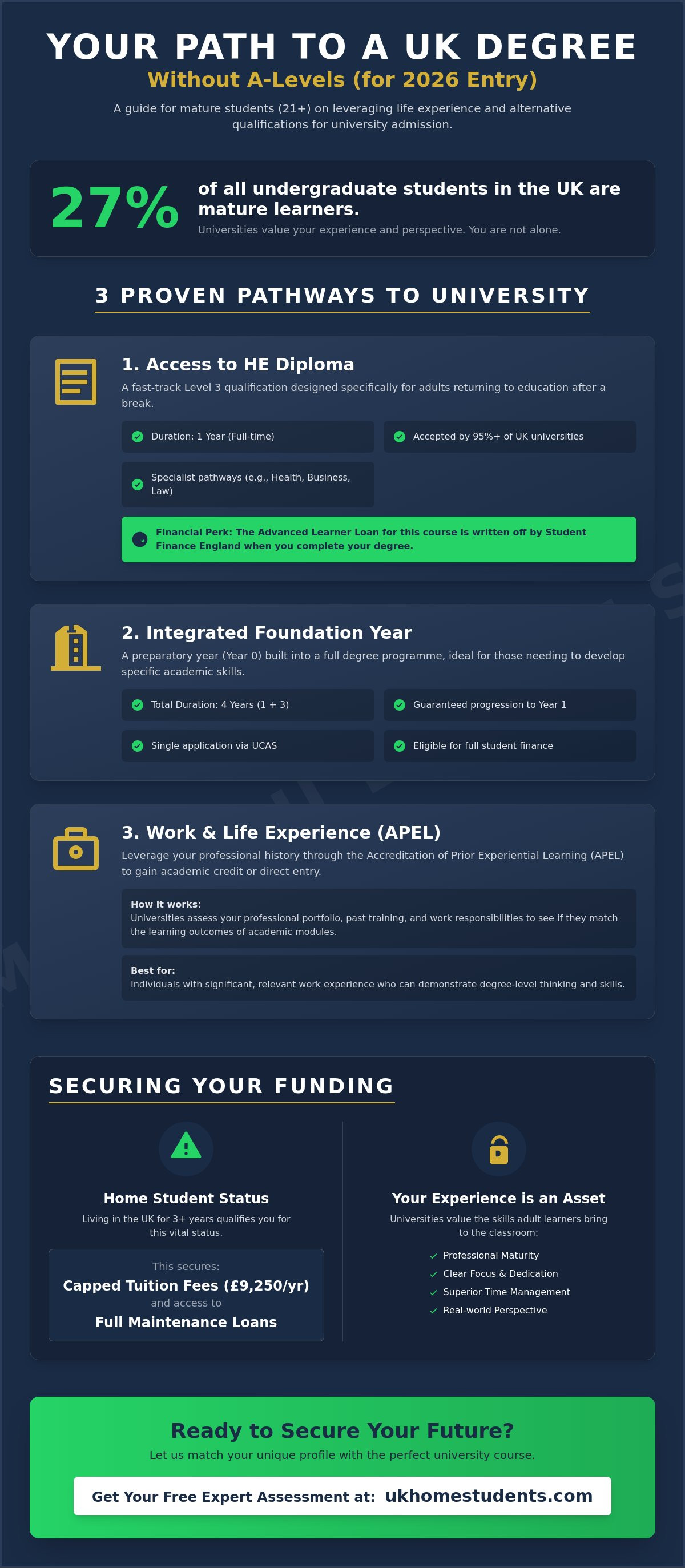
If you've lived in the UK for at least three years, you'll likely qualify for "Home Student" status. This classification is vital for your financial planning. It secures your right to capped tuition fees, which currently stand at £9,250 per year, and ensures you can access the full range of Student Finance England maintenance loans. Without this status, you might be charged significantly higher international rates, making your academic goals much harder to reach.
The 2026 higher education environment focuses on potential rather than just past performance. Universities are moving away from rigid grade requirements and toward contextual admissions. This means they look at your background, your work history, and your personal circumstances to decide if you're ready for degree-level study.
The Myth of the 'Traditional' Student
Many people believe that lecture halls are filled exclusively with 18-year-olds who just finished college. This is a misconception. Data from the Office for Students (OfS) indicates that mature learners make up approximately 27% of all undergraduate entrants in the UK. Universities are actively recruiting adults to diversify their cohorts and meet "widening participation" targets set by the government.
If you're worried about fitting in, remember that your age is a strength. Mature students act as a stabilizing force in academic environments, grounding theoretical discussions in practical, lived experience. This diversity of thought is exactly what modern universities want to foster.
Why Universities Want You (Even Without Grades)
Admissions officers value the professional maturity and real-world perspective that adult learners bring to the table. Your experience in the workplace or managing a family translates into superior time management and resilience. These traits often lead to higher completion rates and better degree outcomes. If you lack standard qualifications, you can often secure a place by completing an Access to Higher Education Diploma. This level 3 qualification is designed specifically for adults returning to study after a break of three years or more.
- Professional Maturity: You've likely developed communication skills that younger students are still learning.
- Focus: Adult learners usually have a clear career goal, which drives academic dedication.
- Classroom Dynamics: Your ability to relate theory to actual work scenarios enriches the learning experience for everyone.
The process of university entry without a levels for adults is no longer a "backdoor" route. It's a respected, mainstream pathway that thousands of people use every year to transform their careers. If you have the drive to succeed, the UK education system has a place for you.
The 3 Best Pathways to Higher Education for Mature Students
The path to a degree isn't a single track. If you're over 21, you have distinct advantages that school leavers don't, including professional experience and focused motivation. Securing university entry without a levels for adults is more straightforward than many realize, provided you select the pathway that aligns with your learning style and career goals.
Access to Higher Education (HE) Diplomas
Access to HE Diplomas are Level 3 qualifications specifically created for adults who've been out of education for some time. These courses usually take one year to complete if studied full-time. They are intensive, fast-track programmes designed to prepare you for the academic rigour of a degree. You can choose specific pathways tailored to your career goals, such as Health Professionals, Business, Law, or Computing.
A significant financial benefit of this route involves the Advanced Learner Loan. If you take out this loan to cover your Access course fees and then go on to complete a degree, Student Finance England will write off the initial loan balance. This effectively makes your pre-university qualification free. You can find more details on university and funding for mature students via official government portals to see how this applies to your specific situation.
Integrated Foundation Years (Year 0)
An integrated foundation year, often called "Year 0," is a four-year degree programme where the first year focuses on building foundational knowledge. This is an excellent option if you have few or no formal qualifications but want the security of a direct university place. You'll be a full university student from day one, with access to all campus facilities, societies, and maintenance loans.
Staying at the same institution for the full duration of your studies provides stability and helps you build a strong network of tutors and peers. If you are based in the Midlands, you might explore specific university courses with foundation year to see which local providers offer the best support for mature learners. Choosing this route ensures you don't have to reapply through UCAS after your first year of study.
Professional Qualifications and NVQs
If you've spent years in the workforce, you might already hold the equivalent of A-levels without realizing it. Level 3 NVQs or professional certificates in fields like childcare, administration, or construction can often be converted into UCAS points. This makes university entry without a levels for adults a reality for those who have focused on vocational training rather than traditional exams.
Universities frequently value vocational backgrounds for practical degrees. For example, a Level 3 Diploma in Health and Social Care is often preferred for Nursing or Social Work applications because it demonstrates hands-on experience. You should contact the admissions office of your chosen university to check their specific equivalency criteria. They may offer you an expert assessment of your current certificates to determine your eligibility and help you navigate the application process.
- Access to HE: Best for those wanting a fast, subject-specific refresh.
- Foundation Year: Best for those seeking a gentle introduction to a specific university environment.
- NVQs/Professional Routes: Best for those with extensive work-based qualifications.
Using Life and Work Experience for University Admission
In 2026, the Accreditation of Prior Experiential Learning (APEL) remains a vital pathway for mature learners. This framework allows universities to recognize the skills you've gained outside a classroom setting. If you have five or more years of professional history, you can often bypass traditional entry requirements entirely. Admissions tutors aren't just looking for certificates; they're looking for evidence that you can handle the rigors of a degree. This process acknowledges that your career has provided a level of intellectual development comparable to formal Level 3 qualifications.
If you apply via this route, expect an interview. This is your opportunity to prove your motivation and demonstrate that you've researched your chosen field. Many adults feel a deep fear of failure when returning to study after a long break. However, your background in parenthood or a fast-paced career gives you a distinct advantage. You've already mastered time management, conflict resolution, and complex problem-solving. These are the exact transferable skills that help mature students often outperform their younger peers.
What Counts as 'Relevant Experience'?
You don't need to have been a senior executive to qualify for university entry without a levels for adults. Universities value diverse backgrounds because they bring different perspectives to the lecture hall. Key roles that map well to degree outcomes include:
- Management and Supervision: Leading a team or managing budgets proves you have analytical and leadership capabilities.
- Childcare and Caregiving: Managing a household or working in care demonstrates resilience, patience, and high-level organization.
- Volunteering: Consistent commitment to a charity or community group proves your dedication and social responsibility.
- Administration: Handling data, schedules, and official documentation maps directly to the research skills needed for academic success.
Tutors look for "readiness for study" rather than a simple "knowledge of facts." To prove this, you'll need professional references. A reference from a current or former employer that highlights your ability to meet deadlines and process complex information carries significant weight with admissions teams.
Winning Over Admissions with Your Personal Statement
Your personal statement is the place to turn your "gap" in education into a strategic strength. Don't apologize for time away from school; instead, frame it as a period of professional and personal growth. Tutors often find that mature students bring a level of passion and commitment that 18-year-olds sometimes lack. You aren't there because it's the next logical step after school; you're there because you've made a conscious choice to advance your career.
It's helpful to look at specific degree courses to see what tutors are looking for in your specific region. Align your work history with the module descriptions of the course. If a degree requires strong communication skills, highlight the reports you've written or the presentations you've delivered in your job. This evidence-based approach builds trust and shows you're prepared for the academic journey ahead.
Navigating the Application and Student Finance Process
Securing university entry without a levels for adults involves more than just academic preparation; it requires a strategic approach to the UK's administrative systems. You'll need to master two main platforms: UCAS and Student Finance England. This process can feel daunting if you've been out of education for years, but the system is designed to accommodate mature applicants with diverse backgrounds and professional experiences.
The UCAS Journey for Adults
Your journey typically begins with the UCAS application. For 2026 entry, the equal consideration deadline is 29 January 2026. If you miss this date, you don't need to wait another year to start your studies. You can still apply through UCAS Extra from late February until 4 July 2026, or enter the Clearing process from July onwards. Mature students often benefit from flexible study models, so consider whether a traditional full-time degree or a part-time route fits your lifestyle. Understanding your Student Finance options during this planning phase is vital, as it dictates which study intensity you can realistically afford while managing existing financial commitments.
Securing Your Maintenance Loan and Grants
Financial support for 2026 is split into two primary categories. The Tuition Fee Loan covers your course costs directly, while the Maintenance Loan helps with daily living expenses like rent and groceries. Your household income determines your maintenance entitlement. If you're over 25, you're usually classified as an independent student, which means your parents' income isn't factored into the calculation. For the 2026/27 academic year, the maximum tuition fee for standard undergraduate courses is set at £9,250 per year for students with home fee status.
Many people seeking university entry without a levels for adults worry about the cost of living, but there are specialized grants available that you don't have to pay back:
- Childcare Grant: This covers up to 85% of your childcare costs during term time and holidays if you have children under 15.
- Parents' Learning Allowance: This provides up to £1,915 per year to help with course-related costs for students with children.
- Adult Dependants' Grant: This is available if you're financially responsible for another adult, such as a partner or elderly relative.
Eligibility for these funds hinges on your status as a "Home Student." Generally, this requires you to have lived in the UK for at least three years before your course begins and to hold settled status or British citizenship. If you're unsure about your specific eligibility or how your residency history affects your application, an expert assessment can clarify your position before you commit to a course.
Securing Your Future with UK Home Students
Achieving university entry without a levels for adults shouldn't feel like an impossible task. Our expert assessment process identifies your existing skills and professional experience to match you with the right degree programme. We remove the stress by acting as your dedicated partner, ensuring you don't waste time on applications that don't fit your profile or your career goals.
Our team maintains an "insider track" on the specific entry requirements of our partner universities. This means we know exactly which institutions value mature students' life experiences over traditional qualifications. We're committed to helping you navigate the complex bureaucracy of UCAS and the often confusing eligibility criteria for Student Finance England. By choosing a specialist who understands the UK system inside out, you gain a significant advantage in securing your place for the 2026 academic year.
Expert Guidance Every Step of the Way
Applying to university involves more than just picking a course. You'll receive comprehensive support with your personal statement, ensuring your professional background translates into academic potential. We also handle detailed funding queries to help you secure the maximum support available for your specific situation.
- Personalised Support: We help you draft a compelling personal statement that highlights your unique strengths and work history.
- Home Student Focus: Our expertise is tailored specifically to UK residents, ensuring you receive the most accurate advice regarding "settled status" and local funding.
- Anxiety Reduction: Professional consultancy turns a confusing process into a clear, manageable roadmap, giving you the confidence to succeed.
If you've lived in the UK for at least three years, you might qualify for significant financial support. We help you understand the difference between a tuition fee loan and a maintenance loan, so you can focus on your studies rather than your bank balance. Our goal is to ensure university entry without a levels for adults is a smooth, transparent transition.
Start Your Academic Journey Today
The long-term return on investment for a degree is substantial. According to data from the Department for Education (2023), graduates earn an average of £11,500 more per year than non-graduates. Beyond the financial gains, a degree offers increased career satisfaction and opens doors to leadership roles that were previously out of reach. It's an investment in yourself that pays dividends for decades.
Your past academic history doesn't define your future potential. Whether you left school decades ago or didn't get the results you wanted at the time, there's a path forward. It's time to stop wondering "what if" and start building the career you deserve with a team that believes in your potential.
Ready to see where you stand? Contact UK Home Students for a free assessment today and take the first step toward your 2026 university place.
Take the First Step Toward Your 2026 Degree
Your academic journey doesn't depend on past results. By the 2026/27 academic year, the UK higher education landscape will remain highly accessible, with UCAS data showing that approximately 25% of all applicants are mature learners. You can leverage your professional history or complete an Access to Higher Education diploma to qualify for competitive courses. If you're concerned about the technicalities of the process, remember that university entry without a levels for adults is a proven route to career progression.
Our team provides an expert assessment of your Home Student status to ensure you meet the eligibility criteria for domestic funding. As specialists in mature student pathways, we offer dedicated support with the UCAS application process and Student Finance England requirements. You don't have to navigate these complex regulations alone. We're here to help you secure the tuition fee grants and maintenance loans you need to succeed.
Unlock your potential today; get expert help with your university application
Your future is waiting, and we're ready to help you claim it with confidence.
Frequently Asked Questions
Is 30 (or 40, or 50) too old to go to university in the UK?
You're never too old to start a degree; in fact, 37% of undergraduate students in the UK are aged 21 or over according to HESA data. Whether you're 30, 40, or 50, universities highly value the professional experience and maturity you bring to the lecture hall. Many institutions actively recruit mature learners to diversify their cohorts and improve overall student outcomes through varied life perspectives.
Can I get a student loan if I didn't finish my A-Levels?
You can absolutely secure a student loan without A-Levels if you meet the residency and course eligibility criteria set by Student Finance England. Your previous academic record doesn't disqualify you from receiving a tuition fee loan or a maintenance loan for your first degree. If you've lived in the UK for at least 3 years before your course starts, you'll likely qualify for funding to cover your studies.
What is the difference between a Foundation Year and an Access to HE course?
A Foundation Year is a "Year 0" integrated into a four-year degree at a specific university, while an Access to HE Diploma is a standalone one-year course usually taught at a local college. Access courses are specifically designed for university entry without a levels for adults and provide 60 credits at Level 3. Choosing between them depends on whether you want to commit to one university immediately or keep your options open for different institutions.
Do I have to apply through UCAS as a mature student?
Most full-time undergraduate applicants must use the UCAS system, but many universities allow mature students to apply directly for part-time or foundation programs. For the 2026 intake, the standard UCAS application fee is £28.50 for multiple choices. Applying through UCAS ensures your application is tracked officially, though direct entry is often a faster route for specific vocational or local courses that don't follow the standard academic cycle.
What happens if I don't have my GCSE certificates anymore?
You can order replacement certificates from the relevant exam boards like AQA or Pearson for a fee of approximately £45 to £50 per certificate. If your original records are lost and cannot be recovered, universities often accept Functional Skills Level 2 in English and Maths as equivalent qualifications. This is a common hurdle for adult learners, so admissions teams are usually equipped to guide you through the verification or equivalency process.
Can I study part-time while working if I don't have A-Levels?
You can certainly study part-time while maintaining your employment, as 10% of UK undergraduates choose this flexible route to balance their responsibilities. This is an ideal way to manage university entry without a levels for adults while securing your financial stability. Most part-time degrees take between 4 and 6 years to complete, allowing you to apply your learning directly to your current professional role as you progress.
How long does it take to get into university without traditional grades?
It typically takes 1 academic year to prepare for university through an Access to Higher Education Diploma, which consists of 45 graded credits at Level 3. Alternatively, you can gain entry immediately if you enroll in a degree with an integrated foundation year that accepts relevant work experience. This means you could transition from having no qualifications to being a full-time university student in as little as 9 to 12 months.
Are there specific degrees that are easier to get into for adults?
Vocational degrees like Nursing, Social Work, and Business Management often have more flexible entry requirements because they value your life experience and soft skills. Around 50% of students on these specific courses are often mature learners who enter via non-traditional routes. Universities look for your potential to succeed in a professional environment rather than just your performance in exams taken decades ago, making these subjects highly accessible.