

What if your past academic results or the years you've spent away from the classroom didn't have to define your professional future in 2026? If you are over the age of 21, you might feel that you've missed your chance to graduate, or perhaps you worry that your lack of traditional A-levels will lead to an immediate rejection. We understand that navigating the UK higher education system feels overwhelming, especially when you're trying to balance your studies with existing work or family commitments in the West Midlands. However, university courses with foundation year birmingham offer a reliable and inclusive gateway to your career goals.
By reading this guide, you'll learn how a foundation year serves as a guaranteed bridge to a full BSc or BA honours degree. We will break down the eligibility criteria for Student Finance England, ensuring you understand how to secure tuition fee grants and maintenance loans for the entire four year duration of your studies. From choosing the right flexible programme to completing your UCAS application with confidence, this article provides the expert assessment you need to move from uncertainty to academic success.
Key Takeaways
- Understand how "Year 0" serves as a guaranteed, integrated gateway to a full honours degree, regardless of your traditional academic qualifications.
- Explore the diverse range of university courses with foundation year birmingham to identify the right integrated pathway for your 2026 enrolment.
- Learn how your professional background and "Life Experience" can secure university entry, even if you lack high UCAS points or traditional A-levels.
- Navigate the complexities of Student Finance England to ensure your foundation year is fully funded through the "Gift Year" rule.
- Discover how an expert assessment can streamline your UCAS application and help you successfully navigate the bureaucracy of the UK education system.
Understanding University Courses with Foundation Year in Birmingham for 2026
Choosing the right path into higher education requires a clear understanding of the options available. A foundation year is officially classified as "Year 0" of a four-year integrated degree programme. It provides a structured entry point for students who don't meet traditional A-level requirements or those returning to education after a break. If you're researching university courses with foundation year birmingham, you'll find that 2026 is a pivotal year. Universities across the West Midlands are prioritising flexible entry routes to address the 7.5% increase in mature student applications recorded in recent UCAS cycles.
The distinction between Home and International pathways is vital for your planning. If you've lived in the UK for three years or more and hold settled status, you likely qualify for Home student funding. This means your "Year 0" is covered by the same Student Finance England (SFE) tuition fee loans and maintenance loans as the rest of your degree. International students follow a separate track, often involving different fee structures and specific English language requirements. Birmingham has become a primary hub for these courses because the city hosts over 80,000 students across five major institutions, creating a competitive yet supportive environment for academic growth.
Why a Foundation Year is Not a "Gap Year"
A foundation year is a formal academic commitment, not a break from study. It's specifically designed to bridge the gap between your current qualifications and the rigours of Level 4 study. You'll focus on mastering academic writing, conducting primary research, and learning subject-specific basics. What is a Foundation Course? It is essentially a preparatory phase that removes the pressure often felt in the first year of a standard degree. This extra year provides a significant psychological benefit. It allows you to build confidence in a university setting before the credits start counting towards your final degree classification.
The "Year 0" Concept: How It Fits into Your Degree
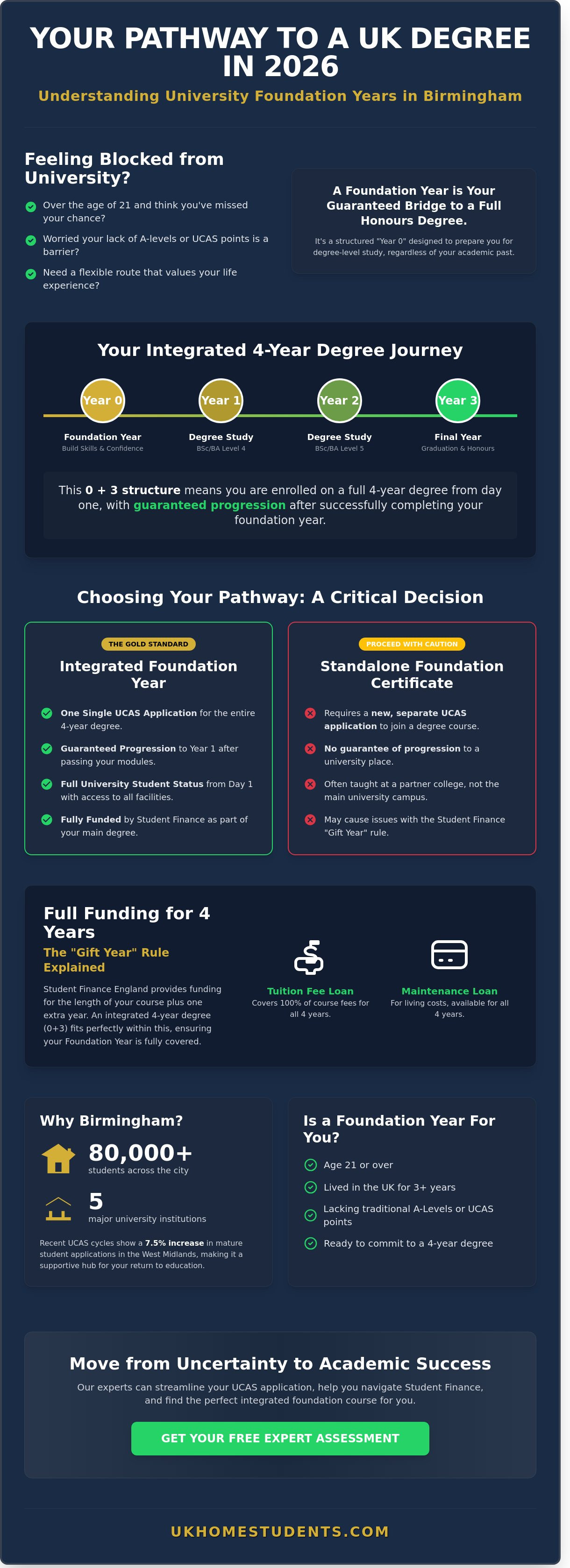
The "Year 0" model follows a 0+3 structure. This means you're enrolled on a full four-year Honours degree from day one. You aren't just a temporary student; you're part of the university cohort for the entire duration. Successful completion of the foundation modules guarantees your progression to the full degree without needing to reapply through UCAS. This stability is why university courses with foundation year birmingham are so popular. You secure your place early, stay with the same peer group, and access the same campus facilities and student support services throughout your four-year journey.
The Difference Between Integrated and Standalone Foundation Pathways
Choosing between the two types of foundation pathways is the most critical decision you'll make when researching university courses with foundation year birmingham. While both options provide a bridge to a full degree, they offer very different levels of financial and academic security. It's vital to understand these distinctions before you submit your UCAS application for the 2026 intake.
Integrated Foundation Years: The Gold Standard for Home Students
Integrated degrees are often called the "Gold Standard" because they offer a seamless, four-year journey under one single UCAS code. You aren't just "preparing" for university; you're a full university student from the very first day. This status grants you immediate access to all campus resources, from the Guild of Students to specialized laboratory equipment in Birmingham's leading departments. This is why the majority of university courses with foundation year birmingham are now designed as integrated 4-year programmes.
- Single UCAS Code: You apply once for the entire 4-year duration (Level 3 to Level 6).
- Consistent Support: You typically keep the same personal tutor throughout your entire degree, ensuring they understand your academic history.
- Guaranteed Progression: As long as you pass your foundation modules, you move automatically into Year 1 of your BSc or BA without a new application.
Standalone Foundation Certificates: What to Watch Out For
Standalone courses, often called Foundation Certificates or HE Diplomas, are one-year preparatory programmes. These are sometimes necessary if you're changing disciplines entirely, such as moving from a creative arts background to a highly technical Engineering degree. However, these courses come with administrative hurdles that can cause significant anxiety for Home students. You're often treated as a "pre-university" student rather than a full undergraduate, which can limit your access to certain campus benefits.
- The Re-application Risk: Many standalone courses require you to re-apply through UCAS to join the first year of a degree. There's no absolute guarantee your chosen university will accept you for the full degree after the year ends.
- Student Finance Complications: Student Finance England (SFE) uses a "length of course plus one" formula. If you take a standalone course and then switch universities or subjects, you might accidentally exhaust your "gift year" of funding before you finish your degree.
- Bureaucratic Gaps: You may have to re-verify your Home student status and eligibility for a maintenance loan every time you change course codes.
If you're feeling overwhelmed by these technicalities, you can request an expert assessment to ensure your chosen pathway aligns with SFE regulations. Securing the right course structure now prevents funding shortfalls in your final year of study.
Entry Requirements: Accessing Higher Education Without Traditional A-Levels
A common misconception prevents many talented individuals in the West Midlands from applying to university. There's a widespread belief that you need a high volume of UCAS points or a perfect set of A-Level results to get through the door. For many university courses with foundation year birmingham, this simply isn't the case. While a standard three year degree might demand 112 or 120 UCAS points, foundation year entry often requires as few as 32 to 64 points. This lower threshold isn't a sign of lower quality; it's a deliberate design to support social mobility and academic potential.
Birmingham universities are increasingly moving away from rigid grade based assessments. They're looking for your capacity to succeed in a higher education environment today, rather than judging you solely on exams you sat years ago. This progressive approach makes university entry without a-levels birmingham a practical reality for local residents who may have missed out on traditional qualifications due to personal circumstances or health issues.
The Mature Student Pathway
If you're over the age of 21, you're classified as a mature student. This status allows you to access the "Non-Standard Entry" process. Admissions tutors at Birmingham institutions frequently prioritise professional experience over academic certificates. If you've spent several years in the workforce, you've likely developed transferable skills in communication, project management, or problem solving. Your personal statement is the place to bridge this gap. By mapping your career achievements to the demands of a degree, you can demonstrate the discipline and motivation required for academic life. Your life experience is a valuable asset, not a drawback.
What if My Grades Were Poor in the Past?
A foundation year is specifically designed to be a fresh start. It's a preparatory year that functions as a safety net, ensuring you're fully equipped before you begin the first year of a full degree. If your previous grades were disappointing, many providers will invite you for an interview or an internal assessment. This is your chance to shine. It allows the university to see your passion for the subject and your current literacy and numeracy levels. You should view what is a foundation year as a strategic bridge. It provides the study skills, confidence, and subject knowledge you need to excel, regardless of your past academic record.
Universities in Birmingham are looking for reasons to accept you, not reasons to reject you. They value the diversity and resilience that non-traditional students bring to the lecture hall. If you have the drive to succeed, the entry requirements are rarely the barrier they first appear to be.
Navigating Student Finance and Funding for Your Foundation Year
Securing your place on one of the many university courses with foundation year birmingham offers is an exciting step, but you must understand how the funding architecture supports your journey. If you're concerned about the cost of an extra year of study, you can rest easy. Student Finance England (SFE) classifies integrated foundation years as part of a single, continuous degree programme. This means you qualify for full funding for all four years of your studies, covering both your initial preparatory year and the subsequent three years of your degree.
The "Gift Year" rule is a vital safety net for every student. SFE typically provides funding for the length of your course plus one additional year. For a four-year degree including a foundation year, this formula gives you five years of total funding eligibility. This extra year remains available if you need to repeat a level or change your subject, provided you haven't previously used your "Gift Year" or studied at a higher education level before. If you have prior university experience, it's essential to check how many years of funding you have left before committing to a new course.
Your financial support is split into two distinct categories. The Tuition Fee Loan covers the full cost of your university fees, which are currently capped at £9,250 per year for home students, and is paid directly to your university. The Maintenance Loan is paid into your bank account in three instalments to cover living costs like rent and food in Birmingham. If you're a parent, a carer, or have a disability, you may also qualify for non-repayable grants such as the Childcare Grant or Disabled Students' Allowance (DSA). These grants provide extra support that you don't need to pay back, helping to level the playing field for all students.
Securing Your Maintenance Loan for All Four Years
Your maintenance loan amount depends on your household income and where you live while studying. Since the foundation year is officially the first year of your degree, your funding starts immediately. To ensure your money arrives before your first lecture in September 2026, follow this application checklist to avoid common delays:
- Confirm your National Insurance number and have your valid UK passport details ready.
- Gather your parents' or partner's P60 or tax return information for the 2024/25 tax year.
- Submit your application by the SFE deadline, usually in late May 2026, to guarantee on-time payment.
- Keep your bank details updated in the SFE portal to avoid payment blocks during your first week.
Funding Eligibility: Home Status vs International Status
To access domestic tuition rates and SFE loans for 2026, you must meet specific residency requirements. Generally, you need "Settled Status" or "Pre-Settled Status" under the EU Settlement Scheme, or have lived in the UK for at least three years before the start of your course. UK Home Students focuses exclusively on helping those who qualify for these domestic fees, as the financial difference between home and international status can often exceed £10,000 per year. For a deeper look at local costs and specific Birmingham regulations, read our student finance birmingham guide.
How UK Home Students Supports Your University Application
Applying for university often feels like an uphill struggle, especially if you've been out of the classroom for five years or more. At UK Home Students, we provide a comprehensive expert assessment service to ensure you select the most suitable university courses with foundation year birmingham that align with your specific background. We understand that the UCAS application system is frequently confusing for mature learners. Our team simplifies this bureaucracy, managing the technical details so you can focus on your future studies.
We prioritise flexibility because we know you have responsibilities outside the lecture hall. Many of the programmes we recommend feature condensed timetables, such as 2-day-a-week attendance models. This structure allows you to balance a part-time job or family commitments while you secure your academic future. You can apply for foundation year birmingham with our professional guidance to ensure your application meets every eligibility criteria for 2026 entry.
Our Step-by-Step Application Support
Our support begins with an initial consultation and continues until your first day on campus. We assist with drafting your personal statement to highlight your life experience, which is vital for mature student entry. Our team handles document verification, ensuring your ID and previous qualifications meet university standards. Having a dedicated mentor means you don't have to deal with university admissions departments alone; we manage the communications for you to ensure a smooth transition into higher education.
Finding the Right Course for Your Future Career
Choosing the right path is a strategic decision. We match your long-term career goals to specific degree programmes, whether you're aiming for a career in Business Management or Health and Social Care. Data from the Office for National Statistics indicates that graduates in the UK typically earn £10,000 more per year than non-graduates. This makes the initial investment in a foundation year a high-return decision for your future. We help you calculate the potential ROI of your degree and select a course that offers the best professional outcomes. Your degree journey starts with a single conversation.
Take the First Step Toward Your 2026 Degree
Choosing the right path into higher education doesn't have to be a source of stress. Whether you're a mature student returning to study or you didn't quite get the grades you expected, university courses with foundation year birmingham offer a legitimate and funded route to a full degree. If you meet the residency criteria, you can access Student Finance England for your tuition fees and maintenance loans. Understanding your "Home" student status is the first step to unlocking these opportunities for 2026.
At UK Home Students, we specialise in navigating these complex eligibility rules. We've helped thousands of applicants secure their futures through our high success rate for mature student placements. Our team provides expert guidance on your specific eligibility for Student Finance England, ensuring you have the financial clarity needed to succeed. Don't let the bureaucracy of UCAS applications hold you back from your potential.
Get your free expert assessment for university entry today
Your academic goals are within reach with the right professional support by your side.
Frequently Asked Questions
Is a foundation year the same as an Access to HE Diploma?
No, these are two different academic routes. A foundation year is an integrated part of a four-year university degree, meaning you're a registered university student from your first day on campus. In contrast, an Access to HE Diploma is a Level 3 qualification usually taught at a local college. While both help you reach the required academic standard, the foundation year offers a more direct route into your specific degree programme.
Can I get a student loan for a foundation year in 2026?
Yes, you'll be able to secure funding through Student Finance England for an integrated foundation year in 2026. If you've lived in the UK for at least three years and hold settled status, you're usually eligible for both a tuition fee loan and a maintenance loan. This ensures your costs are covered just like any other undergraduate student, providing financial security from the start of your academic journey.
Do I have to stay at the same university after my foundation year?
You aren't strictly required to stay at the same university, but it's the most common path. Foundation years are usually integrated into a specific four-year degree, meaning you'll automatically progress to Year 1 upon passing. If you want to move elsewhere, you'll need to apply through UCAS. It's important to check if your new choice accepts external foundation years, as some institutions have specific entry criteria for transfers.
What are the typical entry requirements for a foundation year in Birmingham?
Entry requirements for university courses with foundation year Birmingham typically range from 48 to 72 UCAS points. For the 2026 intake, this often equates to two E grades or a D and a C at A-Level. You'll also need GCSE English and Maths at Grade 4 or above. If you're a mature student without recent qualifications, universities frequently use an expert assessment or interview to evaluate your professional experience.
How many days a week do I need to attend university for a foundation course?
You'll typically need to attend campus for 12 to 16 hours of scheduled teaching per week, often spread over three or four days. While your specific timetable depends on your chosen institution, this structure allows you to balance your studies with other commitments. Most universities in Birmingham release these schedules at least 14 days before the term starts so you can plan your childcare or part-time work effectively.
Will I be the only mature student in a foundation year class?
You definitely won't be the only mature student in your class. Data from the Office for Students shows that foundation years attract a high percentage of learners over the age of 21, often exceeding 40% of the total cohort. These courses are specifically designed to support those returning to education. You'll find a diverse community of peers who share your goals, making the transition back into the classroom much easier.
What happens if I fail my foundation year?
If you fail your foundation year, you'll usually be offered the chance to resit your exams or resubmit assignments during the summer break. Most universities provide a second attempt to ensure you can progress to the first year of your full degree. If you don't pass these resits, you might have to repeat the year or look at alternative pathways. Your personal tutor will help you navigate these options to protect your future funding.
Can I apply for a foundation year through Clearing?
Yes, you can apply for university courses with foundation year Birmingham through UCAS Clearing starting in July 2026. This is a popular route if your results differ from your predictions or if you've decided to start university later in the cycle. You can contact admissions teams directly to secure a place, allowing you to bypass the traditional January deadline and start your studies in September.