

What if your dream career in Business or Health and Social Care didn't depend on the grades you achieved a decade ago or your current confidence in academic writing? If you feel you've missed the boat or worry that you lack the formal qualifications for a standard degree, you aren't alone. Many UK Home Students hesitate to apply because they fear they're "too old" or won't qualify for the necessary funding to cover an extra year of study. Understanding what is a foundation year is the first step toward overcoming these hurdles and securing your place at university.
You deserve a pathway that respects your experience while giving you the tools to excel. This guide will show you how a foundation year acts as a vital bridge to university success, ensuring you can access full Student Finance England support, including tuition fee loans and maintenance grants, for the entire four-year duration. We'll break down the specific entry requirements for 2026, explain the integrated degree structure, and provide a clear roadmap to your professional future.
Key Takeaways
- Understand exactly what is a foundation year and how this Level 3 "Year 0" provides a vital academic bridge into an integrated four-year degree programme.
- Learn how to secure full funding for your studies through Student Finance England, including how the "plus one" rule applies to your tuition fee and maintenance loan eligibility.
- Compare the unique advantages of a university-based foundation year against Access to HE Diplomas to determine which pathway best suits your mature student journey.
- Discover how the curriculum focus on "learning how to learn" helps you build essential study skills to reduce academic risk and maximise your future grades.
- Evaluate the long-term career ROI of an additional year of study to ensure you make an informed decision about your professional progression and university success.
Understanding the Basics: What is a Foundation Year at University?
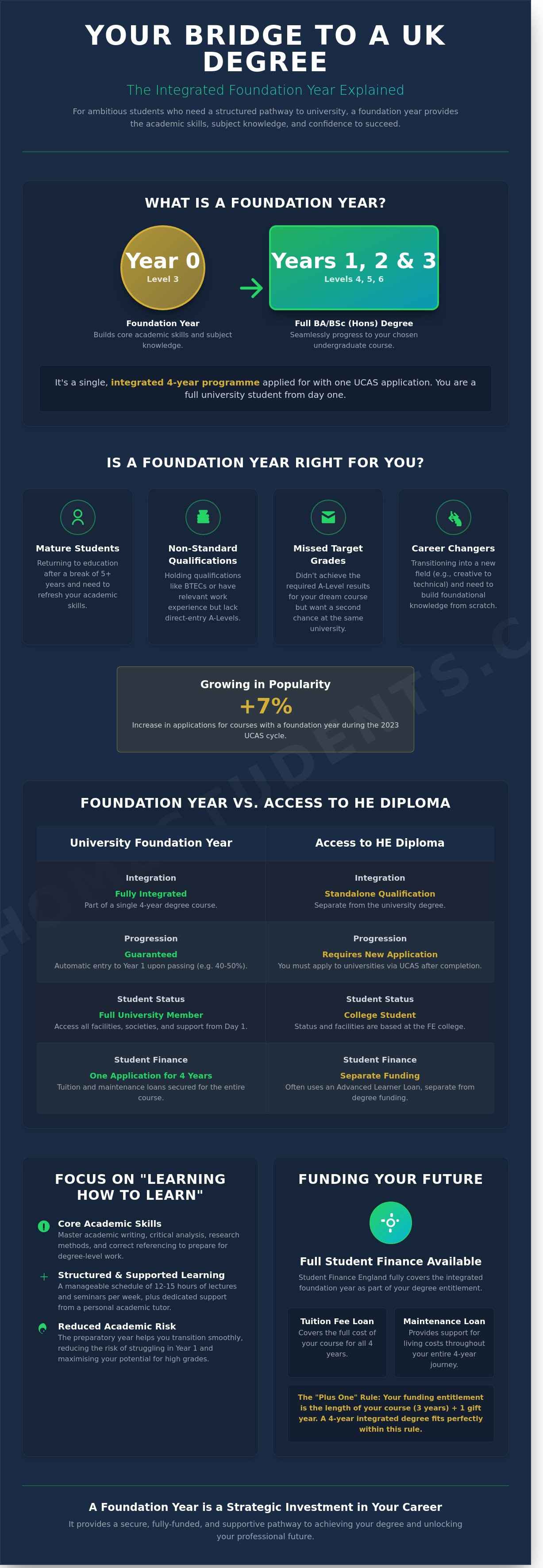
A foundation year is essentially "Year 0" of an integrated four-year degree programme. While a standard undergraduate degree begins at Level 4, this preparatory year sits at Level 3 on the Regulated Qualifications Framework (RQF). It functions as a vital bridge for students who don't yet meet the specific entry criteria for direct entry into the first year of a BA or BSc (Hons) course. This Foundation programme (pre-undergraduate courses) provides the academic grounding necessary to succeed in higher education.
Universities design these pathways to ensure you possess the subject-specific knowledge and study skills required for your chosen field. It's crucial to distinguish this from a Foundation Degree (FdA or FdSc). While a foundation year is an introductory year at Level 3, a Foundation Degree is a standalone Level 4 and 5 qualification equivalent to the first two years of a university degree. Understanding what is a foundation year involves recognising it as a gateway that elevates your academic standing to meet university standards.
Who is a Foundation Year designed for?
If you are a mature student returning to education after a break of five years or more, this pathway is often the most effective route back into the classroom. You might find that your previous qualifications are no longer recognised or are in subjects unrelated to your new career goals. UCAS data from the 2023 application cycle indicated a 7% increase in applications for courses with a foundation year, reflecting their growing popularity among non-traditional learners.
- Students with non-traditional qualifications: If you hold a BTEC in an unrelated field or have relevant work experience but lack A-levels, this year provides the necessary credentials.
- Missing target grades: If your A-level results fell short of the requirements for your dream course, Year 0 offers a second chance at the same institution.
- Career switchers: If you are moving from a creative background into a technical field like Engineering or Computer Science, the foundation year builds your technical vocabulary from scratch.
The "Integrated" Nature of the Course
The defining feature of this pathway is that it's hard-wired into your full degree from day one. When you apply through UCAS, you apply for a single four-year course (e.g., BSc Psychology with Foundation Year) rather than two separate programmes. This integration provides a level of security that standalone access courses cannot match. You are a full member of the university community from the start, with access to all facilities, societies, and student support services.
Progression is guaranteed upon successful completion of Year 0. Most universities require a pass mark of 40% or 50% in your foundation modules to move automatically into Year 1 at Level 4. Because the course is integrated, your Student Finance application covers the entire four-year duration. This means your tuition fee loan and maintenance loan are secured for the whole journey, providing financial peace of mind as you begin your academic transition.
How an Integrated Foundation Year Works: Structure and Curriculum
Understanding what is a foundation year requires looking closely at the "Year Zero" framework. This initial year operates on the standard UK academic calendar, typically running from September to June across two semesters. You'll usually attend 12 to 15 hours of scheduled lectures and seminars each week. This predictable structure helps you balance your studies with existing work or family commitments. Unlike the later years of a degree, the primary focus here is on "learning how to learn" while gaining an introduction to your chosen field.
You won't be left to navigate this transition alone. Every student is assigned a personal tutor or academic mentor who provides one-to-one guidance. These experts act as a steady hand, helping you move from the workplace or a break in education into the university system. They ensure you understand the specific requirements of the UK higher education system and can manage the shift in academic expectations from day one.
Core Academic Skills Development
This phase focuses on mastering academic writing, referencing, and critical thinking from scratch. You'll learn how to use referencing styles like Harvard or APA accurately to secure your grades. Digital literacy is a priority. You'll spend significant time learning to navigate university portals and research databases. These modules build the confidence required to contribute to seminars and lead group discussions, which are essential for modern degrees. If you're ready to secure your place, you can begin your expert assessment to find the right course for your goals.
Subject-Specific Introduction
Introductory modules in fields like Business Management or Health and Social Care are delivered at a manageable pace. For instance, a Health student might explore the basics of social policy or human biology before tackling complex clinical modules in Year One. This "head start" means that by the time you reach the formal degree level, you've already mastered the foundational concepts that often trip up other students. Year Zero is a bespoke academic bridge tailored for those returning to study.
Assessment methods are designed to prepare you for the full degree without the initial pressure of high-stakes exams. You'll complete a mix of 1,000-word essays, group presentations, and practical projects. In the 2024/25 academic cycle, data showed that students who completed a foundation year achieved a 12% higher average grade in their first year compared to those who entered directly. These tasks mirror the 2,500-word reports you'll face later, but they focus heavily on feedback and academic growth to ensure you're ready for the next level.
Comparing Your Options: Foundation Year vs Access to HE Diplomas
If you're a mature student returning to education for the 2026 academic cycle, you'll likely face a choice between two distinct paths. You might choose an Access to Higher Education (HE) Diploma or a four-year degree that includes a foundation year. This is the most frequent dilemma for learners over the age of 21 who don't meet traditional entry requirements. Understanding what is a foundation year compared to an Access course is vital for your long-term academic success and financial planning.
While both options aim to bridge the gap to level 4 study, they offer vastly different experiences. Your decision will affect everything from your daily commute to the way you're assessed. If you've lived in the UK for at least three years, you'll also need to consider how each path fits into your Student Finance England entitlement.
Key Differences in Delivery and Location
Access to HE diplomas are typically delivered in local Further Education (FE) colleges. These environments are often smaller and feel more like a continuation of school or college. In contrast, a foundation year takes place directly on a university campus. You'll use the same high-tech laboratories, 24-hour libraries, and digital resources as final-year students from day one.
- Campus Immersion: You get your university ID card and Students' Union membership immediately.
- Facilities: Access to specialized equipment that FE colleges may lack.
- Psychological Edge: Being on campus helps dismantle "imposter syndrome" by making you feel like a university student before your full degree begins.
Progression and Security
One of the biggest advantages of a foundation year is the "automatic" progression it offers. Once you pass your Year 0 modules, you move straight into Year 1 of your degree at the same institution. You won't need to navigate the UCAS application system a second time or write another personal statement. This removes the stress of the January application deadline and the uncertainty of waiting for new offers.
If you already know which university you want to graduate from, this pathway simplifies your entire journey. In contrast, Access students must re-apply through UCAS and compete with thousands of other applicants for a spot. You can explore these trade-offs further in our guide: Is a Foundation Year Right For Me? Pros and Cons.
Your choice also impacts how you're assessed. Access courses are often modular and credit-heavy. However, when you ask what is a foundation year in terms of preparation, the answer lies in its design. These programmes are built by university academics to mirror the exact exam and essay styles you'll face in your later years. By the time you reach Year 1, you'll already have a firm grasp of the institution's specific academic expectations and a established relationship with your tutors.
Funding and Eligibility: Student Finance for Foundation Year Students
Securing your place is the first step; securing your funding is the second. Many students asking what is a foundation year worry about the extra cost of an additional year of study. If you're a UK home student enrolling on an integrated programme, your foundation year (Year 0) is treated as part of a single, continuous course. This means Student Finance England (SFE) provides tuition fee loans and maintenance support for the entire duration, including that initial year.
The "Gift Year" rule is your financial safety net. SFE typically funds the length of your current course plus one additional year, minus any previous years of higher education study. For a four-year integrated degree, the formula provides 4 + 1 = 5 years of total funding. If you haven't studied at university before, you'll have full coverage for your foundation year and the subsequent three years of your degree. To qualify, you must usually have settled status or right of abode in the UK and have lived here for at least three years before the first day of your course.
Tuition Fee Grants and Loans
You don't need to pay anything upfront for your foundation year. The tuition fee loan, which covers fees up to £9,535 for the 2025/26 academic year, is paid directly to your university. This loan covers all four years of your integrated programme. You'll only start repaying this once you've graduated and your income exceeds the current repayment threshold. If you're unsure how to manage the paperwork, you can learn how to apply for a UK student maintenance loan to ensure your living costs are also handled early.
Maximising Your Support
Beyond tuition, you can access means-tested maintenance loans to help with rent, food, and books. Home students on integrated foundation programmes are entitled to the same maintenance loan support as those on standard three-year degrees. If you have children under 15, or under 17 with special educational needs, you might qualify for the Childcare Grant, which can cover up to 85% of your costs. Students with adult dependants can also apply for an Adult Dependants' Grant, providing up to £3,438 per year depending on household income. Apply for your finance by the May deadline to ensure your funds arrive in time for the September intake.
Ready to confirm your status and secure your funding? Book an expert assessment with our team to navigate the eligibility criteria with confidence.
Is a Foundation Year Worth It? Making the Right Choice for Your Career
Deciding to add an extra year to your studies is a significant choice. You might worry about the additional time, but the return on investment (ROI) often outweighs the extra 12 months. When you ask what is a foundation year worth in the long run, the answer lies in academic stability. Higher Education Statistics Agency (HESA) figures suggest that students who enter via this route have a 15% higher retention rate in their second and third years. You aren't just "catching up"; you're building a foundation that prevents future academic burnout.
The financial aspect is also manageable for UK home students. Since the foundation year is integrated into your degree, you can still access the standard tuition fee loan and maintenance loan for all four years. It's a low-risk way to ensure you're actually ready for the intensity of a full Honours degree. You'll gain professional habits like structured time management and advanced organisation before the credits start to count toward your final grade.
Beyond the grades, the "soft skills" you develop are vital for the 2026 job market. Employers look for graduates who can manage complex projects and communicate professionally. A foundation year gives you a dedicated space to practice these behaviours in a supportive environment. You'll enter Year 1 of your degree with the confidence of a second-year student, already familiar with university systems and expectations.
Long-term Career Advantages
Starting your journey with a foundation year can lead to significantly higher final degree classifications. Statistics show that students who take this route are 20% more likely to achieve a 2:1 or a First Class degree. This happens because you've already mastered the "hidden curriculum" of university life. If you're balancing work or family commitments, the slower pace of the first year provides the breathing room you need to adjust. For those interested in specific sectors, our Business Management Degree Birmingham: The Complete 2026 Guide provides excellent examples of how these courses are structured to fit your lifestyle.
How to Start Your Application
Navigating the UCAS system doesn't have to be a solo mission. If you lack traditional qualifications like A-Levels, your professional experience can often bridge the gap. Understanding what is a foundation year requirement versus a standard entry requirement is where expert guidance becomes vital. We can help you identify flexible courses that offer evening or weekend sessions, making higher education accessible regardless of your current schedule.
Don't let the paperwork hold you back from a 2026 start. Secure your university place with an expert assessment from UK Home Students today. We'll help you navigate the eligibility criteria and ensure your application stands out to admissions tutors.
Secure Your Place on a 2026 Degree Programme
Understanding what is a foundation year represents the first step toward transforming your career prospects in 2026. These integrated courses provide a vital bridge for mature students, offering a year of academic preparation that leads directly into a full degree. You can access comprehensive funding through Student Finance England, which covers both your tuition fees and maintenance loans to help with living expenses. Many of our partner universities now offer flexible timetables with 2-day-a-week attendance, making it easier to balance your studies with work or family commitments.
Navigating the UCAS application process and funding regulations doesn't have to be overwhelming. Our team provides expert guidance on your specific eligibility and offers dedicated support to help you craft a compelling personal statement that stands out to admissions tutors. We've helped thousands of UK home students secure their future through tailored advice and professional intervention. Don't let complex bureaucracy hold you back from achieving your academic goals.
Book your free eligibility assessment with UK Home Students today and take control of your educational journey. Your path to a university degree is clearer than you think.
Frequently Asked Questions
Is a foundation year the same as a foundation degree?
No, these are two distinct academic paths. A foundation year is an integrated preparatory year, often called "Year 0," that leads directly into a full three-year honours degree. A foundation degree is a standalone Level 5 qualification that's equivalent to the first two years of a university degree. You'll typically find foundation degrees are more vocational and involve more work-based learning.
Can I get a student loan for a foundation year?
You can secure full funding from Student Finance England for your foundation year if it's part of an integrated four-year degree. This means your tuition fees of up to £9,250 are covered, and you'll also receive a maintenance loan for your living costs. If you've studied at university before, you must check your remaining eligibility, as the "gift year" rule applies to these programmes.
What are the entry requirements for a foundation year?
Entry requirements are lower than those for standard three-year degrees, making them accessible if your grades weren't what you expected. You'll usually need between 48 and 72 UCAS points from A-Levels, BTECs, or T-Levels for the 2026 intake. Most universities also insist on a Grade 4 or C in GCSE English and Maths, though some institutions offer equivalency tests if you don't have these.
Do I have to stay at the same university after my foundation year?
You aren't forced to stay, but your course is designed as a continuous four-year journey at one institution. If you want to move, you'll need to apply through UCAS as a transfer student for Year 1 at a different university. Success depends on whether the new university accepts your foundation year credits, so it's vital to check their specific transfer policies before you finish your Year 0.
Is a foundation year hard to pass?
The workload is designed to be supportive rather than overwhelming. When you consider what is a foundation year, it's essentially a bridge to help you develop the academic skills you'll need later. Data from UK institutions shows that over 85% of students successfully progress to the first year of their full degree. You'll usually need to achieve a 40% pass mark across your modules to move forward.
What happens if I fail my foundation year?
If you don't pass a module, your university will usually offer you a resit opportunity during the summer. Failing the resit might mean you have to repeat the entire year or withdraw from the programme. You should be aware that Student Finance England typically only funds one "gift year," so failing twice could leave you without tuition fee support for the final year of your degree.
Can I do a foundation year if I already have a degree?
You can apply, but you'll almost certainly have to self-fund the tuition. Student Finance England's "Equivalent or Lower Qualification" policy means they won't pay for a second degree at the same level. Since a foundation year is part of a Level 6 qualification, you'll need to pay the £9,250 annual fee yourself. Some exceptions exist for specific subjects like Medicine, Dentistry, or Architecture.
Are foundation years only for mature students?
They're open to everyone, not just those returning to education. While roughly 30% of foundation year students are mature learners over 21, the majority are school leavers who missed their target grades. Understanding what is a foundation year helps students of all ages see it as a second chance to enter competitive fields like Law, Engineering, or Science without the usual entry hurdles.