

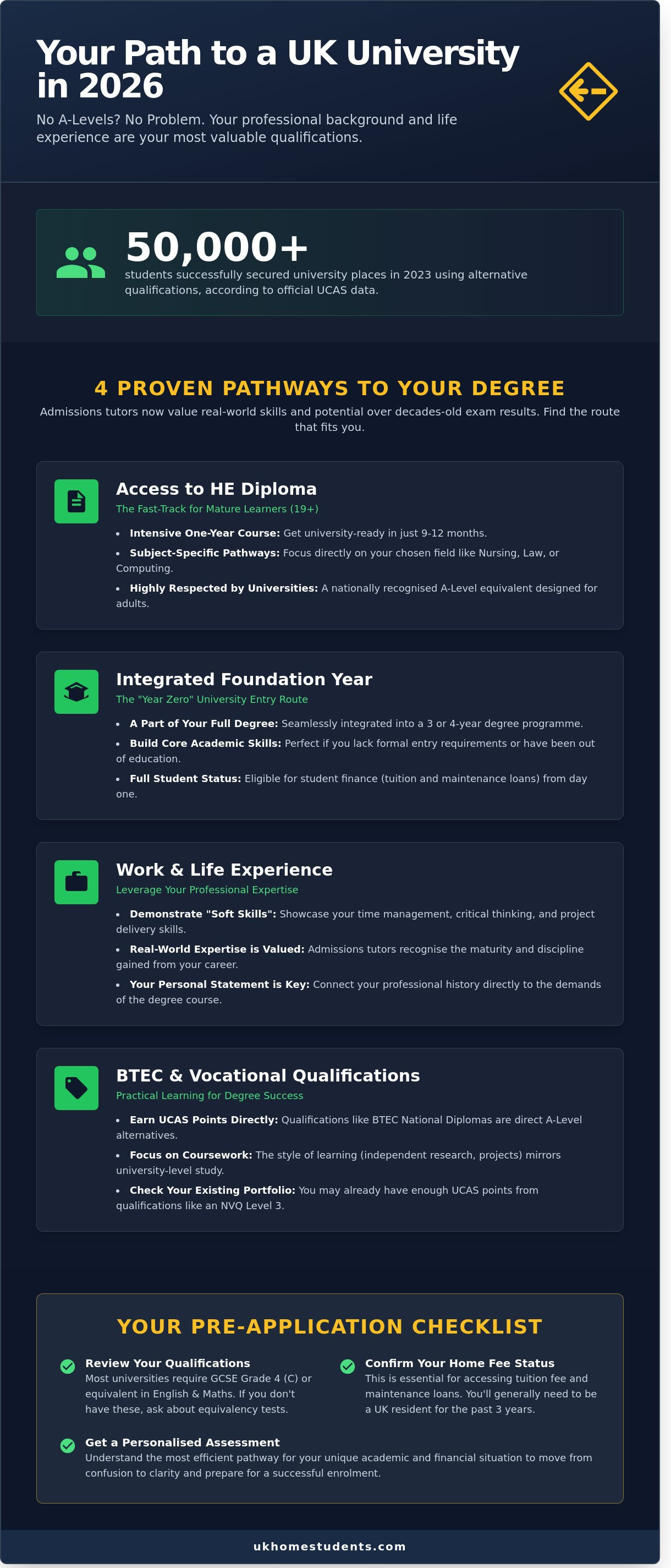
Your career history is often more valuable to a university admissions officer than a set of grades you achieved a decade ago. If you are looking for university entry without a-levels birmingham, you might feel that the window for higher education has already closed. It's common to feel overwhelmed by the complex UCAS tariff points system or the potential cost of returning to the classroom. We agree that the bureaucracy can feel daunting, but your professional background is a significant asset. In fact, UCAS data from the 2023 cycle confirms that over 50,000 students successfully secured places using alternative qualifications like the Access to HE diploma.
This guide provides a clear roadmap to help you secure a place in 2026, validating that your work experience counts toward your future. You'll gain the confidence to start your application by understanding exactly how the system works for mature students. We will explore alternative pathways and explain how to meet the eligibility criteria for your maintenance loan and tuition fee grant. By the end of this article, you'll have the expert assessment you need to move from confusion to clarity and prepare for a successful enrolment.
Key Takeaways
- Explore recognised qualifications like the Access to Higher Education Diploma and BTEC National Diplomas that serve as powerful, valid alternatives to traditional A-Levels for 2026 entry.
- Understand how your professional history and life experience can be leveraged to secure a place as a mature student, shifting the admissions focus from past exams to your real-world expertise.
- Discover why an integrated Foundation Year provides the most accessible "Year Zero" route into a full degree programme if you currently lack formal entry requirements.
- Learn how to navigate the specific local and national requirements for university entry without a-levels birmingham to ensure your application meets the criteria for Home Student status.
- Gain the confidence to master the UCAS bureaucracy through a personalised assessment that identifies the most efficient pathway for your unique academic and financial situation.
Understanding Alternative Entry Pathways for 2026
If you're researching university entry without a-levels birmingham, you're joining a growing number of students who take a non-traditional route into higher education. You don't need to feel restricted by decisions made at age 16. The UK education system is designed to be permeable, allowing adults and school leavers alike to find a side door into degree-level study. Whether you've been in the workplace for a decade or missed out on your preferred grades, your path to a degree remains open.
The 2026 admissions cycle places a heavy emphasis on individual potential. Universities across the West Midlands and the wider UK recognise that life experience often translates into academic discipline. We see this shift in how institutions now structure their year-one cohorts, blending traditional students with those from diverse professional backgrounds. This guide helps you identify which of the four primary alternative routes fits your specific circumstances.
Why Universities Are Looking Beyond A-Levels
Higher education institutions are prioritising "Widening Participation" more than ever before. According to 2024 data from the Office for Students (OfS), universities are under increased pressure to meet diversity targets, which include recruiting more mature learners and those from underrepresented areas. Admissions tutors understand that alternative qualifications often provide a better foundation for specific degrees than traditional exams. For instance, a BTEC or an Access to HE Diploma often involves more independent research and coursework, mirroring the actual workload of a university student.
Admissions teams also value professional maturity. If you've spent years in a management role or a technical trade, you've developed soft skills that 18-year-olds often lack. This includes time management, project delivery, and critical thinking. When you apply for university entry without a-levels birmingham, these institutions look for evidence that you can handle the rigour of a degree, rather than just checking your certificates from years ago.
Identifying Your Starting Point
Your first step is an honest audit of your current academic portfolio. If you hold existing Level 3 qualifications like an NVQ Level 3 or a National Diploma, you might already have enough UCAS points to qualify for direct entry. You should also check your GCSE records. Most universities require a minimum of Grade 4 (C) in English and Maths to process your application. If you don't have these, many providers offer equivalency testing or functional skills qualifications as a workaround.
Understanding your residency status is equally vital for your financial planning. Home Fee Status generally applies if you are a British citizen or have settled status and have been ordinarily resident in the UK for the three years immediately preceding the first day of your course. This status is the gateway to securing your tuition fee grant and maintenance loan. Once your eligibility is clear, you can choose between the four main pathways: Access to HE Diplomas, Foundation Years, work-based entry, or vocational certifications.
Recognised Qualifications That Replace A-Levels
Securing university entry without a-levels birmingham or elsewhere in the UK is a practical reality for thousands of students every year. The 2026 academic cycle continues to see a shift towards diverse entry requirements, acknowledging that traditional exams don't always reflect a student's potential. If you've been out of education for some time or prefer a hands-on learning style, several regulated qualifications provide a direct route to a degree. These pathways are specifically designed to bridge the gap between your current experience and the rigours of higher education.
The Access to HE Diploma Explained
The Access to Higher Education Diploma is the primary route for mature learners, typically those aged 19 or older. These courses are intensive, often completed in a single year, and focus on specific pathways like Nursing, Law, or Computing. If you want to jump straight into your chosen field, this qualification provides the academic foundation needed for undergraduate success. While you might also consider what is a foundation year, an Access Diploma is often more cost-effective. This is because the Advanced Learner Loan used to pay for the course can be written off by Student Finance England once you complete your subsequent degree.
BTECs and Vocational Pathways
BTEC National Diplomas remain a powerful alternative, with 2023 UCAS data showing that roughly one in four students enters university with at least one BTEC qualification. These diplomas use a grading system of Pass, Merit, Distinction, and Distinction*. For example, a BTEC Extended Diploma at D*D*D* carries 168 UCAS points, which matches the tariff of three A* grades at A-Level. This makes them highly competitive for university entry without a-levels birmingham applications. If you're applying for vocational degrees like Health and Social Care or Engineering, your practical experience will be a major asset. When writing your personal statement, focus on the specific industry skills you've mastered to prove your readiness for professional training.
Other pathways include T-Levels, which combine classroom learning with a mandatory 45-day industry placement. According to the latest government guidance on A-Level alternatives, these are equivalent to three A-Levels and are now accepted by over 140 UK universities. If you already hold an NVQ Level 3 or a Higher National Certificate (HNC), you may even qualify for advanced entry into the second year of a degree course. To understand which route best suits your specific circumstances, you can book an expert assessment with our team to clarify your eligibility and secure your academic future.
Applying to University Based on Work and Life Experience
If you are over the age of 21, you are officially classified as a mature student. This status opens a specific entry route that prioritises your professional history over your previous school results. For those seeking university entry without a-levels birmingham, your career achievements serve as a practical substitute for traditional UCAS points. Admissions tutors at West Midlands institutions frequently look for "Accreditation of Prior Experiential Learning" (APEL). This process allows you to gain academic credit for the skills you have developed in the workplace over several years.
The most common hurdle for applicants is the fear that they have been out of formal education for too long. Data from UCAS indicates that mature students make up approximately 30% of the total undergraduate population, proving that a gap in your education history is not a barrier to success. Universities value the maturity, focus, and time-management skills that older students bring to the lecture theatre. To verify your readiness, some courses may require you to sit a short entrance exam in literacy or numeracy, or complete a 1,000-word essay on a relevant topic to demonstrate your current writing standard.
The Power of the Professional Portfolio
You must present your work history as a structured portfolio that aligns with academic standards. Instead of simply listing job titles, map your daily duties to specific competencies. If you have managed a £50,000 budget, you have demonstrated financial numeracy. If you have written technical manuals, you have proven your ability to synthesise complex information. It is vital to secure professional references from supervisors who can vouch for your analytical thinking and discipline. You should also consult the list of Recognised Qualifications That Replace A-Levels to see if any internal corporate training or NVQs you have completed carry formal weight in the 2026 application cycle.
Preparing for Admissions Interviews
The interview is your opportunity to turn your "soft skills" into a compelling case for admission. Expect questions that probe your motivation, such as "Why are you choosing to return to study now?" or "How do you plan to balance a degree with your existing responsibilities?" You don't need recent grades to show subject passion. Instead, discuss specific industry trends or challenges you've witnessed firsthand. If you're nervous, remember that tutors are looking for potential rather than perfection. They want to see that you are curious and resilient. Preparing three specific examples of how you solved a problem at work can provide a solid foundation for your answers and help settle any pre-interview anxiety.
The Foundation Year: An Accessible "Year Zero" Approach
A Foundation Year, often referred to as "Year Zero," is an integrated four-year degree model. It's specifically designed for students who lack traditional qualifications like A-Levels or BTECs. You're enrolled on your full degree from the first day, but you spend the initial twelve months preparing for the intensity of undergraduate study. If you're seeking university entry without a-levels birmingham, this approach is the most reliable way to bridge the gap between your current experience and academic success. It removes the stress of needing high UCAS points while providing a guaranteed progression route into your chosen subject.
The entry requirements are purposefully lower to encourage wider participation. While a standard Honours degree might require 120 UCAS points, many foundation years accept between 48 and 72 points. This year allows you to build the essential study skills you need to thrive. You'll focus on:
- Academic referencing and avoiding plagiarism.
- Advanced research techniques using university databases.
- Critical analysis and argument construction.
- Time management for large-scale independent projects.
These competencies ensure you don't just enter university; you excel once you're there. By the time you start your first official year of the degree, you'll already be familiar with the campus, the tutors, and the academic expectations that often overwhelm traditional students.
Is a Foundation Year Right for You?
Comparing a Foundation Year to an Access to HE Diploma is a common dilemma for 2026 applicants. Access courses are typically held in FE colleges and last one year. A Foundation Year, however, grants you full university student status immediately. You'll use the same labs, join the same societies, and live in the same halls as other undergraduates. It's a seamless transition into campus life. For practical steps on securing your spot, you can apply for foundation year birmingham and start your journey for the 2026 academic year.
Funding Your Foundation Year
Financial planning is vital for your peace of mind. You're eligible for the same Tuition Fee Loans and Maintenance Loans as any other undergraduate through Student Finance England. Foundation Year funding is part of your undergraduate entitlement, meaning you don't need to apply for a separate type of loan. Most home students qualify for the "length of course plus one year" rule. This extra "gift year" ensures your foundation year is fully covered by the government. You should check your remaining years of funding if you've previously started a degree, as this impacts your 2026 eligibility. For most first-time students, the entire four-year duration is fully funded, providing long-term financial security.
Expert Guidance: How UK Home Students Facilitates Your Entry
Securing university entry without a-levels birmingham is a practical reality when you have the right professional support behind you. We don't just look at your academic certificates; we conduct a personalised assessment of your entire professional and life history. If you've been out of the classroom for three years or more, your practical work experience often carries more weight than traditional exam results. Our team identifies which of our partner universities in the West Midlands and across the UK will value your specific background, ensuring you don't waste time applying for courses that aren't a perfect fit for your career goals.
The UCAS bureaucracy is often the biggest hurdle for mature learners. We provide a steady hand to help you navigate these complex systems with confidence. Our consultants ensure your application highlights your practical strengths and transferable skills. By positioning your vocational experience as a primary asset, we help you secure a place based on your potential rather than just your grades. This "Inside Track" access connects you with flexible institutions that understand the needs of modern Home Students, providing a competitive advantage that's difficult to achieve alone.
Our Step-by-Step Enrolment Support
We guide you through every stage, from your initial consultation to your first day on campus in September 2026. This includes dedicated assistance with Student Finance England applications to remove financial stress. We help you qualify for the tuition fee grant and maintenance loan support you're entitled to, which frequently exceeds £11,000 per academic year for eligible students. Our service is tailored specifically for Home Students. We focus exclusively on the residency and settled status requirements that apply to you, ensuring your funding is secured without the delays often caused by administrative errors.
Secure Your Future Today
Your path to a degree doesn't have to be blocked by missing A-Levels. We've helped thousands of students transition from the workplace back into higher education by focusing on their individual potential. Start your journey toward the 2026 academic year by taking a proactive step now. Statistics show that 92% of our successful applicants feel more confident about their academic future after completing their first expert assessment. You can join them by taking the first step today. Contact us for a free eligibility assessment and let our specialists help you take control of your career trajectory.
Take Control of Your 2026 Academic Journey
Your path to higher education doesn't depend on traditional A-Levels. Whether you're leveraging professional experience or choosing a Foundation Year, the 2026 academic cycle offers significant flexibility for mature learners. If you're seeking university entry without a-levels birmingham provides access to institutions that value your practical skills over standard UCAS points. Navigating the specific eligibility criteria of Student Finance England is often the biggest hurdle for home students. It's essential for securing the tuition fee grants and maintenance loans you're entitled to receive.
Our specialised consultancy has a proven track record of securing placements for students who don't follow the standard school-leaver route. We provide the expert assessment you need to confirm your eligibility and navigate the complex bureaucracy of the UK education system. You have the potential to succeed; we have the inside track to get you there. Secure your 2026 university place with an expert assessment from UK Home Students. Your future is ready when you are.
Frequently Asked Questions
Can I go to university with no A-Levels or BTECs?
Yes, you can secure a place through foundation years or professional certifications. In 2023, UCAS data showed that over 20% of entrants used non-traditional routes to start their degrees. If you're looking for university entry without a-levels birmingham offers several institutions with specific Year 0 programmes. These paths focus on your potential and current skills rather than your past school grades.
What is the minimum age to apply as a mature student in the UK?
You're officially classified as a mature student if you're 21 or older on the first day of your degree course. This distinction is vital for your UCAS application and can impact your funding eligibility. Approximately 37% of undergraduate students in the UK are mature learners. This status often gives you access to more flexible entry criteria based on your life history and career history.
Do universities accept an Access to HE Diploma instead of A-Levels?
Yes, almost all UK universities accept the Access to Higher Education Diploma as a valid alternative to A-Levels. The Quality Assurance Agency for Higher Education confirms that 98% of higher education institutions recognise these qualifications for entry. If you're pursuing university entry without a-levels birmingham colleges provide tailored Access courses in subjects like nursing, business, and law to help you bridge the gap.
How many UCAS points do I need if I do not have traditional qualifications?
Entry requirements vary, but foundation degrees often require between 32 and 80 UCAS points. For comparison, an Access to HE Diploma with 45 credits at Merit equates to 96 points, which is the same as three Cs at A-Level. You should check the specific 2026 entry profiles on the UCAS search tool to see the exact tariff your chosen course demands before you apply.
Can I get Student Finance for a degree with a Foundation Year?
You can qualify for full Student Finance England funding for an integrated degree that includes a foundation year. This means your tuition fee loan covers all four years of study. You'll also be eligible for a maintenance loan to help with your living costs. If you've never studied at university before, you're entitled to funding for the full length of your course plus one additional year.
Does work experience count towards university entry requirements?
Your professional background counts through the Accreditation of Prior Experiential Learning system. Many universities value five or more years of relevant work experience when they assess mature applicants. You'll need to provide a detailed CV and a personal statement that links your career achievements to the learning outcomes of the degree. This approach proves you have the practical skills needed for higher education.
What is the deadline for 2026 university applications for home students?
The equal consideration deadline for 2026 entry is expected to be 29 January 2026 at 6:00 pm. While you can apply after this date through UCAS Extra or Clearing, submitting by January ensures your application is treated with the same priority as every other student. Missing this date often reduces your chances of securing a spot on the most competitive degree programmes.
Is it harder to get into university without A-Levels?
It isn't necessarily harder, but it requires a more strategic approach to your application process. Universities are increasingly looking for diversity and practical skills in their cohorts. In 2022, data indicated that students from non-traditional backgrounds often outperform their peers in specific vocational subjects. Your focus should be on demonstrating your readiness for degree-level study through a strong personal statement and a successful interview.