

What if you could earn a full BSc or BA degree without quitting your job or missing your child's school play? Many adults believe that higher education is a closed door once they've started a career or family, but 2024 data from the Higher Education Statistics Agency shows that over 500,000 mature learners are currently proving otherwise. You've likely worried that you aren't academic enough or that part-time university courses for mature students will leave you drowning in debt and deadlines. It's a common anxiety, especially when you're balancing a mortgage with the desire for a better career.
We're here to show you that your experience is an asset, not a hurdle. This 2026 guide will help you find flexible two-day-a-week or evening programmes that respect your existing commitments. You'll discover how to secure full funding through a part-time maintenance loan and tuition fee grant, ensuring your living costs are covered while you study. We'll walk you through the specific eligibility criteria for UK Home Students and provide a step-by-step roadmap to help you manage the UCAS application process with total clarity.
Key Takeaways
- If you are aged 21 or over, learn how to maintain your professional momentum by selecting flexible attendance models like evening sessions or weekend blocks.
- Discover the most suitable part-time university courses for mature students and gain clarity on navigating the 4-6 year academic timeline for your degree.
- Identify your eligibility for Student Finance England in 2026 and secure the maintenance loans you need to fund your education without financial stress.
- Navigate the complexities of the application process by understanding when to utilize direct university entry instead of the traditional UCAS route.
- Leverage an expert assessment to bypass academic bureaucracy and ensure you are placed in a vetted programme that aligns with your career aspirations.
Understanding Part-Time University Courses for Mature Students
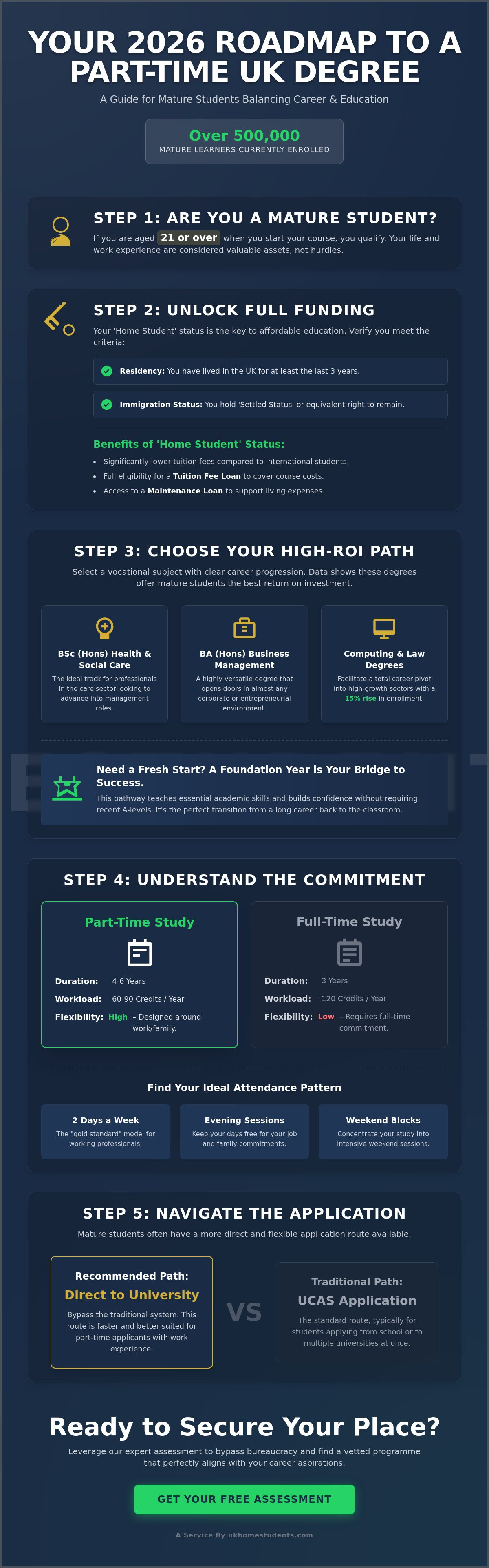
If you're over 21 and considering a return to education, you're officially classified as a mature learner. Understanding what is a mature student entails is the first step toward securing your academic future. In 2026, the UK higher education landscape is shifting toward extreme flexibility through the Lifelong Learning Entitlement. This makes part-time university courses for mature students more accessible than ever before. You don't have to sacrifice your current salary or professional momentum to earn a degree. Instead, you can balance your existing career with structured learning that builds your credentials over time. This approach allows you to apply new theories to your workplace in real-time, creating an immediate impact on your professional value.
Your eligibility for funding depends heavily on your residency status. If you have lived in the UK for at least three years and possess settled status, you likely qualify as a "Home Student." This status is the key to accessing lower tuition fees and comprehensive maintenance loans from Student Finance England. International students face significantly higher costs and different visa restrictions, making this distinction the most critical factor in your initial assessment. We focus on helping you verify this status early so you can maximize your available funding and avoid unnecessary debt.
Foundation Year Pathways: A Fresh Start
Bridging the gap between a long career and a lecture hall requires a specific entry point. Foundation years act as a bridge for those who may have been out of the classroom for a decade or more. They teach you essential academic writing and research skills while building your confidence. If you're based in the West Midlands, exploring university courses with foundation year in Birmingham provides a localized path to success. These programs allow you to transition from professional experience to academic excellence without needing recent A-levels. It's a fresh start that respects your work history while preparing you for the rigors of a full degree.
Popular Degree Subjects for Mature Learners
ROI is a priority for adult learners. Data from 2024 and 2025 shows a surge in enrollment for vocational subjects that offer clear career progression. Choosing a subject with a vocational focus ensures that your part-time study translates directly into a higher salary bracket. Popular choices include:
- BSc (Hons) Health and Social Care: Ideal for those already working in the care sector looking to move into management.
- BA (Hons) Business Management: A versatile degree that applies to almost any corporate environment.
- Computing and Law: We've seen a 15% increase in mature students opting for these subjects to facilitate a total career pivot into high-growth sectors by 2027.
These subjects offer the best return on investment because they align with current UK skills shortages, making you a highly desirable candidate upon graduation.
Key Criteria for Choosing Your Part-Time Degree
Selecting the right course requires a realistic assessment of your weekly capacity and long-term career goals. Most part-time university courses for mature students extend the traditional three-year degree into a four to six-year commitment. This extended timeline reduces your annual credit load, usually to 60 or 90 credits instead of the standard 120. If you're balancing a career, you should check if the institution offers an accelerated track. Some universities now provide intensive summer modules that can shorten your graduation timeline to 3.5 years.
Professional accreditation is another vital factor. If you're entering regulated fields like accounting, engineering, or psychology, you must ensure the course is validated by relevant bodies such as the ACCA or the British Psychological Society. Choosing a non-accredited path might mean you'll need to sit additional professional exams after graduation. When you're calculating the costs of these extra years of study, it's essential to review the latest guidance on student finance for mature students to understand your tuition fee loan eligibility.
Evaluating Attendance Patterns
The "2-day-a-week" model is widely considered the gold standard for working parents. It provides a predictable routine that allows you to schedule childcare and work shifts with precision. If you require even more flexibility, blended learning offers a middle ground. This model combines online theory modules with occasional on-campus sessions. While digital learning is convenient, you shouldn't ignore the value of face-to-face instruction. Physical attendance fosters networking opportunities that are often lost in purely remote settings. If your commute to campus is longer than 45 minutes, a blended approach usually offers the best return on your time investment.
Support Services for Adult Learners
Success in higher education often depends on the quality of the "wraparound" support provided. You should look for universities that offer dedicated mature student societies and on-site childcare facilities. These services help bridge the social gap and reduce the logistical strain of returning to study. If it's been several years since you were last in a classroom, academic skills support is a priority. Many institutions now offer bespoke workshops on digital literacy, essay planning, and referencing techniques.
Career services are equally important, but they must be relevant to your stage of life. Standard graduate advice often misses the mark for those with years of professional experience. Look for services that specialize in career pivoting or leadership development for part-time university courses for mature students. If you're unsure which path aligns with your current experience, you can request a professional consultation to map out your academic journey.
Navigating Student Finance and Funding for Part-Time Study
A common misconception prevents many adults from returning to education: the belief that maintenance loans are reserved solely for full-time learners. This isn't the case. If you're looking into part-time university courses for mature students, you can access substantial financial support through Student Finance England. For the 2026 academic year, the system remains designed to support those balancing education with existing work or family commitments.
Your eligibility depends heavily on your "intensity of study." To qualify for a tuition fee loan and a maintenance loan, your course must have an intensity of at least 25% compared to a full-time equivalent. For example, if a full-time degree takes three years, your part-time track must be completed within 12 years. If you study at 50% intensity, you'll generally be eligible for 50% of the maintenance loan amount available to a full-time student in your specific household circumstances.
Securing "Home Student" status is the most vital step in your financial journey. This classification ensures you pay the capped UK tuition fees rather than the significantly higher international rates. If you've lived in the UK for at least three years before the first day of your course and hold settled status, you're likely to qualify. Our Student Finance in Birmingham Guide provides a localized breakdown of how these regulations apply to residents in the West Midlands.
Maintenance Loans and Tuition Fee Grants
Your maintenance loan entitlement is calculated based on your household income and where you live while studying. Unlike full-time students, part-time learners don't usually receive their first payment until they've completed the first 25% of their academic year. If you have a long-term health condition, mental health difficulty, or specific learning difference like dyslexia, you should apply for the Disabled Students’ Allowance (DSA). This grant doesn't need to be repaid and covers essential costs like specialist equipment or non-medical helpers.
Hidden Costs and Financial Planning
While tuition is often covered by loans, you must budget for the "hidden" expenses of higher education. These include:
- Professional Memberships: Many part-time university courses for mature students in fields like accounting or psychology require fees for bodies like the ACCA or BPS.
- Travel and Tech: Commuting to campus once or twice a week adds up; ensure your budget accounts for peak-time rail fares or parking.
- Course Materials: Digital textbooks are common, but specific modules may require physical copies or specialized software.
If your degree directly benefits your current role, consider pitching employer sponsorship. Many UK firms have dedicated training budgets that can cover 50% to 100% of tuition fees in exchange for a commitment to stay with the company for a set period. We recommend using an "Expert Assessment" approach to your application. By having a professional review your residency history and financial evidence before submission, you can maximize your funding and avoid the delays that often plague complex mature student applications.
How to Apply for Part-Time Courses as a Mature Student
Applying for higher education later in life requires a different strategy than the one used by school leavers. If you've been out of the classroom for several years, you'll find that part-time university courses for mature students often prioritize your professional journey over your teenage exam results. Universities recognize that a decade of management experience or technical work provides a level of discipline that A-levels cannot always measure. You should begin by researching partner universities that specifically cater to working professionals, as these institutions often have more flexible entry requirements and dedicated support teams.
Gathering evidence of your professional history is a vital first step. If you don't have traditional qualifications like A-levels or BTECs, many admissions tutors will look for "Recognition of Prior Learning" (RPL). This process allows you to claim credits for skills you've gained in the workplace. You'll need to provide detailed references from employers and perhaps a portfolio of work to prove you're ready for level 4 study or higher. If you're invited to an interview or assessment day, treat it like a professional consultation. Be prepared to discuss how you'll balance your current job with 15 to 20 hours of weekly study.
Applying Directly to the Institution
Most part-time programs bypass the standard UCAS application route. If you apply directly to the university, you often benefit from a faster response and a more personal interaction with the admissions team. This is particularly helpful if you're looking at January intakes rather than the traditional September start. Managing these deadlines is crucial; while UCAS has strict January cut-offs, direct applications sometimes remain open until a few weeks before the course begins. Speaking to an education consultant before you submit can help you identify which universities offer the most supportive direct-entry routes for your specific career path.
Crafting a Mature Student Personal Statement
Your personal statement must translate your "work skills" into "academic potential." If you've managed a budget of £50,000 or led a team of ten people, you've already demonstrated the analytical and leadership skills required for a degree. Address any gaps in your education history with confidence rather than apology. Explain that your time away from academia allowed you to gain practical perspective. You must also demonstrate your commitment to the long-term journey. Since a part-time degree can take six years to complete, tutors need to see that you have a clear motivation and a stable environment to support your goals.
If you're unsure whether your work experience meets the eligibility criteria for your chosen course, we can help you clarify your options. Contact UK Home Students for an expert assessment of your application today.
Expert Support: Securing Your Place with UK Home Students
Applying for university as an adult involves more than just filling out a form. The UK higher education system is rigorous, particularly regarding funding and residency requirements. UK Home Students acts as your professional advocate, simplifying the recruitment process by vetting every institution we partner with. We ensure that the part-time university courses for mature students we recommend meet high standards for flexibility and academic support. Our team understands that your time is a valuable resource, so we focus on programmes that offer genuine work-life balance.
Our team provides an "Inside Track" on admissions. This means we understand what university registrars look for in a non-traditional application. We don't just pass your details along; we provide a comprehensive vetting service that matches your specific professional background with the right academic pathway. This reduces the risk of rejection and ensures you don't waste time on programmes that don't fit your schedule. We provide step-by-step guidance, moving from initial course selection to the final day of enrolment with a focus on clarity and confidence.
Why Use an Education Consultancy?
The complexity of government bureaucracy can be a significant barrier. If you've been out of education for a decade, the shift to digital-first UCAS applications and Student Finance England portals is often overwhelming. We specialise in ensuring you meet the strict "Home Fee" status requirements. These regulations generally require three years of ordinary residence in the UK prior to the start of your course. This status is vital because it determines your eligibility for lower tuition fees and maintenance loans. Our consultants help you access flexible degree courses in Birmingham and other major educational hubs, ensuring your local options are fully explored and vetted.
Your Next Steps to a 2026 Enrolment
Securing your place for the 2026 academic year requires early preparation. Most part-time university courses for mature students have rolling admissions, but funding deadlines remain strict. To begin, you should book a free assessment with our team to verify your eligibility for Home student status and financial support. This assessment removes the guesswork from your application.
Following your assessment, you'll need to gather your documents. This typically includes your passport, proof of address for the last three years, and any previous academic transcripts or certificates. We guide you through this collection process to ensure your application is hassle-free and professional. If you're ready to advance your career and gain a formal qualification, Start your journey today with UK Home Students and let our experts handle the technicalities while you focus on your future studies.
Secure Your Academic Future in 2026
Choosing to return to education is a transformative step that requires a clear, logical strategy. You've now seen how part-time university courses for mature students provide the essential flexibility needed to balance your degree with existing work or family life. Many institutions now offer specialized 2-day-a-week schedules, ensuring your studies fit around your life rather than against it. It's also vital to remember that Student Finance eligibility isn't limited to full-time study; maintenance loans and tuition fee grants are accessible to help cover your costs.
If you don't have traditional A-levels, don't let that stop you. Your professional history and life experience are often enough to secure a university offer. Navigating the complex requirements of UCAS and government funding can be stressful, but you don't have to face the bureaucracy alone. Our team acts as a steady hand, guiding you through every eligibility check and application detail to ensure you maximize your funding and secure your place.
Get a Free Expert Assessment for Your University Application and start your journey with confidence. We're ready to help you turn your career goals into a reality.
Frequently Asked Questions
Am I too old to go to university at 30, 40, or 50?
You're never too old to start a degree. In 2023, data from HESA showed that 37% of UK undergraduates were mature students aged 21 or over. Universities actively recruit older learners because they bring valuable professional experience and a dedicated mindset to the lecture hall. Your age is often an advantage in seminar discussions where real-world context is highly prized.
Can I get a full maintenance loan for a part-time course?
You can secure a Maintenance Loan for a part-time course if your study intensity is at least 25% of a full-time equivalent. For the 2024/25 academic year, the maximum loan amount is £8,610 if you live at home or £10,227 if you live away from home outside London. These funds help cover your living costs while you're enrolled in part-time university courses for mature students.
Do I need A-levels to apply for a degree as a mature student?
You don't always need traditional A-levels to qualify for a degree. Many universities accept professional experience or alternative qualifications like an Access to HE Diploma. If you're over 21, admissions tutors will look at your life experience and your ability to handle the academic workload rather than just your previous exam results from 10 or 20 years ago.
How many hours a week is a part-time university course?
A part-time course typically requires between 15 and 20 hours of total study time per week. This includes approximately 4 to 6 hours of contact time in lectures or seminars, with the remaining hours dedicated to independent reading and assignments. Most part-time university courses for mature students are structured to allow you to maintain your career and family life simultaneously.
Can I work full-time while studying for a part-time degree?
Yes, you can work a 35 to 40-hour week while studying, provided you stay organized. Most part-time degrees are designed for working professionals, with many institutions offering evening classes or block teaching sessions. If you dedicate 2 hours each evening to your studies, you'll stay on track with your modules without burning out or compromising your professional performance.
What is an Access to Higher Education Diploma?
An Access to HE Diploma is a Level 3 qualification specifically designed for adults who want to enter university but lack the necessary UCAS points. These courses take 1 year to complete and cover subject-specific knowledge along with essential study skills. If you complete your degree afterwards, Student Finance England will cancel the balance of your Advanced Learner Loan used to pay for the Access course.
What happens if I fail a module while working?
If you fail a module, you'll normally be given a second chance to pass through a resit assignment or exam. Most UK universities allow you to retake the failed component during the summer or alongside your next semester's modules. If work pressures or health issues caused the failure, you can submit an Extenuating Circumstances form to protect your academic record and secure a fresh attempt.
How do I prove my "Home Student" status for funding?
You prove your Home Student status by demonstrating that you've been ordinarily resident in the UK for at least 3 years before your course begins. You'll need to provide your UK passport, settled status documentation, or proof of indefinite leave to remain. If you've been living abroad temporarily, you can use 2 or 3 forms of evidence like bank statements or tax records to confirm your permanent ties to the UK.