

What if the years you've spent caring for family or volunteering weren't just personal milestones, but the foundation of a professional career with a starting salary that can exceed £28,407? You probably recognise that the UK care sector is expanding rapidly, yet you might be searching for the specific reasons to study health and social care before committing to a three year degree. It's natural to feel anxious about balancing lectures with your home life or to worry that you won't qualify for the necessary funding to make your transition into higher education work.
This guide clarifies the professional and financial rewards of this path, shifting the focus from basic vocational training to the high-level strategic roles a degree unlocks. You'll discover how to navigate the eligibility criteria for a maintenance loan and why your unique life experience makes you a priority candidate for the 2026 intake. We provide a clear career checklist and a breakdown of the financial support available to ensure you can secure your future with total confidence and professional clarity.
Key Takeaways
- Understand how the UK’s ageing population is driving unprecedented workforce demand, ensuring your skills remain vital in the 2026 job market.
- Discover how to transition from frontline support to high-level health service management and policy-making roles through specialised academic training.
- Explore the primary reasons to study health and social care, including competitive starting salaries and the unique financial stability of the public sector.
- Utilise our professional checklist to determine if you are ready to move from "doing" to "leading" within the healthcare hierarchy.
- Learn how to simplify your UCAS application and secure your future with a free expert assessment from the UK Home Students team.
Why Health and Social Care is a Vital Choice in 2026
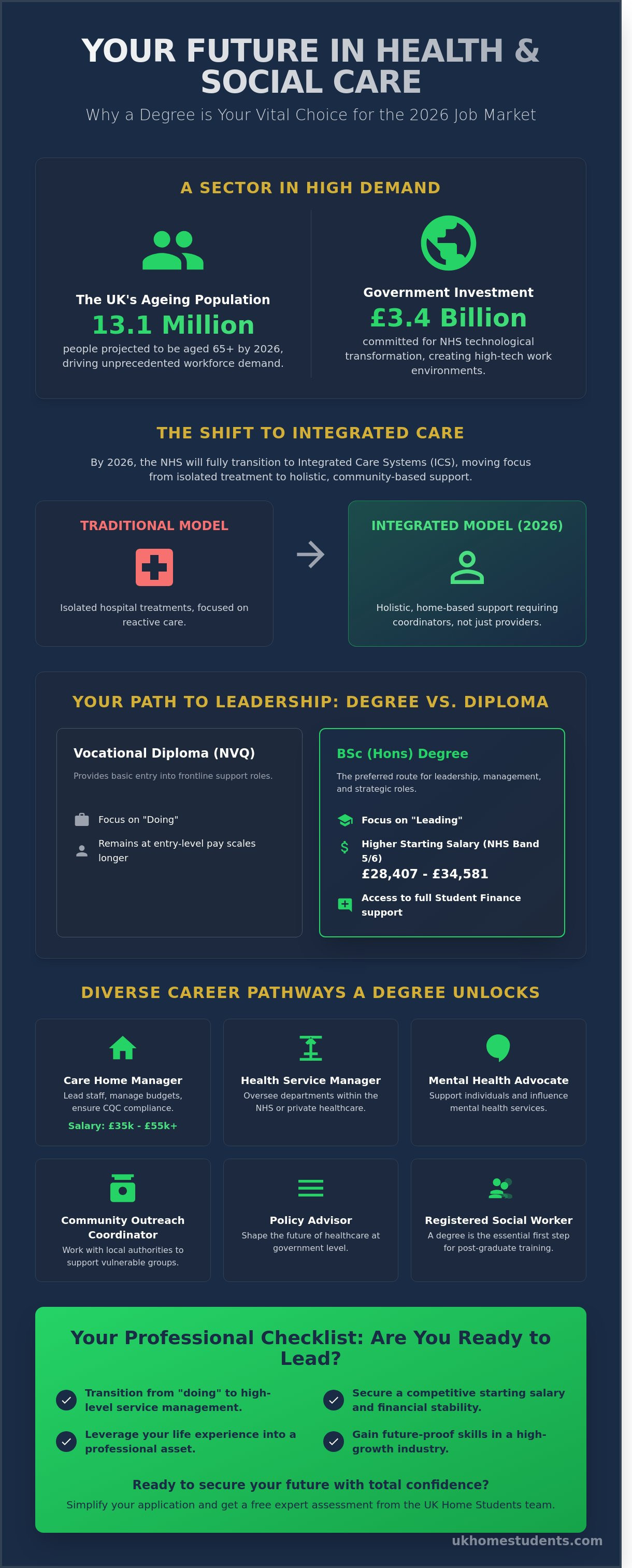
Health and social care is a multi-disciplinary professional field that combines clinical knowledge with community-based support systems. If you're looking for a career that offers both stability and a deep sense of purpose, understanding What is Health and Social Care? provides the necessary context for this expanding sector. By 2026, the UK's Office for National Statistics (ONS) projects that over 13.1 million people will be aged 65 or older. This demographic shift has transformed the sector into a vital pillar of the national economy. It's no longer just a tertiary service; it's a high-growth industry requiring a massive influx of skilled professionals.
One of the primary reasons to study health and social care is the rapid shift toward integrated community models. By 2026, the NHS and local councils will have fully transitioned to Integrated Care Systems (ICS). This moves the focus away from isolated hospital treatments toward holistic, home-based support. This evolution requires a new generation of practitioners who can manage complex cases across various departments. You won't just be a care provider; you'll be a coordinator in a sophisticated network of professionals.
The Evolving UK Healthcare Landscape
The modern sector relies heavily on digital health and social prescribing. If you enter the workforce in 2026, you'll use data-driven tools to monitor patient outcomes and coordinate with multidisciplinary teams. The government's recent fiscal commitments include £3.4 billion for NHS technological transformation, ensuring that future practitioners work in high-tech environments. A degree prepares you to lead these teams. You'll learn to navigate the bureaucracy of the Care Quality Commission (CQC) and deliver care that meets strict 2026 regulatory standards. This academic grounding ensures you're ready for the "inside track" of modern healthcare management.
Academic vs. Vocational Paths
While Level 3 NVQs provide basic entry, a BSc (Hons) degree is now the preferred route for leadership roles. If you want to secure a Band 5 or 6 position within the NHS, an academic qualification is essential. Graduates often start with salaries between £28,407 and £34,581, whereas vocational diploma holders often remain at entry-level pay scales for longer periods. If you qualify for Home Student status, you can access the full range of Student Finance England support. This includes tuition fee grants and maintenance loans to cover your living costs. Securing your place as a Home Student gives you a competitive advantage. It allows you to maximize your funding and focus on professional development. This financial security, combined with the academic depth of a degree, makes it the most logical choice for your future career.
Diverse Career Pathways Beyond Traditional Care
A common misconception is that this qualification limits you to residential care work. This couldn't be further from the truth. One of the primary reasons to study health and social care is the sheer breadth of professional environments you can enter. You'll gain a versatile toolkit that applies to schools, prisons, government offices, and corporate boardrooms. By understanding the legal and ethical frameworks of the UK care system, you position yourself as a candidate for roles that require both empathy and strategic oversight. Many students cite this professional versatility as one of their top reasons to study health and social care when planning their long-term progression.
The degree acts as a springboard into specialised fields. You might choose to focus on mental health advocacy or community outreach, where you'll coordinate with local authorities to support vulnerable populations. If you aim to become a registered social worker or a therapist, this undergraduate foundation is often the essential first step required for post-graduate training and registration with bodies like Social Work England. Exploring the various career pathways with a health and social care degree reveals that graduates are increasingly moving into policy-making roles to address the long-term challenges facing the NHS.
Leadership and Management Roles
The sector currently faces a significant demand for skilled leaders. As a Care Home Manager or Service Lead, you won't just oversee daily operations; you'll manage budgets, lead staff teams, and ensure compliance with Care Quality Commission (CQC) standards. Salaries for these positions often range from £35,000 to over £55,000 for senior roles in private healthcare groups. If you prefer a broader impact, NHS commissioning involves planning and buying health services for entire regions. Public health project managers are also in high demand, with many local councils seeking experts to lead vaccination programmes or obesity reduction strategies. If you're ready to take the next step, you can secure your future by speaking with a consultant about your application.
Specialist Advocacy and Support
Beyond management, there's a vital need for specialist support roles that bridge the gap between healthcare and social justice. Family support officers and youth workers play a critical role in early intervention, often preventing crises before they escalate. You could also find yourself working in rehabilitation as an occupational therapy assistant, helping patients regain independence after surgery. The field of housing advocacy and domestic violence support has seen a 7% rise in workforce requirements since 2022. These roles require the deep understanding of safeguarding and legislation that you'll master during your studies. This variety ensures your career remains dynamic and aligned with your personal values.
The Financial and Personal Rewards of the Degree
If you are looking to secure a career that offers both competitive pay and deep personal meaning, this degree is a premier choice. Graduates entering the NHS on the Agenda for Change pay scale typically start at Band 5. As of late 2024, this entry-level salary begins at £28,407, with guaranteed annual increments as you gain experience. By 2026, these figures are expected to increase following standard public sector pay reviews. This financial trajectory provides a clear path toward home ownership and long-term stability for many UK students.
The "social wage" is equally vital. You'll work on the front lines of community wellbeing, which fosters a level of emotional intelligence that 71% of hiring managers now value more than IQ, according to research from CareerBuilder. This profound sense of purpose is one of the most significant reasons to study health and social care. It's a career where your daily efforts directly improve the lives of vulnerable individuals, providing a level of job satisfaction that few office-based roles can match.
Stability and Job Security
The health sector is famously resilient during economic fluctuations. While private industries often face redundancies during a recession, the demand for care services in the UK remains constant. Data from Skills for Care indicates there are currently over 152,000 vacancies across the adult social care sector in England alone. You'll find that roles are available in every region of the UK, from major cities to rural communities. This geographic flexibility is paired with a clear progression ladder. You can move from a graduate practitioner to a specialist lead or a commissioning executive, where salaries often exceed £60,000.
Transferable Professional Skills
Your degree provides a versatile toolkit that extends far beyond clinical or care settings. You'll develop high-level competencies that are essential in the modern workforce:
- Crisis Management: The ability to remain calm and effective under extreme pressure.
- Legislation Awareness: A deep understanding of the Care Act 2014 and mental capacity regulations.
- Empathy and Communication: Mastering the art of navigating complex human emotions and sensitive conflicts.
These skills are highly prized in human resources, corporate management, and legal sectors. The confidence you gain through university-level critical thinking ensures you can lead teams and manage budgets effectively. If you decide to transition into a different industry later, your background in safeguarding and person-centred care will distinguish you as a candidate with exceptional integrity and resilience.
Your Decision Checklist: 5 Reasons to Study Health and Social Care
Choosing to return to education is a significant milestone that requires a clear understanding of the professional landscape. If you are weighing up your options for 2026, these five factors highlight the primary reasons to study health and social care and how they align with the current UK job market.
- Guaranteed Longevity: The sector is expanding at an unprecedented rate. Skills for Care reported in late 2023 that the adult social care workforce needs to grow by 25 percent by 2035 to meet demand. This equates to roughly 480,000 new posts.
- Transition to Leadership: If you are currently working in an entry-level role, a degree is your bridge from "doing" to "leading." It provides the credentials required for Registered Manager status, where salaries often exceed £35,000 per year.
- Flexible Working Environments: The 24/7 nature of the sector allows for diverse shift patterns. If you need to work around childcare or other commitments, the variety of roles in community centres, hospitals, and private clinics offers flexibility that traditional office roles cannot match.
- Formalising Life Experience: Many mature students have spent years providing unpaid care for family members. A degree allows you to transform that lived experience into a professional qualification recognised by the Care Quality Commission (CQC).
- Access to UK Funding: If you meet the criteria for UK Home Student status, you can secure a tuition fee loan of £9,250 per year. You may also qualify for a maintenance loan of up to £13,022 to support your living costs while you study.
Assessing Your Personal Fit
Before you apply, you must reflect on your emotional resilience. Do you remain calm under pressure? Can you adapt your communication style to support vulnerable individuals? If you find yourself gravitating toward strategic planning and team coordination, a management-focused degree path is ideal. However, if you prefer direct patient interaction, you should look for courses with heavy placement components. Your long-term goals should dictate whether you pursue office-based oversight or frontline clinical support.
The Practicality of Full-Time Study
Many students fear that full-time study is incompatible with family life. In reality, many UK universities now offer "compressed" timetables. This often means you only need to be on campus two days a week. If you have been out of the classroom for a long time, a foundation year can bridge the gap. It provides the academic groundwork needed to succeed at Level 4 and beyond. Use this quick checklist to gauge your readiness:
- Can you dedicate 15 to 20 hours a week to independent research and writing?
- Have you confirmed your residency status to ensure you qualify for Home fee rates?
- Do you have a reliable support network to assist with domestic responsibilities during exam periods?
If you are ready to secure your place and maximise your funding, you can start your expert assessment today to find the right path for your career.
Securing Your Place: How UK Home Students Supports Your Journey
Choosing your career path is a significant decision. One of the compelling reasons to study health and social care is the long-term job security it offers in the 2026 UK labour market. At UK Home Students, we provide a free expert assessment to ensure you meet the specific eligibility criteria for your chosen course. We act as your professional advocate, simplifying the often complex UCAS and university application process. Our team removes the administrative burden, allowing you to focus on your future career.
We specialise in identifying the most flexible degree programmes available. If you have family commitments or a part-time job, we find universities that offer blended learning or schedules that fit your life. Our commitment is to empower UK students through education, turning academic goals into achievable realities. We provide the "inside track" on which institutions offer the best support for home students, ensuring you aren't just another number in the system.
Navigating Student Finance and Funding
Funding your education is often the biggest concern for new applicants. If you meet the residency requirements, you can access the UK student maintenance loan to help with your day-to-day living costs. Beyond loans, many health-related courses qualify for additional grants, such as the NHS Learning Support Fund, which provides at least £5,000 per year in non-repayable support. You must track the student finance deadline for 2026, typically in mid-May, to ensure your money is ready for the September start.
Start Your Application Today
Your journey begins with a simple, three-step process. First, you'll have a consultation to discuss your career goals. Second, we'll help you gather your documents and evidence. Third, we'll submit your application to the university that best suits your needs. If you've been out of education for a while or lack traditional A-levels, a foundation year university course is an excellent option. This entry year provides the academic grounding you need to succeed in a full degree programme.
- Expert Assessment: We verify your "Home Student" status for funding.
- UCAS Support: We guide you through every section of the application.
- Flexible Options: We find courses that respect your work-life balance.
Don't let the bureaucracy of higher education hold you back from a rewarding career. There are many reasons to study health and social care, but the most important one is your own professional growth. Contact UK Home Students for a free assessment and let our consultants secure your place for the 2026 academic year.
Launch Your Health and Social Care Career Today
The 2026 job market demands skilled professionals. With the adult social care sector currently contributing £60 billion to the UK economy, the financial and personal rewards are substantial. You aren't just choosing a job; you're entering a field with over 150,000 current vacancies across the NHS and private sectors. These compelling reasons to study health and social care highlight a path toward stability and a starting salary that often exceeds £26,000 for qualified practitioners. If you're a mature student, you don't have to navigate the complex UCAS application or Student Finance England rules alone. Our team maintains a 98% success rate in securing university placements and tuition fee grants for UK home students. We provide specialised guidance on flexible degree programmes that fit around your existing family commitments. It's time to stop feeling overwhelmed by eligibility criteria and start focusing on your professional growth.
Secure your future in Health and Social Care with a free expert assessment from UK Home Students.
Your journey toward a meaningful career is achievable with the right support behind you.
Frequently Asked Questions
Is Health and Social Care a good degree to get in the UK?
Yes, it's an excellent degree choice because the UK health sector currently faces a workforce gap of 152,000 vacancies according to 2024 Skills for Care data. One of the primary reasons to study health and social care is the exceptional job security it provides. You'll enter a stable profession where your skills are in high demand across both the NHS and private sectors.
What jobs can I get with a Health and Social Care degree?
You can secure roles such as a Care Manager, Community Support Officer, Health Service Manager, or Charity Officer. The NHS employs over 1.5 million people, and many of these positions are non-clinical roles that require the specific leadership and policy knowledge gained during your studies. You'll also be qualified for positions in local government and housing associations.
Can I study Health and Social Care without A-levels?
Yes, you don't need traditional A-levels if you hold an Access to Higher Education Diploma or a BTEC Level 3 qualification. Most universities accept between 48 and 112 UCAS points from these alternative routes. If you're a mature student over 21, your relevant work experience in a care setting can often be used to secure a place through an individual assessment.
How much can I earn after graduating in Health and Social Care?
You can expect a starting salary between £23,000 and £28,000 depending on your specific role and location. Graduate outcomes data from HESA shows that those moving into health service management can see their earnings rise to over £45,000 within five years of graduating. Senior commissioning roles or private care home management often offer even higher packages exceeding £55,000.
Is a Health and Social Care degree harder than a diploma?
A degree is more academically rigorous because it's a Level 6 qualification that requires 360 credits of study, whereas most diplomas are Level 3 or 5. While a diploma focuses on practical tasks, a degree requires you to perform critical analysis and conduct independent research. It's designed to prepare you for management and strategic roles rather than just frontline care work.
Can I get a maintenance loan for a Health and Social Care course?
You're eligible to apply for a maintenance loan if you meet the standard Student Finance England residency criteria for home students. For the 2024/25 academic year, students living away from home in London can receive up to £13,348 to help with their living costs. This funding is paid directly into your bank account in three instalments to help you manage your budget throughout the year.
What happens if I want to switch to Nursing later?
You can transition into nursing by completing a two-year accelerated Masters (MSc) in Nursing after you graduate. This pre-registration route recognizes your previous degree, allowing you to qualify as a Registered Nurse faster than the standard three-year undergraduate path. It's a brilliant way to build a foundation in social policy before moving into a clinical clinical specialism.
How long does a BSc (Hons) in Health and Social Care take?
A standard BSc (Hons) degree takes three years to complete when you study full-time. If you need more flexibility, part-time programmes typically last between four and six years. Some universities also offer an accelerated two-year version or a "top-up" year if you already hold a Level 5 Foundation Degree or an HND in a related subject.