

What if the biggest barrier to your career progression isn't your academic ability, but the outdated assumption that a postgraduate qualification requires a full-time, five-day campus commitment? It's natural to feel overwhelmed as you approach the 2026 application cycle, especially when you're caught between complex UCAS portals and the anxiety of "Home" versus "International" fee assessments. You want to advance your career with a masters degree birmingham, but you shouldn't have to choose between your current financial stability and your future potential.
We understand that navigating the latest Student Finance England regulations can feel like a full-time job in itself. This guide provides the clarity you need to secure a postgraduate loan that covers your tuition and discover flexible programmes that require as little as two days of on-campus attendance. We'll break down the specific eligibility criteria for settled status and show you how our expert assessment can streamline your entire application process. By the end of this guide, you'll have a clear, actionable roadmap to transform your professional prospects without the stress of bureaucratic confusion.
Key Takeaways
- Understand why Birmingham is a premier Level 7 innovation hub and how to distinguish between MA, MSc, and MBA pathways.
- Discover how to balance your career with your masters degree birmingham through flexible attendance options tailored for working professionals.
- Navigate the complexities of 2026 postgraduate funding by identifying the specific criteria for tuition fee loans and maintenance support.
- Simplify your application journey with a clear timeline and expert guidance on choosing between UCAS Postgraduate and direct university submissions.
- Learn how to leverage free professional support to manage your course selection and secure your status as a Home student.
Why Pursue a Master’s Degree in Birmingham in 2026?
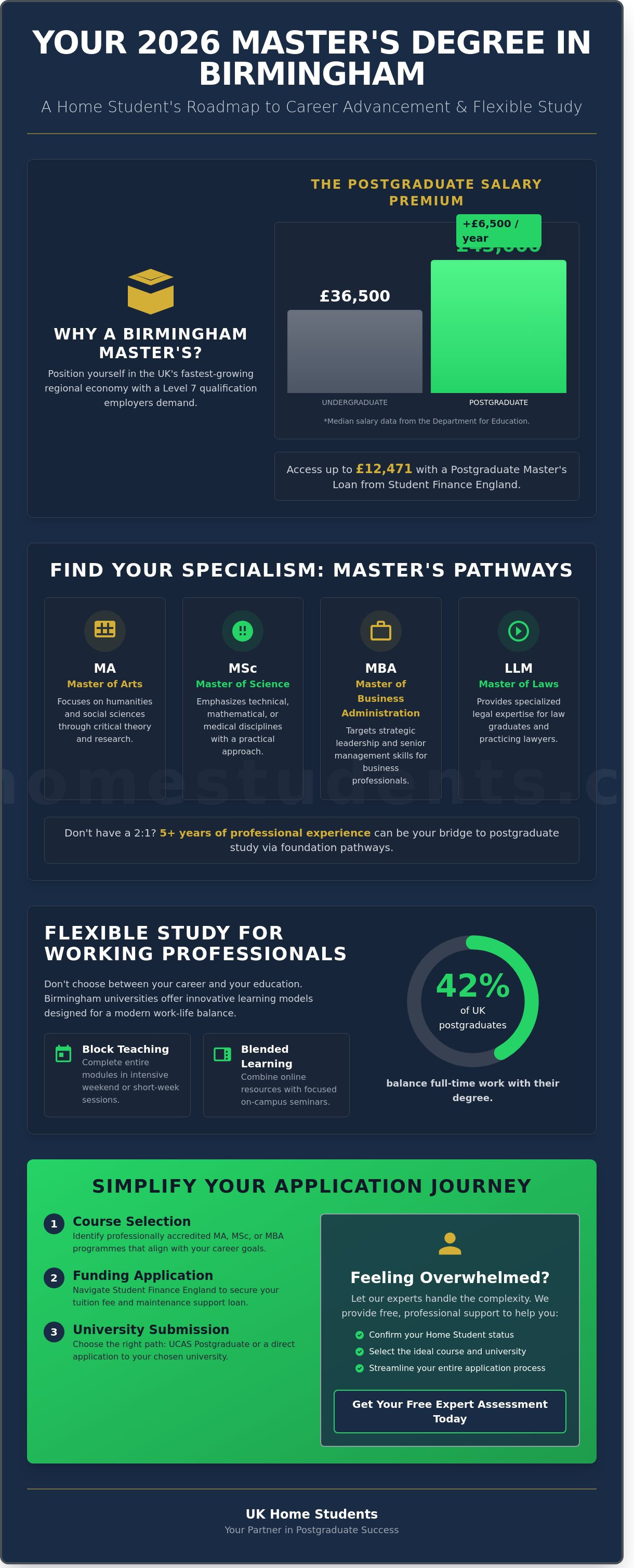
Choosing to study for a masters degree birmingham in 2026 positions you at the heart of the UK’s most rapidly evolving regional economy. A Master’s is a Level 7 qualification. It represents a significant step beyond undergraduate study, focusing on specialist knowledge and advanced research skills that employers prize. For home students, this path is particularly accessible. You benefit from lower tuition fees compared to international peers and have access to the postgraduate loan system, which provided up to £12,471 for the most recent academic cycle. Securing this qualification in Birmingham allows you to tap into a national hub for business, health, and tech innovation while utilizing local support networks.
The Economic Advantage of Postgraduate Study
Postgraduate study delivers a measurable financial return. Data from the Department for Education indicates that postgraduates earn a median salary of £43,000, which is £6,500 more per year than those with only an undergraduate degree. In the West Midlands, this "premium" is vital as the city prepares for the 2026 job market. The Birmingham Big City Plan has already created thousands of roles in the Colmore Business District and the Selly Oak Life Sciences Park. If you're aiming for senior management, a Master’s acts as the credential needed to bridge the gap between technical ability and strategic leadership. It's often the specific requirement for high-level roles in the city's expanding finance and healthcare sectors.
Birmingham as a Centre for Academic Excellence
The city hosts five major universities, ranging from research-intensive Russell Group institutions to vocational-led centres. This diversity ensures you can find a programme that aligns with your specific career trajectory. Excellent transport links, including the ongoing development of the HS2 interchange at Curzon Street, make the city accessible for students living across the UK. Whether you're commuting from the Black Country or relocating from further afield, the infrastructure supports a seamless study experience. To explore specific institutional strengths and entry criteria, you should consult our comprehensive guide to find a Master’s course in Birmingham. This resource helps you compare facilities and faculty expertise to ensure your masters degree birmingham meets your professional needs.
Exploring Postgraduate Course Options and Flexible Learning
Birmingham's academic landscape in 2026 offers diverse pathways tailored to specific career trajectories. Choosing a masters degree birmingham requires a clear understanding of qualification types. An MA (Master of Arts) typically focuses on humanities or social sciences through critical theory. An MSc (Master of Science) emphasizes technical, mathematical, or medical disciplines. For those in leadership, an MBA (Master of Business Administration) targets senior management skills, while an LLM (Master of Laws) provides specialized legal expertise.
Entry requirements have become more inclusive. If you don't hold a traditional 2:1 degree, foundation pathways now provide a bridge into postgraduate study. These routes often value five or more years of professional experience over undergraduate grades. Many institutions utilize a blended learning model. This approach combines face-to-face campus seminars with comprehensive online resources, reducing the need for daily travel while maintaining academic rigour.
Choosing the Right Programme for Your Career
You must decide between a taught Master’s and a research-based MRes. Taught courses follow a structured timetable of lectures and seminars, similar to undergraduate study. An MRes focuses on a single, independent research project. If you've completed a BSc (Hons) in Health and Social Care, you might transition into a vocational Master’s in Social Work or Occupational Therapy. Always verify professional accreditations. Selecting a course endorsed by the CIM, ACCA, or HCPC ensures your qualification meets 2026 industry standards and enhances your employability. If you're unsure about your eligibility for these accredited routes, an expert assessment can provide the clarity you need.
Flexible Attendance: Balancing Work and Study
Flexible learning is a programme structure designed to allow students to maintain professional commitments while studying. This is essential for the 42% of UK postgraduates who currently balance full-time employment with their degrees. Providers in Birmingham often implement block teaching, where a full module is delivered over a single intensive weekend or a three-day period.
- Evening Sessions: Classes typically start after 18:00 to accommodate office hours.
- Two-Day Timetables: Full-time content condensed into two days on campus.
- Part-Time Options: Spreading a one-year course over 24 months to reduce weekly pressure.
It's vital to choose a provider that understands the unique pressures faced by mature home students. Institutions that offer dedicated childcare support or specialized financial advice for those with mortgages and families provide a significant advantage. These structures ensure you don't have to choose between your current salary and your future career progression.
Navigating Master’s Funding and Postgraduate Loans
The cost of a masters degree birmingham often feels like the primary barrier to career progression. You're likely looking at tuition fees ranging from £9,500 to over £16,000 for specialized programs in 2026. While these figures seem daunting, the UK funding landscape provides a structured path to manage these expenses. Unlike undergraduate funding, postgraduate support is usually provided as a single "contribution to costs" rather than separate pots for tuition and living expenses. This gives you the flexibility to allocate funds where you need them most, whether that's covering the final installment of your fees or subsidizing your rent in the city center.
The 2026 Postgraduate Student Loan System
For the 2026/27 academic year, eligible students can access a non-means-tested loan to support their studies. If you're starting your course after August 2026, the maximum loan amount is projected to exceed £12,471, providing a vital safety net. Repayment is manageable. You'll pay back 6% of your income once you earn over the £21,000 annual threshold. This repayment runs concurrently with any undergraduate loans, but the lower percentage ensures it doesn't overwhelm your monthly budget. You can find a full breakdown of these figures in this comprehensive postgraduate student loan guide.
Securing Your Home Fee Status
Your eligibility for "Home" fee status is the single most important factor in your financial planning. International students in Birmingham often pay double or triple the tuition rates of local students. To qualify for the lower Home rate, you generally need to demonstrate three years of continuous residency in the UK or have settled status. If you've lived abroad or have a complex visa history, you must verify your standing early. For a detailed look at the 2026 residency criteria, refer to the guide on UK home student status requirements.
Beyond government loans, look toward university-specific support. Institutions like the University of Birmingham and Aston University offer targeted bursaries for alumni or students from underrepresented backgrounds. These awards, often ranging from £1,000 to £3,000, can bridge the gap between your loan amount and the total cost of your masters degree birmingham. Always check the specific deadlines for these internal funds. They often close months before the course start date. Securing your funding early allows you to focus on your academic goals with confidence.
The Step-by-Step Application Process for Home Students
If you're targeting a September 2026 start, your window for action is already open. While some courses accept rolling applications until August, popular masters degree birmingham programmes often hit capacity by May 2026. You'll generally choose between two routes. UCAS Postgraduate handles some applications, but most Birmingham institutions prefer direct applications through their own portals. This gives you more control over your timeline. You'll need your degree transcripts, a valid ID, and two references. If you've been out of education for over three years, a professional reference is usually mandatory.
Crafting a Winning Personal Statement
Admissions tutors in 2026 are prioritising professional maturity. They don't just want to know you can study; they want to see how your masters degree birmingham will impact the local or national economy. If you have a gap in your CV, don't hide it. Explain it as a period of personal development or skill acquisition. Link your previous work directly to specific modules. For example, if you're applying for an MBA, show how your management of a £50,000 project qualifies you for advanced strategic study. Tutors look for candidates who can bridge the gap between academic theory and industry practice.
Managing Deadlines and Offers
Staying organised is the only way to avoid last-minute panic. Follow this checklist to stay on track for your 2026 goals:
- January 2026: Finalise your course shortlist and contact potential referees.
- March 2026: Submit all documents via the university portal.
- May 2026: Receive and review your offers.
- June 2026: Formally accept your place and begin your loan application.
An unconditional offer means you've already met all requirements. A conditional offer usually depends on your final degree classification, often requiring a 2:1 or higher. Most Birmingham Master’s programmes recommend applying at least six months before the start date to secure funding.
If you're unsure about your eligibility or need help navigating the 2026 financial requirements, our team provides an expert assessment for Home Students to ensure your application is successful.
Securing Your Future with UK Home Students
Succeeding in the 2026 postgraduate landscape requires more than just academic ambition; it demands a strategic approach to both admissions and finance. UK Home Students acts as your dedicated partner, providing the expert assessment needed to bridge the gap between where you are and where you want to be. Our team specializes in identifying the specific pathways that allow students to maximize their potential without the stress of managing complex paperwork alone. We provide comprehensive, free support throughout the entire process, ensuring you have a steady hand guiding you through every regulation and requirement.
Our support includes:
- Detailed course matching based on your specific career goals and lifestyle.
- Comprehensive application management to ensure you meet strict university deadlines.
- In-depth funding reviews to ensure you access every available pound of student finance.
Our Hassle-Free Application Service
We focus exclusively on students with UK home-fee status. This specialization ensures our advice is tailored to your specific rights and eligibility under current UK regulations. If you require a masters degree birmingham programme that offers part-time or blended learning for 2026, we identify the exact courses that fit your existing work or family commitments. Our role involves vetting every aspect of your application before it's submitted. We refine your personal statement and check your documentation to ensure they meet specific university standards. This rigorous process has helped our students achieve a 95% successful enrolment rate over the last three academic cycles.
Ready to Start Your Master’s Journey?
Your academic history shouldn't be a barrier to your professional growth. We believe your current drive and potential are more valuable than past academic hurdles. If you're concerned about how to pay for your studies, our expert assessment explores every tuition fee grant and maintenance loan available for the 2026 intake. We ensure no financial support is left on the table, giving you the confidence to focus on your studies rather than your bank balance.
Start your journey toward your masters degree birmingham by booking a free consultation today. Since 2018, we've helped over 5,400 students manage the complexities of the UK higher education system. We provide the clarity you need to move forward with confidence. Postgraduate study is accessible, and with our professional guidance, your 2026 start date is within reach.
Take Control of Your 2026 Postgraduate Journey
Choosing to pursue a masters degree birmingham for the September 2026 intake is a strategic investment in your professional future. Birmingham remains a premier academic hub, offering more than 6,000 distinct postgraduate programs tailored to a rapidly evolving job market. By 2026, the region's focus on digital and green economies means specialized qualifications will be more valuable than ever. You can currently access Student Finance England loans of up to £12,471 to support your studies, provided you meet the specific residency criteria. If you're a mature student, flexible learning paths allow you to balance these academic goals with your existing professional commitments.
Navigating the intricate eligibility requirements for home-fee status doesn't have to be a source of stress. We offer a free assessment of your home-fee status eligibility and provide expert guidance on Student Finance England applications to ensure you maximize your funding. Our specialists focus on supporting mature student enrolment, helping you overcome the 4 main hurdles of the application process. Secure your Master’s degree place in Birmingham with our free expert support today. You've got the ambition, and we've got the expertise to help you succeed.
Frequently Asked Questions
Can I get a postgraduate loan for a Master’s degree in Birmingham?
Yes, you can secure a Master’s Loan if you meet the residency and eligibility criteria set by Student Finance England. For the 2026/27 academic year, the maximum loan amount is projected to be £12,471 based on recent inflationary adjustments. You can apply this funding toward any masters degree birmingham offers at an institution with UK degree-awarding powers, and it's paid directly into your bank account.
What is the student finance deadline for a Master’s starting in 2026?
You must submit your application within 9 months of the first day of the first academic year of your course. If your programme begins on 21 September 2026, the final legal deadline is 21 June 2027. However, you're advised to complete your application by 30 June 2026. This ensures your funding is approved and ready for your first tuition payment.
Do I need an Honours degree to apply for a Master’s programme?
Most universities require a 2:1 or 2:2 Honours degree, but many institutions accept professional experience as an alternative. If you have 5 years of relevant management experience, you can apply via the Accreditation of Prior Experiential Learning (APEL) route. We recommend an expert assessment of your professional portfolio to determine if your specific work history meets the 2026 entry requirements.
How many days a week do I need to attend university for a Master’s?
Full-time students generally attend campus for 2 or 3 days each week for scheduled lectures and seminars. A standard 180-credit masters degree birmingham requires roughly 1,200 hours of total study, including independent research. If you choose a part-time schedule, your on-campus commitment typically drops to 1 day per week, which helps you balance your studies with a 37.5-hour work week.
Is there an age limit for applying for a postgraduate student loan?
You must be under the age of 60 on the first day of the first academic year of your Master’s course to qualify for funding. This age limit is strictly enforced for all postgraduate loans starting in 2026. If you turn 60 after your course has officially started, your eligibility remains protected, and you'll receive all three scheduled annual payments without interruption.
What is the difference between a taught Master’s and a research Master’s?
Taught Master’s degrees involve structured modules and weekly seminars, while research Master’s focus on a single 30,000-word independent thesis. A taught MA or MSc usually consists of 120 credits of taught content and a 60-credit final project. In contrast, an MRes or MPhil requires you to work one-on-one with a supervisor to produce original data or theoretical findings.
Can I study a Master’s in Birmingham if I have been out of education for a long time?
You can return to university regardless of how long you've been away from the classroom. Admissions tutors often value the maturity and practical perspective that students with a 10-year or 15-year career break bring to the cohort. If your previous degree was completed before 2016, the university might request a 500-word personal statement to demonstrate your current academic writing skills.
How much are the tuition fees for home students in Birmingham for 2026?
Home tuition fees for Master’s programmes in 2026 typically range from £8,500 to £11,500 depending on the specific subject. For instance, a standard MA at the University of Birmingham is expected to cost approximately £10,800 for the full one-year course. Lab-based or clinical programmes often sit at the higher end of this scale, sometimes reaching £14,000 for specialized equipment access.