

What if the only thing standing between you and a career-defining Master’s degree is a simple misunderstanding of your "settled status"? For the 2026/27 academic year, securing a postgraduate student loan of up to £12,471 requires more than just an offer letter; it demands a precise grasp of residency and eligibility rules. You probably agree that the current Student Finance system feels like a maze of Plan 3 repayment thresholds and "Home Student" criteria that change just when you think you've mastered them. The fear that the debt might outweigh your career ROI is real. This is especially true when you're trying to figure out if a part-time course even qualifies for support.
We believe that funding your future should be a source of empowerment, not anxiety. You don't have to face the bureaucracy alone. This guide provides a clear roadmap to help you handle the 2026 application process with total confidence. You'll learn exactly how to qualify for the maximum available funds, how the 6% repayment rate above the £21,000 threshold affects your take-home pay, and how to select a flexible programme that fits the loan structure perfectly.
Key Takeaways
- Understand the critical shift from the undergraduate "Tuition + Maintenance" model to the postgraduate "Single Pot" system to better manage your study costs.
- Determine your eligibility by navigating the three-year residency rule and age restrictions to ensure you qualify for a postgraduate student loan in 2026.
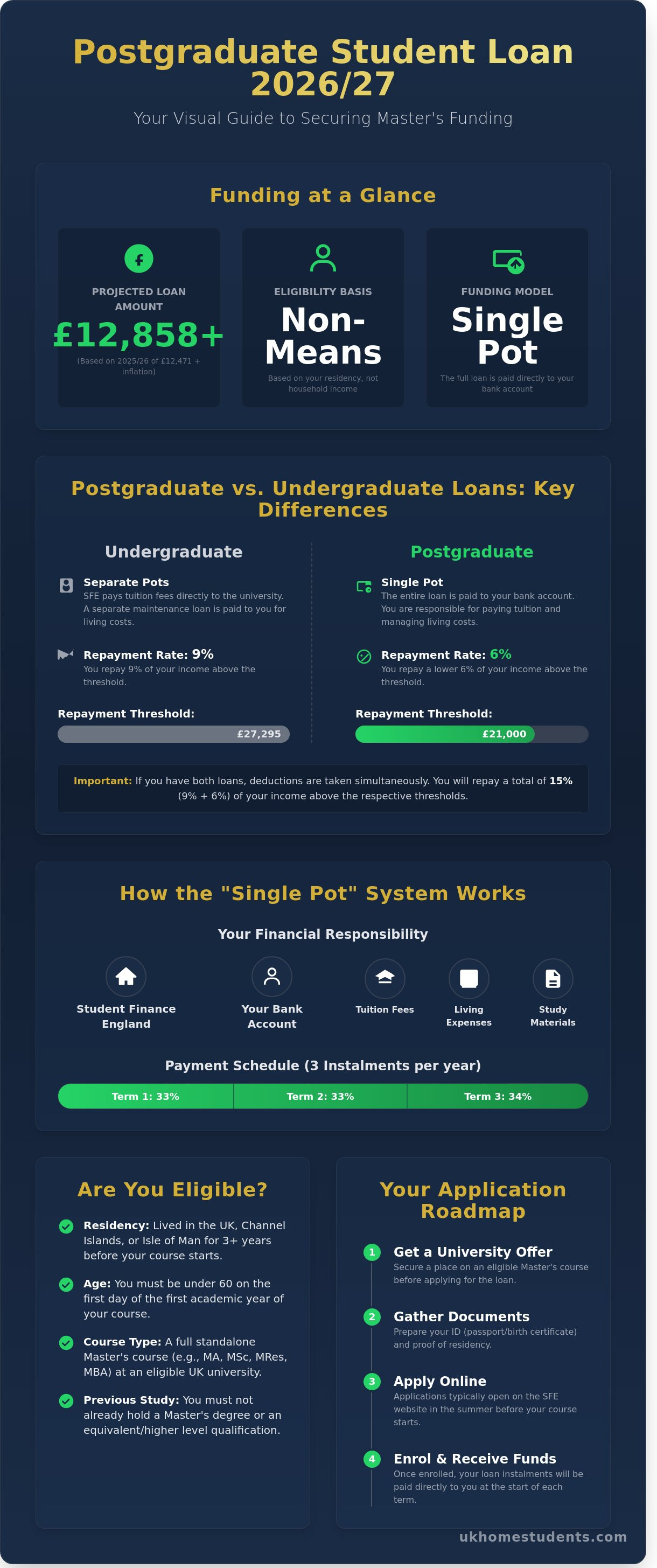
- Gain clarity on the projected £12,858+ funding amount and the three-instalment payment schedule to plan your academic budget with confidence.
- Follow a streamlined application roadmap to gather essential evidence and secure your funding without unnecessary delays or administrative hurdles.
- Discover how flexible Master’s programmes in high-growth sectors like Health and Business can help you balance professional commitments while maximising your degree's ROI.
What is the Postgraduate Student Loan in 2026?
If you're planning to start a Master's programme in 2026, the postgraduate student loan serves as your primary financial gateway. Managed by Student Finance England (SFE), this loan is designed as a "contribution to costs" rather than a full subsidy for your education. It provides a vital lifeline for students who have already completed their initial degrees and want to specialise further. Unlike the undergraduate UK student loan system, which often covers the entirety of tuition and provides a separate maintenance sum, the postgraduate version is a capped amount. For the 2025/26 academic year, this figure is set at £12,471, and we expect a similar or slightly adjusted figure for the 2026 intake based on inflationary trends.
A defining feature of this funding is that it's entirely non-means tested. Your eligibility doesn't depend on your household income or your parents' financial status. If you meet the residency requirements, such as living in the UK for at least three years before your course start date, you'll qualify for the full amount regardless of your bank balance. This creates a level playing field, ensuring that your professional progression depends on your academic merit rather than your family's wealth. SFE oversees the application process, which typically opens in the summer before your course begins, allowing you to secure your funding well before your first lecture.
The "Single Pot" Funding Model Explained
The "Single Pot" system is a major departure from what you likely experienced during your undergraduate years. Instead of SFE paying your university directly for tuition, they'll pay the entire postgraduate student loan directly into your UK bank account. These payments arrive in three instalments per year, usually split 33%, 33%, and 34%, aligned with the start of each term. This model places the financial responsibility firmly in your hands. You'll need to manage the following priorities:
- Tuition Fees: You're responsible for paying the university yourself using the loan instalments.
- Living Expenses: Any money left over after tuition can be used for rent, food, or travel.
- Study Materials: You can allocate funds specifically for textbooks, software, or research trips.
This structure gives you the freedom to organise your finances based on your specific professional needs. If you've secured a scholarship that covers your tuition, you can use the entire loan to support your living costs. Conversely, if your course is exceptionally expensive, you might choose to use the entire pot for fees and find part-time work to cover your rent. It's a flexible system that respects your status as an adult learner.
Postgraduate vs. Undergraduate: The Crucial Distinctions
You'll find that the rules for postgraduate funding are stricter and more streamlined than the undergraduate Plan 2 or Plan 5 systems. There are no separate maintenance grants available for the majority of Master's students in England. You won't receive extra help for being from a low-income background, which makes budgeting essential from day one. The Postgraduate Master’s Loan is a fixed contribution rather than a full-cost coverage.
Repayment also follows a different logic. You'll start repaying your loan once you earn over £21,000 per year, which is a lower threshold than the £24,990 or £27,295 seen in undergraduate plans. The repayment rate is 6% of your income above that threshold. If you're still repaying an undergraduate loan, these deductions happen simultaneously, meaning a total of 15% of your income above the respective thresholds will go toward debt clearance. Understanding these figures now ensures you won't face surprises when you enter the professional workforce after graduation.
Eligibility Criteria: Who Qualifies as a Home Student?
If you're looking to secure a Postgraduate Master's Loan, your residency status is the first hurdle you'll need to clear. You must have lived in the UK, the Channel Islands, or the Isle of Man for three full years before the first day of your academic year. This isn't just about being present; it's about being "ordinarily resident," meaning your stay wasn't solely for the purpose of receiving full-time education. If you've spent significant time abroad for work or travel, you'll need to provide evidence that the UK remained your permanent home during that period.
Age plays a strict role in the application process. You must be under 60 on the first day of the first academic year of your course to qualify for funding. If you turn 60 during your studies, your funding continues, but starting a course at 60 or older disqualifies you from this specific government support. Additionally, this loan is strictly for your first Master’s level qualification. If you already hold an MA, MSc, or a higher degree like a PhD, you won't qualify for the postgraduate student loan, even if your previous degree was self-funded or completed abroad.
Your nationality dictates your path to "Home" status. British citizens and those with "settled status," which means there's no time limit on how long you can stay in the UK, are generally eligible. Following the UK's exit from the EU, the rules for European nationals have changed. You must typically have settled or pre-settled status under the EU Settlement Scheme, or be an EU national protected by the Withdrawal Agreement, to access the same funding rates as UK nationals.
Course and University Requirements
Not every course qualifies for government funding. You can secure a postgraduate student loan for a standalone Master’s degree such as an MSc, MA, MBA, LLB, or MRes. However, the university must hold "degree-awarding powers" or operate through a validated partnership with a recognised UK institution. Your course can be full-time, lasting one or two years, or part-time. If you choose part-time, it must be completed in no more than four years to remain eligible for the full loan amount.
The "Home Status" Deep-Dive
Proving you're "ordinarily resident" can be complex if you've recently returned from living overseas. You'll need to demonstrate your ties to the country through documents like utility bills, bank statements, or employment records from the last 36 months. For students in Birmingham and across the West Midlands, local enrolment often involves specific checks to ensure you meet regional residency requirements. This is particularly relevant if you're applying for local bursaries that supplement your national loan.
Navigating these regulations feels daunting, especially when a mistake can delay your studies. If you're unsure where you stand, our team can provide an expert assessment of your eligibility to ensure you don't miss out on vital funding. We specialise in identifying the nuances that separate "Home" and "International" status, helping you secure the best possible financial outcome for your future academic career.
Financial Breakdown: Loan Amounts and Repayment Rules
Securing a postgraduate student loan is the most common way for UK home students to cover their Master's costs. For the 2026/27 academic year, the maximum loan amount is estimated to reach £12,858 or more. This projection follows the inflationary trend seen in previous cycles, such as the rise to £12,471 in 2024/25. Unlike undergraduate funding, this money is paid directly to you. It's your responsibility to divide it between tuition fees and your daily living expenses. Student Finance England (SFE) releases these funds in three specific instalments: 33% at the start of term one, 33% at term two, and the final 34% at the beginning of term three. You should investigate other postgraduate funding options on the GOV.UK website to determine if you can supplement this loan with specific bursaries or research grants.
Interest starts building from the day your first payment hits your account. The rate is typically calculated as the Retail Price Index (RPI) plus 3%. While this accumulates during your studies, you don't start paying it back until the April after you graduate. Repayments only trigger once your annual income exceeds the £21,000 threshold. If your income drops below this figure at any point, your repayments stop automatically. This "Plan 3" system ensures that your debt remains manageable relative to your actual earnings.
Calculating Your Monthly Repayments
Your repayment rate is set at 6% of whatever you earn above the £21,000 limit. If you land a role with a £30,000 salary, you'll pay 6% on the £9,000 difference. This works out to £540 per year, which means a deduction of £45 from your monthly take-home pay. If you're still paying off an undergraduate loan, you must manage concurrent repayments. This means you'll have a Plan 2 or Plan 5 deduction and a postgraduate deduction taken from your salary at the same time. Your postgraduate debt is cancelled after 30 years regardless of the balance.
Managing the Three-Instalment Cycle
Strategic budgeting is vital because the gap between the second and third payments is often four months long. You'll receive your second instalment in January, but the third may not arrive until late April or May. To stay afloat, you must set aside a portion of your first two payments to cover this spring "dry spell." Most universities allow you to align your tuition fee payment plan with these SFE disbursement dates. If you request this, the university will usually collect fees shortly after your loan lands in your bank account.
You can also look for alternative funding to reduce your reliance on the loan. Over 3,500 UK charities provide small educational grants that can help with textbook costs or travel. If you're currently working, ask your HR department about employer sponsorship. Many firms will fund a portion of a Master's degree if the curriculum directly benefits your current role. Combining these small wins with your main loan provides a much sturdier financial foundation for your studies.
Application Roadmap: Securing Your Funding Without Delays
Navigating the bureaucracy of Student Finance England requires a methodical approach. To ensure your postgraduate student loan is approved before your tuition fees are due, you must follow a strict chronological path. This process begins long before you set foot on campus; it starts the moment you receive your offer letter. Thousands of students face delays every year because they treat the application as a last-minute task rather than a strategic priority.
- Step 1: Confirm Your Offer and Fee Status. You must have a firm offer from a UK university. Crucially, your institution must classify you as a "Home" student. If you're incorrectly tiered as "International," your loan application will be automatically rejected. Check your offer letter carefully for this distinction.
- Step 2: Gather Your Evidence. You'll need your valid UK passport, National Insurance number, and a comprehensive 3-year UK residence history. If you don't have a passport, you'll need to provide original documents like a birth certificate, which can take up to 6 weeks to process and return.
- Step 3: The Online Portal. Log into the Student Finance England website. If you've had a loan before, your details will be saved, but you must create a new application specifically for postgraduate funding. Ensure every digit of your bank details is accurate to avoid payment failure.
- Step 4: Proactive Monitoring. Once submitted, your application enters the "Requests for Evidence" phase. Check your account every 48 hours. SFE often requires additional proof of residency or identity, and delays in responding can push your payment date back by 20 to 30 working days.
When to Apply: The Early Bird Advantage
Timing is your greatest asset. For courses starting in September 2026, the application window typically opens in May or June 2026. You shouldn't wait for your final undergraduate results or a "confirmed" university place to start the process. You can apply using your preferred choice and update the course details later. While the official deadline is 9 months after the start of your academic year, applying this late forces you to self-fund your initial tuition instalments while you wait for government approval.
Common Pitfalls and How to Avoid Them
The "Previous Study" trap is the most frequent reason for application failure. If you've already achieved a Master's degree, or if you completed a 4-year Integrated Master's (such as an MEng or MSci) funded via undergraduate finance, you won't qualify for a new postgraduate student loan. The system is designed to fund one Master's level qualification only. Another common error involves residency dates. You must prove you were "ordinarily resident" in the UK for the full 3 years before 1 September of your starting year. Even small gaps in your address history or extended holidays can trigger an investigation. If you're unsure about your status, you should get a free eligibility check from UK Home Students today to avoid a mid-semester financial crisis.
Securing your funding is the final hurdle before your academic journey begins. By starting early and maintaining precise records, you can focus on your studies rather than your bank balance. Speak with an expert at UK Home Students to ensure your application is airtight from day one.
Maximising the ROI: Flexible Master’s Degrees for Professionals
Securing a postgraduate student loan is a strategic move that requires a clear plan for return on investment. For the 2024/25 academic year, the UK government provides up to £12,471 to eligible students. This sum isn't just a contribution toward tuition; it's the capital you need to pivot your career. To truly maximise this investment, you should look for programmes that respect your existing professional commitments. Flexible, two-day-a-week Master’s degrees have become the gold standard for working adults. They allow you to maintain a steady income while your qualification builds equity in your professional future.
Choosing the right sector is equally vital for ensuring your degree pays for itself. We focus on high-growth industries where the demand for leadership outstrips the supply of qualified candidates. These include:
- Health and Social Care: A sector requiring advanced clinical and administrative leadership.
- Business Management: Essential for navigating the post-Brexit economic landscape.
- Computing: Specifically data analytics and cybersecurity, where the skills gap remains a national priority.
Birmingham offers a distinct advantage for postgraduate study. The city has seen a 4.1% increase in professional job vacancies since late 2023, yet its cost of living remains significantly lower than London. This means your postgraduate student loan goes further, covering more of your lifestyle costs while you study at nationally accredited institutions. UK Home Students acts as your expert guide in this process. We bridge the gap between initial funding confusion and successful enrolment by providing a full assessment of your eligibility and matching you with courses that offer the best career trajectory.
Master of Business Management (MBA/MA)
For mature students in the West Midlands, an MBA or MA in Business Management is a powerful tool for climbing the corporate ladder. The regional economy contributes over £100 billion to the UK's GDP, and employers are actively seeking managers with Level 7 qualifications. Many of our recommended programmes integrate professional certifications, such as CMI or ILM diplomas, directly into the degree. This means your loan pays for two qualifications simultaneously. If you're ready to enhance your leadership credentials, you can Browse Postgraduate Courses in Birmingham to find a schedule that suits your life.
MSc Health and Social Care
The healthcare sector is currently managing a leadership vacuum, with over 150,000 vacancies reported across the NHS and private social care providers in 2023. An MSc in Health and Social Care prepares you for senior roles where salaries often exceed £45,000 per year. These programmes use flexible timetables to ensure you don't have to leave the front line to study. You'll gain expertise in clinical governance and strategic policy while remaining active in your field. This practical approach ensures that your academic growth is mirrored by your professional experience. To secure your funding and start your journey, Contact our Birmingham centre to start your application today.
Take the Next Step Toward Your 2026 Master’s Degree
Securing your academic future depends on navigating the strict eligibility criteria for Home Fee status. You must confirm you've lived in the UK for the three years preceding your course start date to access the full postgraduate student loan, which offers up to £12,471 for the 2025/26 cycle. Missing a single detail in your application can lead to significant delays or funding rejections. By choosing a flexible degree partner, you'll balance your professional life while managing repayments through the 6% income-contingent model once you earn over £21,000 per year.
Our Birmingham-based experts provide the clarity you need to bypass complex bureaucracy. We specialise in UK Home Fee status assessments and maintain direct partnerships with flexible degree providers to ensure your enrolment is seamless. We've helped thousands of students identify their eligibility and secure the financial backing they deserve. Don't leave your funding to chance when professional guidance is available to secure your place.
Apply for your Master’s with expert funding support
Your professional advancement is within reach, and we're here to help you claim it with confidence.
Frequently Asked Questions
Can I get a postgraduate loan if I already have a Master’s degree?
No, you can't usually secure a postgraduate student loan if you already hold a Master’s degree or a higher qualification. Student Finance England regulations state that this funding is exclusively for your first full postgraduate qualification. This rule applies even if you self-funded your previous degree or completed it at an international institution. If you're looking to switch careers, you'll need to explore alternative funding like scholarships or employer sponsorships.
Is the postgraduate student loan based on my parents’ income?
No, the postgraduate student loan isn't based on your parents' or partner's household income. This is a non-means-tested contribution, meaning your financial background doesn't affect the amount you receive. Every eligible Home student receives the same flat rate to help with their Master's costs. This makes the application process much simpler than undergraduate finance, as you won't need to provide detailed evidence of family earnings to secure your funding.
How much is the postgraduate student loan for 2026?
For the 2024/25 academic year, the maximum postgraduate student loan is £12,471. While the Department for Education hasn't released the specific 2026 figures yet, the amount typically rises annually to match inflation. You can expect the 2026/27 rate to be confirmed in early 2026. This money is paid directly into your bank account in three separate instalments, usually timed with the start of each university term to help manage your cash flow.
Do I have to pay my tuition fees upfront before getting the loan?
You don't need to pay your tuition fees upfront before you apply for the loan. Most UK universities understand the Student Finance timeline and allow you to pay your fees in instalments that match your loan disbursements. You just need to provide your university with your financial notification letter during registration. Once they confirm your attendance, the first portion of your loan is typically released within 5 working days.
What happens to my loan if I study part-time?
If you choose to study part-time, your total loan is spread across the duration of your course. For a standard two-year Master's, you'll receive half the funds in year one and the rest in year two. If your course lasts three or four years, the payments are divided accordingly. It's vital to ensure your part-time course has an intensity of at least 50% compared to a full-time equivalent to remain eligible for support.
Can I get a postgraduate loan for a PGCE or a PhD?
You cannot get a postgraduate Master's loan for a PGCE, as these courses are funded through the undergraduate finance system. For a PhD, you'll need to apply for the Postgraduate Doctoral Loan instead. The Doctoral Loan offers up to £29,390 for students starting in the 2024/25 cycle. If you're transitioning from a Master's to a PhD, you'll need to start a completely new application for this separate funding stream via the Student Finance portal.
Will I qualify for a loan as a mature student over 40?
Yes, you'll qualify for a postgraduate student loan if you're under the age of 60 on the first day of your course. There's no upper limit for mature students until you reach this 60-year threshold. Data from the Higher Education Statistics Agency indicates that thousands of students over 40 successfully secure this funding every year. Your previous undergraduate debt won't prevent you from qualifying for this specific Master's support as long as you're not in arrears.
How do I repay my postgraduate loan if I move abroad?
You must inform the Student Loans Company if you move abroad for more than 3 months. Your repayment threshold will be adjusted based on the cost of living in your destination country. If you're working in Australia, for instance, the repayment threshold may be higher or lower than the UK's £21,000 limit. You'll set up a direct debit to make repayments from your international bank account to ensure you stay compliant with your loan agreement.