

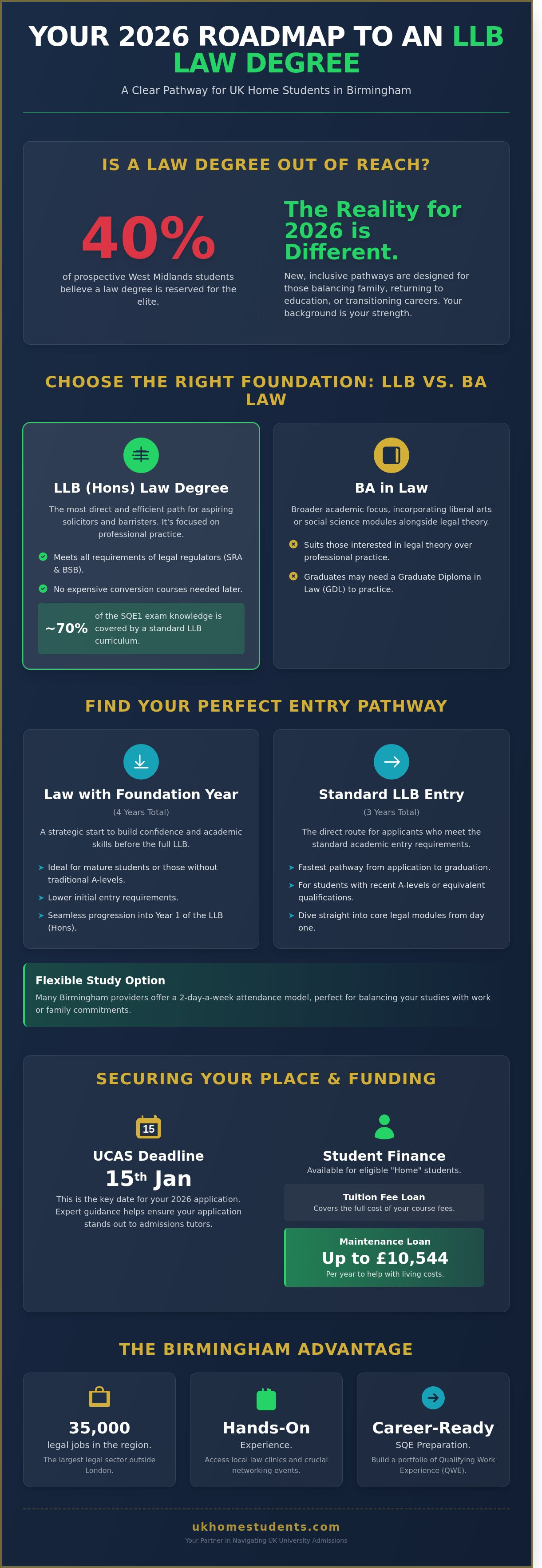
What if you could start your legal career without having a string of straight A* grades or a massive savings account? Over 40% of prospective students in the West Midlands believe that securing an llb law degree birmingham is a dream reserved for a specific elite, but the reality for 2026 entry is far more inclusive. If you are looking to transition into the legal profession while balancing a family, you likely feel that the 15th January UCAS deadline is a looming hurdle that demands expert navigation.
It's completely normal to feel anxious about whether you're "academic" enough or if you'll qualify for the maximum maintenance loan, which can reach up to £10,544 per year for eligible home students. This guide provides a clear, professional roadmap to help you navigate the 2026 application cycle with total confidence. We'll show you how to secure your funding, choose a flexible pathway that respects your schedule, and ensure your application stands out to admissions tutors so you can focus on your future career.
Key Takeaways
- Understand the vital distinction between a standard degree and a Qualifying Law Degree (QLD) to ensure your studies provide a solid foundation for your legal career.
- Identify the most suitable entry pathway for your background, including flexible foundation year options if you are returning to education without traditional A-levels.
- Learn how to navigate the UCAS application process and select the best providers to secure your llb law degree birmingham for the 2026 academic year.
- Discover how to maximise your funding by correctly identifying your "Home" student status and applying for comprehensive tuition fee loans and maintenance support.
- Gain a competitive advantage through a professional eligibility assessment that simplifies complex enrolment procedures and clarifies your path to university.
Understanding the LLB (Hons) Law Degree: The Foundation of Your Legal Career
If you're aiming to enter the legal profession, the LLB (Hons) is your first major milestone. This undergraduate Bachelor of Laws degree represents a rigorous academic study of the English legal system. In the UK, it typically takes three years of full-time study to complete. For those looking to secure an llb law degree birmingham offers a competitive environment with institutions like the University of Birmingham or Birmingham City University providing high-calibre training. Holding this degree proves you've mastered the core pillars of law, from contract to criminal litigation, which is essential for any aspiring solicitor or barrister.
Choosing to start your studies in 2026 is a strategic move. By the time you graduate in 2029, the Solicitors Qualifying Examination (SQE) will be the established standard for all new entrants. While the old Qualifying Law Degree (QLD) terminology is technically being phased out by the Solicitors Regulation Authority (SRA), the seven foundations of legal knowledge remain the bedrock of the SQE1 assessment. A structured LLB ensures you don't have to take additional, expensive conversion courses later. For UK home students, this degree also unlocks access to Student Finance England, covering your tuition fees and providing a maintenance loan to help with living costs in the city.
LLB vs. BA Law: Which should you choose?
The primary difference lies in the focus on professional practice. An LLB is a dedicated law degree designed to meet the specific requirements of legal regulators. A BA in Law often incorporates more liberal arts or social science modules, which might suit those interested in legal theory rather than practice. Statistics from the Higher Education Statistics Agency (HESA) consistently show that graduates entering high-street or Magic Circle firms predominantly hold an LLB or a GDL. Choosing the LLB route simplifies your journey toward the Bar or the roll of solicitors by focusing on the core modules required for professional exemptions.
The SQE and your law degree journey
The SRA introduced the SQE in September 2021 to standardise entry into the profession. Although you can technically sit the SQE with any degree, the LLB remains the most efficient path. It covers approximately 70% of the functioning legal knowledge required for the SQE1 exams. By focusing on an llb law degree birmingham students can access local law clinics and networking events that prepare them for the two years of Qualifying Work Experience (QWE) needed alongside the exams. This route provides a clear, logical progression from your first lecture in 2026 to your final qualification as a solicitor.
- Core Knowledge: Covers Tort, Contract, Equity and Trusts, and Land Law.
- SQE Readiness: Aligns with the SRA’s assessment specifications for 2026 onwards.
- Employability: Birmingham’s legal sector is the largest outside London, offering 35,000 jobs in the region.
How to Choose the Right Law Degree Pathway: Foundation Years and Flexible Study
Choosing your entry point for a llb law degree birmingham depends entirely on your current academic standing and career history. If you've been out of formal education since 2018 or don't hold traditional A-levels, the standard three-year route isn't your only option. Birmingham universities offer diverse pathways for 2026 entry that cater specifically to adult learners and those switching careers from other sectors.
The benefits of a Law Foundation Year
A foundation year provides a vital transition for students who require a refresher in academic skills before diving into complex case law. You'll spend your first year focusing on the fundamentals of legal research, drafting, and the structure of the UK legal system. This year isn't just a "catch-up" period; it's a strategic start that builds the confidence needed for high-level study. Once you pass your foundation modules, you'll move straight into the first year of the full LLB (Hons) programme without needing to re-apply through UCAS.
- Ideal for mature students returning to study after a five-year break or longer.
- Lower initial entry requirements compared to the standard three-year degree.
- Full access to university facilities and student support from day one.
Flexible study for working professionals
Balancing a law degree with a job or family is a priority for many home students. Many providers in Birmingham now facilitate a 2-day-a-week attendance model. This condensed schedule means you spend less time commuting and more time managing your professional life. You should verify that your chosen centre uses a blended learning approach, where campus seminars are supplemented by robust online resources and recorded lectures you can access at any time.
If you're concerned about how these study modes impact your budget, you should review the official student finance information to confirm your funding eligibility. Most students on a 4-year foundation route still qualify for the full maintenance loan and tuition fee grant for every year of study. This financial security allows you to focus on the demanding reading lists that define legal education without constant financial stress.
When comparing courses, examine the specific modules on offer to ensure they match your goals. Whether you're aiming for criminal law or property litigation, the right curriculum makes all the difference. If you're unsure which route suits your specific qualifications, you can get a professional assessment of your options to ensure you're making the right choice for your 2026 application.
Step-by-Step Guide: Navigating the UCAS Application for Law Students
Securing your place for an llb law degree birmingham requires a methodical approach to the UCAS portal. You'll start by registering and selecting up to five course choices. It's wise to mix your options between high-ranking institutions and "insurance" choices to safeguard your future. Most Birmingham providers expect a strong academic reference, so you should approach your tutors at least three weeks before the deadline to ensure they have ample time to draft a supportive testimonial.
Preparation for the Law National Admissions Test (LNAT) is often a requirement for top-tier universities in the city. If you're targeting the University of Birmingham for 2026, you must sit this assessment by 20 January 2026. This 135-minute test evaluates your reasoning skills rather than your legal knowledge, so don't feel pressured to memorise statutes beforehand. Instead, focus on practice papers to familiarise yourself with the multiple-choice and essay formats.
Writing a law-focused personal statement
Your personal statement is your primary tool for demonstrating "legal awareness" without needing a month of work experience at a Magic Circle firm. You can show your passion by discussing a recent Supreme Court ruling or referencing insights from the UCAS Law Subject Guide regarding core modules like Tort or Contract Law. Focus on transferable skills such as your ability to synthesise complex information and your attention to detail during debates or research projects. Avoid the common mistake of using generic quotes from famous judges; admissions tutors want to hear your unique voice and logical reasoning.
Managing the UCAS timeline
The 29 January 2026 deadline is the most critical date for your diary. Missing this "equal consideration" window significantly reduces your chances at competitive institutions. If you find yourself without offers after this date, UCAS Extra opens on 25 February 2026, allowing you to add a new choice. For those looking at a January 2026 intake, many Birmingham-based providers offer direct application routes that bypass the standard September cycle. Always verify your home student status early in the process. If you've been a UK resident for three years, you'll typically qualify for the capped tuition fee of £9,250, ensuring your llb law degree birmingham remains financially manageable.
Securing Your Future: Student Finance, Maintenance Loans, and Grants for Law Degrees
Securing funding is the most critical hurdle for any student pursuing an llb law degree birmingham. If you've lived in the UK for at least three years before your course starts in September 2026, you'll likely qualify for Home Student status. This status is vital because it caps your tuition fees at £9,250 per year, rather than the significantly higher rates charged to international applicants. You won't need to pay this upfront. The Student Loans Company pays this directly to your chosen Birmingham institution once your enrolment is confirmed.
Your maintenance loan provides the essential cash flow for rent, food, and textbooks. For the 2024/25 academic year, students living away from home outside London can receive up to £10,227. This amount is means-tested, which means your household income determines exactly how much you'll receive. If your household earns less than £25,000 annually, you'll qualify for the maximum support package. Whether you study at the University of Birmingham or Birmingham City University, an llb law degree birmingham requires a clear financial roadmap.
Navigating Student Finance England
You should start your application in March 2026 to ensure your funds are ready for the autumn term. You'll need several key items to complete the process:
- A valid UK passport or birth certificate
- Your National Insurance number
- Financial details for your parents or partner if you're a dependant
- A share code if you're proving your settled status digitally
Student Finance England verifies your residency history to confirm you aren't subject to international fee structures. If your application is delayed, you might be asked to provide utility bills or bank statements covering the last 36 months.
Maximising your financial support
Look beyond the standard loans. If you have a long-term health condition or learning difficulty, the Disabled Students' Allowance (DSA) offers up to £26,291 of support per year that you don't have to pay back. Parents can also access the Childcare Grant, which covers 85% of weekly costs up to £193.35 for one child. Your loan repayment only starts once you earn over £25,000 under Plan 5 regulations. At that point, you'll pay back 9% of your income above that threshold, making it more of a graduate tax than a traditional bank loan.
Expert Support for Your Legal Journey: How UK Home Students Simplifies Your Enrolment
Applying for a university place often feels like a full-time job. Between UCAS deadlines and complex eligibility criteria, the process drains your energy. We understand that UK home students face unique hurdles, especially when trying to balance life commitments with a rigorous llb law degree birmingham. Our role is to act as your specialised consultant. We provide a steady hand to help you navigate the intricate requirements of the UK education system.
A professional assessment of your goals ensures you don't waste time on unsuitable courses. If you've lived in the UK for three years or hold settled status, you likely qualify for significant support. We bridge the gap between your career ambitions and a successful placement by matching your profile with universities that offer the flexibility you need. This clarity replaces the anxiety often felt when facing university admissions alone.
Our hassle-free application process
Applying isn't just about filling in a form; it's about securing your future. We simplify the journey by handling the technical details that often cause delays. Our team provides direct assistance with:
- Selecting the right course from accredited providers in the West Midlands.
- Managing your Student Finance England application to ensure you receive your full tuition fee grant and maintenance loan entitlements.
- Providing tailored advice for mature students who may have non-traditional qualifications or have been out of education for several years.
If you're worried about the £9,250 annual tuition cost, we show you exactly how to access the funding you're entitled to. We've helped students from diverse backgrounds transform their career prospects through methodical, step-by-step guidance.
Start your legal career today
The 2026 academic year will arrive faster than you expect. Popular law programmes in Birmingham often reach capacity months before the September start date. Taking action now secures your spot and gives you peace of mind. You don't have to struggle with bureaucratic forms or confusing funding rules. Our expertise gives you a competitive advantage, allowing you to focus on your studies rather than the paperwork. Don't let administrative hurdles stand between you and your llb law degree birmingham.
Secure Your Place for the 2026 Intake
Starting your legal journey requires careful planning and a clear understanding of the 2026 UCAS deadlines. You've now seen how a foundation year provides a vital bridge into higher education and why choosing flexible study pathways helps balance your degree with existing commitments. Securing your funding is equally critical. Navigating Student Finance England to access maintenance loans and tuition fee grants ensures you can focus entirely on your studies without financial strain. Missing the 29 January UCAS deadline could delay your career goals by a full year.
If you're a mature student or a home learner, the process doesn't have to be overwhelming. Pursuing an llb law degree birmingham places you at the heart of one of the UK's most significant legal sectors. Our team at UK Home Students acts as your dedicated mentor, providing expert guidance on complex eligibility criteria and application steps. We offer a specialised assessment to ensure you meet every requirement for the 2026 academic year. We've helped thousands of students navigate these regulations with confidence and clarity.
Apply for your LLB Law Degree with expert help today
Take the first step toward your professional qualification today. Your career in the legal sector is waiting for you.
Frequently Asked Questions
Can I study an LLB law degree without A-levels?
Yes, you can study an llb law degree birmingham without traditional A-levels by completing an Access to Higher Education Diploma or a foundation year. Most Birmingham universities accept an Access to HE Diploma where you've achieved 45 credits at Level 3. Alternatively, a four-year LLB with a foundation year provides a dedicated entry route if your previous qualifications don't meet the standard three-year criteria.
How much is the maintenance loan for a law student in 2026?
Your maintenance loan amount depends on your household income and where you live while studying. For the 2024/25 academic year, students living away from home outside London receive up to £10,227 per year. Since Student Finance England typically adjusts these rates annually for inflation, you should expect a slightly higher maximum for the 2026 intake. We recommend an expert assessment of your household income to calculate your exact entitlement.
Is an LLB law degree harder than other undergraduate subjects?
Law is widely considered one of the most academically rigorous subjects because of the high volume of reading and complex analysis required. You'll typically spend 15 hours in lectures and seminars each week, supplemented by 30 hours of independent research. While the workload is intensive, the structured nature of the llb law degree birmingham ensures you develop the logical reasoning skills needed to succeed in the legal sector.
What is the difference between a law degree and a GDL?
An LLB is a three-year undergraduate degree worth 360 credits that covers core legal principles from scratch. In contrast, the Graduate Diploma in Law (GDL) is a condensed one-year conversion course designed for students who already hold an undergraduate degree in a different subject. If you're starting your higher education journey in 2026, the LLB is the standard route to gain foundational legal knowledge.
Can I work full-time while studying for an LLB law degree?
Working full-time isn't recommended because an LLB is a full-time academic commitment that requires roughly 40 hours of work per week. Most Birmingham universities advise that students limit part-time employment to 15 hours weekly to ensure academic performance doesn't suffer. If you need to work more hours, you might consider a part-time LLB route, which typically extends the study duration to four or six years.
How long does it take to complete an LLB law degree in the UK?
A standard full-time LLB degree takes three years to complete in the UK. Some institutions offer a four-year programme if you choose to include a professional placement year or a foundation year at the start of your studies. Part-time options are also available at several Birmingham campuses, which usually take between four and six years depending on the intensity of your module selection.
What are the entry requirements for an LLB with a foundation year?
Entry requirements for an LLB with a foundation year are typically lower than the standard three-year course, often asking for 104 UCAS points or BCC at A-level. This route is specifically designed for students who show potential but haven't met the higher grade boundaries, such as ABB or AAA, required for direct entry. You'll also need at least five GCSEs at grade 4 (C) or above, including English and Maths.
Will Student Finance cover my law degree if I already have a different degree?
Student Finance England generally won't provide a second tuition fee loan if you already hold an undergraduate degree, as law isn't currently on the "exception" list for second degree funding. This is known as the Equivalent or Lower Qualification (ELQ) policy. If you're looking to switch careers, you'll usually need to self-fund your tuition fees, though you might still qualify for a maintenance loan depending on your personal circumstances.