

If you believe that returning to university at 30, 40, or 50 is a financial impossibility, you're missing out on a funding system specifically designed to support your transition. It's natural to feel anxious about trading a steady salary for a lecture hall, especially when you have a mortgage to pay or children to support. You likely worry that the standard student loan for mature students won't cover the actual costs of adult life or that your "independent student" status is too complex to prove to Student Finance England.
This comprehensive guide will show you exactly how to secure your tuition fees and maximize your maintenance loan for the 2026 academic year. We'll also reveal the specific non-repayable grants available for parents and carers that can provide over £3,000 in additional annual support. By the time you finish reading, you'll have a clear, step-by-step roadmap to funding your degree with total confidence. We will break down the latest eligibility criteria and the precise evidence you need to guarantee your financial stability during your studies.
Key Takeaways
- Confirm your eligibility for tuition fee funding and understand why there is no upper age limit for UK Home Students.
- Discover how to secure a student loan for mature students by leveraging independent status to maximise your maintenance loan.
- Identify non-repayable grants for parents and carers, including childcare support that covers up to 85% of your weekly costs.
- Navigate the 2026 application process with a clear timeline for gathering evidence and selecting courses with flexible attendance.
- Learn how an expert assessment can simplify complex Student Finance bureaucracy and ensure you receive your full funding entitlement.
Understanding Your Eligibility: Can You Get a Student Loan as a Mature Student?
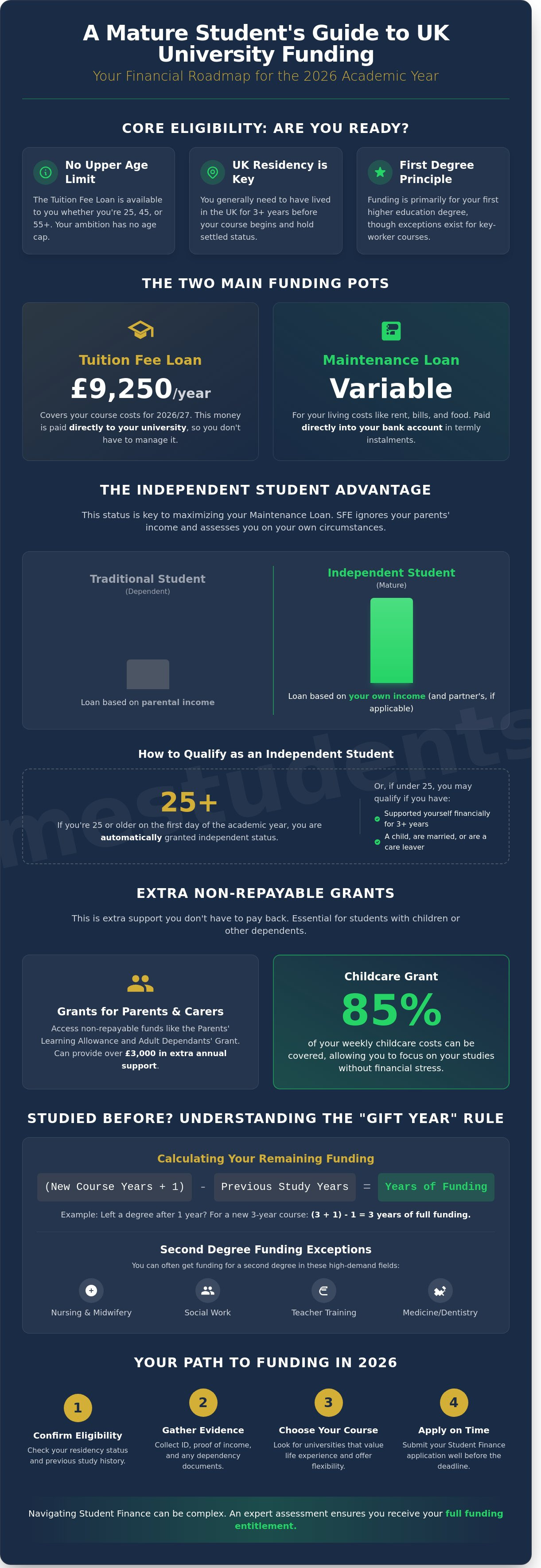
Securing a student loan for mature students is a standard process in the UK, yet many applicants worry they have missed their window for financial support. There's no upper age limit for the Tuition Fee Loan. Whether you're 25 or 55, the government provides the same basic support for your first undergraduate degree. Your primary hurdle isn't your age; it's your residency status. To qualify for "Home Student" funding, you typically need to have lived in the UK for at least three years before your course starts and hold settled status or a qualifying nationality.
The UK student loan system is designed to facilitate career changes at any stage of life. You will interact with two main pots of money. The Tuition Fee Loan covers your course costs up to £9,250 per year for the 2025/26 and 2026/27 academic cycles. This is paid directly to your university. The Maintenance Loan is the second pot, which is paid into your bank account to help with living costs. While the tuition loan has no age cap, Maintenance Loans for students over 60 are subject to different criteria based on household income levels.
Defining the Mature Student Category
Most universities define a mature student as anyone aged 21 or over at the start of their undergraduate degree. In 2023, UCAS data revealed that over 20% of all university applicants were mature learners, proving that adult education is a massive growth sector. If you don't have traditional A-levels, don't worry. Admissions tutors frequently value five or ten years of professional experience as a valid alternative to standard school-leaver qualifications. This life experience often makes you a more dedicated and successful candidate during the interview process.
The "First Degree" Principle
Student Finance England generally reserves funding for your first higher education qualification. If you have studied before, the authorities use a "gift year" formula to calculate your remaining eligibility. This formula is: (Duration of current course + 1 year) minus (Years of previous study). If you started a degree in 2018 but left after one year, you still have full funding for a new three-year course. Certain vocational subjects allow you to bypass this rule. You can often secure a student loan for mature students for a second degree in the following areas:
- Nursing and Midwifery
- Social Work
- Teacher Training (PGCE)
- Medicine or Dentistry (as a second degree, though funding rules are specific)
If you're unsure about your remaining "gift year" balance, you should request an expert assessment from Student Finance before you submit your UCAS application. This ensures you have total clarity on your budget before committing to a three-year programme.
The Independent Student Advantage: How Age Affects Your Maintenance Loan
The way Student Finance England (SFE) calculates your entitlement changes significantly once you reach a specific age threshold. For most applicants, the "Independent Student" status is the primary gateway to securing a more substantial student loan for mature students. This classification means that SFE completely ignores your parents' household income when deciding how much money to lend you for living costs. Instead, they base their assessment solely on your own financial circumstances or those of your cohabiting partner.
This shift often leads to a higher Maintenance Loan for mature learners. While traditional students often rely on their parents to bridge the gap between their loan and their actual living costs, independent students are assessed on their current life stage. If you've been out of the education system for several years, this status acknowledges that you're no longer a financial dependent of your family.
Applying Over the Age of 25
Once you reach the age of 25, the process becomes much simpler. If you're 25 or older on the first day of your academic year, which is typically 1st September for autumn starters, SFE automatically grants you independent status. They won't ask for your parents' P60s or income details. This removes a massive layer of bureaucracy and potential friction with family members. Your funding is calculated based on your household's current income. If you live with a spouse or a long-term partner, their earnings will be assessed. If you live alone or with housemates, only your own income is factored into the equation. It's a system designed to reflect your actual adult life.
Financial Support for Those Under 25
You don't necessarily have to be 25 to qualify as an independent student. SFE recognises that many younger adults have already established their own lives. You can secure independent status if you meet one of these criteria:
- Self-support: You've supported yourself financially for at least 36 months before the start of your course. This doesn't have to be consecutive.
- Family status: You're married or in a civil partnership before the academic year begins.
- Parental responsibility: You have a child or children who depend on you.
- Estrangement: You're irreconcilably estranged from your parents.
To prove self-support, you'll need to provide concrete evidence such as P60s, month-by-month payslips, or benefit statements. SFE is strict about the 36-month rule, so having your paperwork organised is vital. If you're unsure whether your previous earnings meet the threshold, you might want to seek an expert assessment of your funding status to avoid delays in your application. Proving independence under 25 requires more effort, but it's often the difference between a minimum loan and a full support package for your student loan for mature students.
Beyond the Basic Loan: Extra Financial Support for Parents and Carers
Securing a student loan for mature students is only the first step in building your financial package. If you have children or adult dependants, you can access non-repayable grants that don't add a penny to your total debt. These funds are designed to level the playing field for those balancing family commitments with higher education. Unlike the maintenance loan, these grants are not repaid after you graduate, making them essential for maintaining financial stability during your degree.
Support for Students with Children
You can claim up to 85% of your weekly childcare costs through the Childcare Grant. For the 2025/26 academic year, this reaches up to £193.62 per week for one child. If you have two or more children, you can receive up to £331.95. To qualify, your provider must be Ofsted-registered. Payments are handled through the Childcare Grant Service portal, which pays your provider directly once you approve their invoices.
The Parents’ Learning Allowance (PLA) provides up to £1,915 per year to help with course-related costs like books and travel. Student Finance England calculates your PLA based on your household income. It doesn't affect your benefits or other financial support. If you're also caring for an adult, the Adult Dependants’ Grant offers up to £3,354 per year for those with a partner or relative who is financially dependent on them.
Disabled Students’ Allowance (DSA)
The Disabled Students’ Allowance (DSA) is a grant, not a loan. You'll never have to pay it back. It covers the extra costs you face because of a mental health condition, a learning difficulty like dyslexia, or a long-term physical illness. For 2026 applicants, the maximum allowance is £26,948 per year. This funding can be used for specialist equipment, non-medical helpers, or even travel costs related to your condition.
You should apply for DSA as soon as you submit your initial student loan for mature students application. It can take up to 14 weeks to process your assessment and order equipment. Applying early ensures your support is in place for day one of your first term. You don't need a confirmed university place to start this process; you only need to show that you've applied for a qualifying course.
Navigating the Application: Timeline and Essential Evidence for 2026
Securing your student loan for mature students requires a methodical approach to the Student Finance England (SFE) portal. The process is entirely digital, but the evidence requirements are strict and time-sensitive. You should follow these five functional steps to ensure your funding is in place before your first lecture.
- Step 1: Research flexible attendance. Look for "commuter-friendly" courses that pack contact hours into two days a week. This reduces travel costs and allows you to maintain part-time employment.
- Step 2: Register your account. Set up your profile on the SFE website. You will need your National Insurance number and your bank details to hand.
- Step 3: Verify your identity. A valid UK passport is the most efficient method as it is checked digitally. If you use a birth certificate, you must post the original document to SFE, which can take up to 20 working days to return.
- Step 4: Financial assessment. If you're applying for the means-tested maintenance loan, you must provide household income details from the 2024-25 tax year.
- Step 5: Monitor the portal. Check your "To-do list" weekly. SFE often requests additional evidence, such as marriage certificates or proof of address, mid-way through the assessment.
When to Apply for 2026 Entry
The application window typically opens in March 2026. You don't need a confirmed university place to start your application; simply use your preferred choice and update it later if necessary. Aim to submit everything by the late May deadline. If you apply after this date, you risk receiving only a "minimum payment" on your first day. This temporary measure provides the basic non-means-tested loan while SFE spends six to eight weeks verifying your full household income.
Choosing the Right Course for Your Lifestyle
Modern universities recognize that mature learners have different needs. Many institutions now offer "flexible degrees" or "blended learning" models where 40% of the content is delivered online. If you have been out of formal education for 10 years or more, consider a course with an integrated foundation year. These programmes act as a bridge, allowing you to regain academic confidence and secure a student loan for mature students for the entire four-year duration.
Unsure if your specific circumstances qualify you for maximum support? Get an expert assessment of your funding options to clarify your eligibility before you apply.
Securing Your Future: How UK Home Students Supports Your Return to Education
Returning to university as an adult often feels like a bureaucratic maze. UK Home Students acts as your professional partner, simplifying the search for a student loan for mature students. We provide an expert assessment to identify which 2026 funding routes match your specific circumstances. Our team reduces the stress of UCAS applications by helping you draft a compelling personal statement that highlights your professional experience. We ensure you capitalise on every available resource, from standard maintenance loans to specific grants like the Parents' Learning Allowance, which can provide up to £1,915 per year for the 2025/26 academic cycle.
- Expert Assessment: We analyse your previous qualifications and residency history to confirm your eligibility.
- Application Support: Our consultants guide you through the UCAS portal, ensuring no deadlines are missed.
- Funding Maximisation: We identify additional bursaries for childcare or disability that often go unclaimed.
Our Bespoke Application Service
We match your career ambitions with flexible degree programmes designed for working adults. If you've lived in the UK for at least 3 years before your course starts, we vet your eligibility for Home-fee status to ensure you aren't overcharged. Having a dedicated consultant means you get immediate answers to "what if" questions regarding your 2026 start date. This bespoke approach ensures your application is robust and compliant with the latest Student Finance England regulations.
Take the First Step Today
Your age is a distinct advantage in the lecture hall. It brings perspective and discipline that younger students often lack. We invite you to book a no-obligation consultation to explore your 2026 opportunities and secure the right student loan for mature students. Your transition back to education doesn't have to be overwhelming. It starts with one clear, professional conversation. We provide the clarity you need to move from confusion to confidence.
Take Charge of Your 2026 Academic Journey
Returning to university as an adult is a strategic move for your career and personal growth. You've seen that age is an asset rather than a barrier in the UK education system. Most applicants over 25 qualify for independent status, which typically unlocks higher maintenance loan rates to cover living costs. If you're balancing family life, specific grants like the Parents’ Learning Allowance can offer up to £1,915 in additional annual support. Securing a student loan for mature students is a manageable process when you follow the 2026 evidence timeline and verify your residency status early.
The complexity of Student Finance regulations shouldn't stand in the way of your degree. UK Home Students brings expert guidance on "Home Student" status and a proven track record with mature student placements to your application. We're specialists in flexible degree pathways that fit your existing commitments. Our consultants ensure you meet every criteria and submit a robust application that reflects your unique circumstances and financial needs.
Secure your 2026 university funding with an expert assessment from UK Home Students. Your path to a new career is clear and achievable with the right professional support.
Frequently Asked Questions
Do I have to pay back my student loan if I am a mature student?
Yes, you must repay your student loan, but only once your annual income exceeds the repayment threshold, which is £25,000 for Plan 5 loans. If you earn £30,000, you'll repay 9% of the £5,000 difference, which equals £37.50 per month. These repayments are deducted directly from your salary through the PAYE system. Any remaining balance is written off after 40 years, regardless of how much you've paid back.
Can I get a student loan if I already have a degree from years ago?
Usually, you can't get a student loan for mature students if you already hold an equivalent or higher-level qualification. However, exceptions exist for specific subjects like Nursing, Midwifery, or certain STEM courses. If you're pursuing a second degree in these exempt categories, you can often access full tuition fee and maintenance support. Our expert assessment can confirm if your chosen 2026 course qualifies for this specific funding route.
Is there an age limit for the Maintenance Loan in the UK?
There's no upper age limit for applying for a Maintenance Loan or Tuition Fee Loan for undergraduate study in the UK. Whether you're 30 or 65, you're eligible for the same standard support as younger students. This ensures that career changers can access vital living cost support at any stage of their life. You just need to meet the standard UK residency and Home student status criteria to qualify.
How much maintenance loan will I get if I am over 25?
As a student over 25, you're automatically classified as an independent student, meaning your parents' income isn't considered. For the 2026 academic year, you could receive up to £10,227 if living away from home outside London, or up to £13,348 if studying in London. These figures are based on your own household income, including a partner's earnings, rather than your previous salary or parental financial history.
What happens to my student loan if I am working part-time while studying?
Working part-time doesn't reduce the amount of Tuition Fee Loan or Maintenance Loan you receive. Your loan entitlement is based on your household income from the previous tax year, so current part-time earnings won't lower your 2026 funding. It's a common strategy to supplement your £10,227 maintenance support with 10 to 15 hours of weekly work. This helps manage living costs without impacting your primary student finance package.
Can I get extra funding if I have children or a disability?
Yes, you can access non-repayable grants that sit alongside your student loan for mature students. If you have children, the Childcare Grant covers up to 85% of your costs, capped at £193.35 per week for one child. Students with disabilities or long-term health conditions can apply for Disabled Students' Allowance (DSA), which provides up to £26,291 per year in support. These funds don't need to be paid back.
How do I apply for a student loan as a mature student for the 2026 academic year?
You should apply online through the Student Finance England portal, which typically opens in March 2026 for courses starting in September. You don't need a confirmed university place to start your application; simply use your preferred choice and update it later. Ensure you have your UK passport and National Insurance number ready. Completing your application by the May 2026 deadline ensures your funding is processed before your first term.
Will my credit score affect my ability to get a student loan?
Your credit score has no impact on your eligibility for a government student loan. Unlike commercial bank loans, Student Finance England doesn't conduct credit checks for Tuition Fee or Maintenance Loans. Whether you have a perfect rating or a history of debt, you'll secure funding as long as you meet the residency and nationality requirements. This system ensures that financial history isn't a barrier to your professional development and academic success.