

What if a Russell Group degree wasn't just a badge of academic prestige, but a strategic, practical investment in your 2026 career? You likely recognise the university of birmingham as a global top 100 institution, yet the prospect of meeting high UCAS point targets often feels out of reach. It's natural to feel anxious about whether your predicted grades are sufficient or if the £9,250 annual tuition fee will lead to unmanageable debt while you study.
We're here to simplify these complexities and show you that your academic background doesn't have to be a barrier. This guide evaluates Birmingham’s reputation and course offerings while highlighting accessible entry routes, such as Foundation Years, for students who don't meet standard requirements. You'll gain a clear understanding of how to secure your Student Finance and navigate the maintenance loan system with total confidence. We will explore specific eligibility criteria and practical career support to ensure your 2026 application is both informed and successful.
Key Takeaways
- Discover how the university of birmingham’s 'Redbrick' prestige and Russell Group status can give your 2026 graduate career a competitive advantage.
- Identify the most popular degree programmes for Home students and see how the curriculum is adapting to the needs of the future workforce.
- Evaluate whether a direct A-Level entry or a supportive Foundation Year pathway is the best way to secure your place on a top-tier course.
- Gain clarity on navigating Student Finance regulations to ensure your tuition fees are covered and your maintenance funding is fully maximised.
- Master the 2026 UCAS application process with professional guidance on how to organise your profile for a successful expert assessment.
Evaluating the University of Birmingham: Prestige, Ranking, and Student Experience
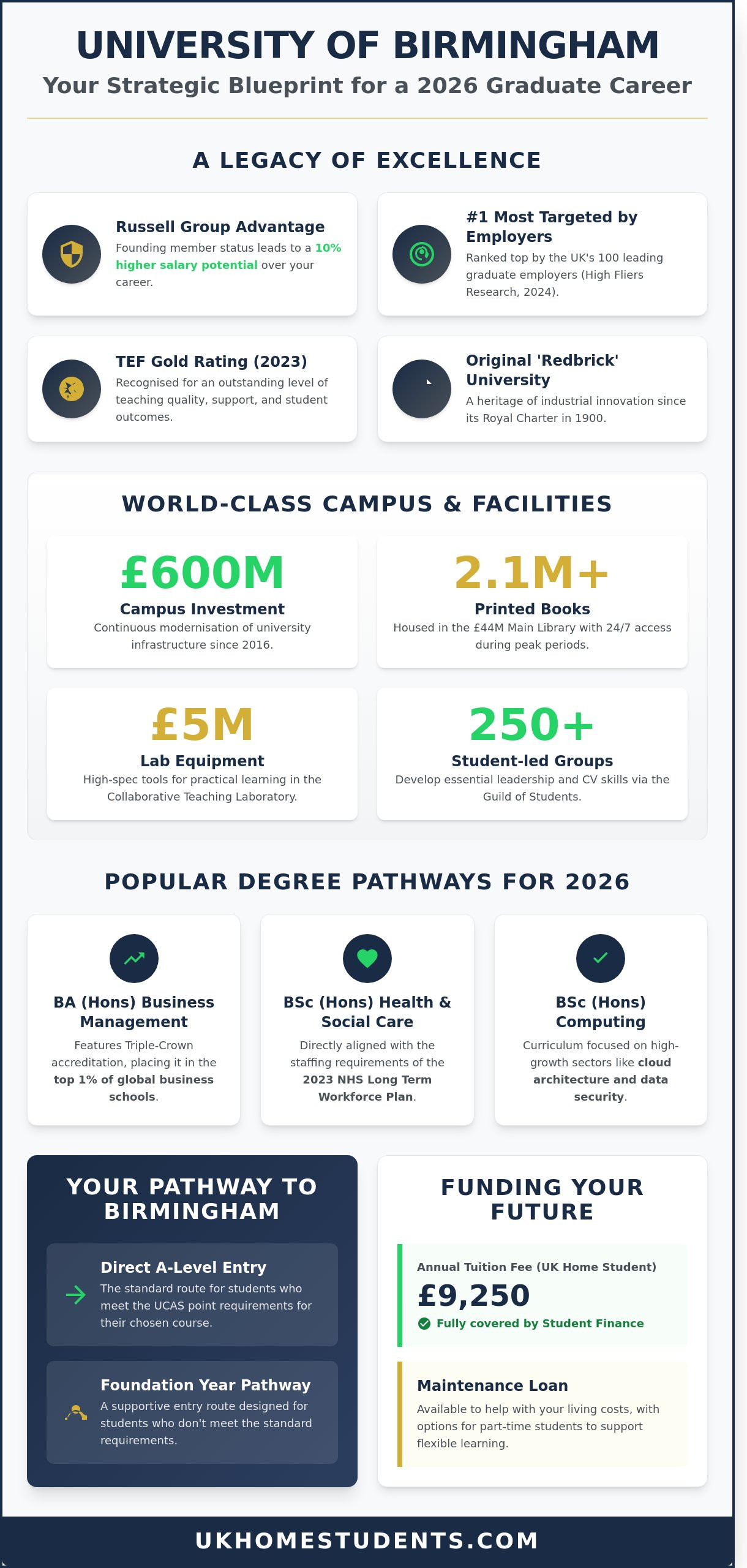
If you are planning your UCAS application for 2026, the university of birmingham represents a strategic choice for both academic rigour and career progression. It was the UK’s first civic university, gaining its Royal Charter in 1900. This 'Redbrick' heritage isn't just about history; it’s about a long-standing commitment to professional education and industrial innovation. In 2024, the High Fliers Research report named it the most targeted university by the UK’s top 100 graduate employers. This high demand from recruiters stems from a curriculum that balances traditional theory with modern, technology-driven applications. The university currently holds a Gold rating in the Teaching Excellence Framework (TEF 2023), which ensures you receive an outstanding level of support and tuition throughout your studies.
The Russell Group Advantage for UK Students
As a founding member of the Russell Group, the university provides a research-intensive environment. This means you aren't just learning from books; you are being taught by the people writing them. If you want to secure a competitive edge, this distinction is crucial for several reasons:
- Expert Instruction: You gain access to lecturers who are active researchers at the forefront of their fields.
- Salary Potential: Data from the Institute for Fiscal Studies indicates that graduates from these institutions often see a salary premium, earning approximately 10% more over their career than peers from other universities.
- Global Recognition: Your degree acts as a global passport, recognised by employers from London to New York.
This environment signals to future employers that you can thrive under high academic standards and tackle complex, real-world problems.
Campus Life and Facilities
The Edgbaston campus offers a unique 'campus-style' experience while remaining integrated with the city. Since 2016, the university has delivered a £600 million investment programme to modernise its infrastructure. You will have access to the £44 million Main Library, which houses over 2.1 million printed books and provides 24/7 access during peak periods. The Collaborative Teaching Laboratory, opened in 2019, offers students £5 million worth of high-specification equipment for practical learning. Beyond the classroom, the Guild of Students serves as the heart of extracurricular life. With over 250 student-led groups, you can develop leadership skills that are essential for your CV. Whether you are using the Olympic-length swimming pool or socialising under the 100-metre 'Old Joe' clock tower, the environment is designed to support both your wellbeing and your academic success.
Comparing Undergraduate and Postgraduate Programmes for Home Students
Choosing between undergraduate and postgraduate study at the university of birmingham requires a clear understanding of how different honours degrees shape your career trajectory. While a BA (Hons) focuses on theoretical and qualitative analysis, a BSc (Hons) emphasises technical proficiency and quantitative data. If you're pursuing a legal career, the LLB provides the qualifying degree status necessary to progress toward solicitor or barrister training. For 2026, the university has updated its curriculum to reflect the UK's shift toward a high-skill economy, ensuring every module delivers practical value.
Popular Degree Subjects for 2026
The BA (Hons) Business Management remains a top choice for home students, holding triple-crown accreditation which places it in the top 1% of global business schools. This ensures your qualification is recognised by international employers and professional bodies alike. Aspiring practitioners often choose the BSc (Hons) Health and Social Care, a route specifically designed to meet the staffing requirements identified in the 2023 NHS Long Term Workforce Plan. For those eyeing the tech sector, the BSc (Hons) Computing aligns with the latest industry standards in cloud architecture and data security, providing a direct pipeline into high-growth roles.
Flexible Learning and Part-time Options
The university of birmingham provides several pathways for those balancing professional roles with academic growth. Many postgraduate taught (PGT) programmes offer modular structures, allowing you to complete your Master's over two years instead of one. Blended learning options combine online theory with monthly on-campus seminars; this is ideal for mature students with family commitments. Before you commit to a specific schedule, you should check your funding eligibility to see if a part-time maintenance loan covers your living costs. This flexibility ensures you don't have to choose between your current salary and your future qualifications.
- Modular Study: Available across most Humanities and Social Science departments.
- Blended Learning: Utilises the Canvas VLE for 24/7 access to lecture materials.
- Evening Seminars: Offered for specific professional development courses in Education and Law.
If you're looking to transition into a new industry, the university's conversion courses allow graduates from any discipline to pivot into fields like Psychology or Computer Science. These intensive programmes are designed to bridge the skills gap quickly, typically lasting 12 months for full-time students. By aligning these programmes with the 2026 job market, the institution ensures that your investment in higher education yields a measurable professional advantage.
Entry Requirements vs. Foundation Year Pathways: Which Route is Better?
Choosing your route into the university of birmingham depends on your current qualifications and your academic confidence. Direct entry is the standard path for students with traditional A-Levels or BTECs, but it isn't the only way to secure a place for the 2026 intake. While direct entry saves time, a Foundation Year offers a vital bridge for those who narrowly missed their predicted grades or are returning to study after a long break. You must weigh the immediate entry against the long-term stability a preparatory year provides.
Traditional Entry Requirements
Direct entry typically requires A-Level grades ranging from AAA to ABB, or BTEC Level 3 Extended Diplomas at D*D*D. You can calculate your UCAS tariff points by assigning values to your grades; an A* earns 56 points while an A earns 48. Most programmes at the university of birmingham require at least a Grade 4 or 5 in GCSE English and Maths. Your personal statement acts as a critical tie-breaker during the selection process. You should use this space to highlight specific work experience or independent research that proves your readiness for high-level study.
The Benefits of a Foundation Year
If you don't meet the standard criteria, a Foundation Year provides a soft landing into intensive academic life. It adds one year to your degree duration and carries the standard £9,250 tuition fee, which is fully fundable through Student Finance England. This route isn't a lesser qualification; it's a strategic choice that guarantees progression to a full degree upon successful completion. For mature students who haven't been in a classroom for five years or more, this year builds the essential research and writing skills needed to succeed.
Comparison of the two routes involves looking at your specific circumstances:
- Duration: Direct entry is three years; Foundation routes are four years total.
- Cost: An extra year of tuition at £9,250 plus maintenance loan requirements.
- Academic Prep: Foundation students often achieve higher final degree classifications because they've mastered university-level study techniques early.
- Eligibility: Foundation years are specifically designed for students with non-traditional backgrounds or those from specific postcodes with lower progression rates to higher education.
Don't view the Foundation Year as a setback. It's a tool to maximize your potential and ensure you don't feel overwhelmed when you start your first year of a full honours degree. Whether you qualify for direct entry or need a preparatory year, the outcome is the same: a prestigious degree from a global top-100 institution.
Navigating Student Finance and Funding at Birmingham in 2026
Securing your place at the university of birmingham requires a clear financial strategy. You don't pay your tuition fees upfront. Instead, Student Finance England pays the £9,250 annual fee directly to the institution. You only begin repayments once you graduate and your income exceeds the £25,000 threshold. If your salary drops below this figure, your repayments stop automatically. This system ensures that higher education remains accessible regardless of your current financial standing.
Maintenance loans provide the essential cash flow for your daily life. For the 2026/27 academic year, students living away from home can access up to £10,544 to cover rent, food, and books. The exact amount you receive is calculated based on your household income. To ensure your funds are ready for the start of term in September, you must submit your application by 22 May 2026. Missing this deadline can lead to delays in receiving your first payment instalment.
Tuition Fee Loans and Maintenance Grants
Your fee status is a critical factor in your funding journey. Home students benefit from the £9,250 cap, whereas international fees vary significantly by course. Beyond loans, you should seek out non-repayable grants. The university of birmingham offers the Chamberlain Award, which provides £2,000 per year to students from households earning below £25,000. These awards are applied automatically if you satisfy the eligibility criteria during your Student Finance application.
Additional Support for Mature and Local Students
Support extends beyond standard loans for those with specific circumstances. If you have children, the Childcare Grant covers 85% of your costs, providing up to £193.35 per week for one child in 2026. Students with long-term health conditions or learning difficulties can access the Disabled Students’ Allowance (DSA). This fund provides up to £26,291 per year for specialist equipment or non-medical helpers. Local students from under-represented backgrounds should also explore the Pathways to Birmingham bursaries, which offer additional financial cushions of £1,500 or more.
If you're unsure about your eligibility or need help navigating the complex application process, you can book an expert assessment to secure your maximum funding entitlement.
How to Organise Your Application: Expert Support for Home Students
Securing a place at the university of birmingham for the 2026 entry cycle requires a methodical approach to the UCAS timeline. The standard deadline for most undergraduate applications is 29 January 2026. Missing this date often means your application is only considered if spaces remain after the first round of offers. You must register on the UCAS Hub, provide a full employment and education history, and correctly identify your residency status to ensure you qualify for the £9,250 annual tuition fee cap.
Expert assessments are vital during this phase. An initial review of your academic profile helps determine if your predicted grades align with the typical AAA to ABB requirements for 2026 courses. Professional consultancy reduces the stress of these high-stakes decisions by providing a clear roadmap. We help you identify which of your five UCAS choices provides the highest probability of an offer based on historical admissions data from the university of birmingham and similar Russell Group institutions.
- Step 1: Register on UCAS Hub and complete the personal details section.
- Step 2: Select your five course choices based on realistic grade predictions.
- Step 3: Draft your personal statement following academic-heavy frameworks.
- Step 4: Secure a strong academic reference from your current or previous tutor.
- Step 5: Review all entries for factual accuracy before the January deadline.
Crafting a Competitive Personal Statement
Your personal statement is a 4,000-character document that must prove your suitability for intense academic study. For a top-tier university, you should follow an 80/20 structure: 80% of the content must focus on your academic interests and subject-specific reading, while 20% covers transferable skills. Don't use clichés like "I have always been interested in" or "Since a young age." Instead, cite a specific 2024 journal article or a 500-page historical text you've analysed. This evidence-based approach shows admissions tutors you possess the critical thinking skills required for degree-level work.
How UK Home Students Simplifies the Process
We act as a dedicated advocate for your academic journey. Our role involves vetting every section of your application to ensure you don't trigger an "International" fee status by mistake, which can happen if residency details are entered incorrectly. We offer a hassle-free enrolment experience by matching your specific profile to the right entry pathways. If you're confused by the 2026 entry requirements, contact our team for a free eligibility assessment. We provide the professional intervention needed to turn a complex bureaucratic process into a straightforward path toward your degree. Secure your future today by making an informed, expert-backed decision.
Secure Your Academic Future in Birmingham for 2026
Securing your place at the university of birmingham for the 2026 intake requires more than just meeting grade boundaries. As a prominent member of the Russell Group, this institution maintains rigorous standards across its 350 undergraduate courses. Whether you're weighing up the 1-year Foundation pathway or direct entry, having a clear roadmap is essential for success. Navigating the £9,250 annual tuition fees and the latest Student Finance England maintenance loan regulations can feel overwhelming, but it's a hurdle you can clear with the right strategy.
If you're a mature student returning to study or a home student confused by eligibility criteria, you don't have to manage the UCAS process alone. We provide expert guidance on Student Finance eligibility and offer specialised support for mature student applications through our partnerships with leading UK higher education providers. We've helped thousands of applicants clarify their settled status and secure the funding they deserve. Our team acts as your dedicated partner, turning complex bureaucracy into a straightforward path toward your degree.
Secure your place at a top university with our free expert assessment and move forward with the clarity you need to succeed. Your journey to a world-class education starts with one professional conversation.
Frequently Asked Questions
Is the University of Birmingham hard to get into for home students?
Admission to the University of Birmingham is competitive because it's a member of the prestigious Russell Group. Typical entry requirements for 2026 range from A*AA to ABB at A-Level. While the university receives over 55,000 applications annually, your chances improve if you meet the specific eligibility criteria for your chosen course.
If you're applying from a state school or a low-participation area, you might qualify for a contextual offer. This often reduces the standard grade requirement by up to two grades. Meeting these benchmarks is the most reliable way to secure your place in a high-demand department.
Can I apply to the University of Birmingham as a mature student without A-Levels?
You can certainly apply as a mature student without traditional A-Levels by using an Access to Higher Education Diploma. The university typically requires 60 credits overall, with 45 credits at Level 3, of which 30 or more must be at Distinction. If you've been out of education for over three years, relevant professional experience is also considered alongside your application.
It's vital to check the specific subject requirements, as some degrees still require a GCSE Grade 4 in English and Maths. The university values the diverse perspectives mature learners bring to the campus, so don't let a lack of traditional qualifications stop your progress.
How much is the tuition fee for a degree at Birmingham in 2026?
Tuition fees for Home students at the University of Birmingham in 2026 are set at £9,250 per year for full-time undergraduate degrees. This amount is regulated by the UK government and is subject to change based on new legislative decisions. If you're studying part-time, your fees are usually calculated pro-rata based on the number of credits you're taking.
You don't need to pay this upfront, as you can secure a tuition fee loan through Student Finance England to cover the full cost. This ensures that your financial background isn't a barrier to accessing a world-class education at this institution.
What is the student finance deadline for the 2026/27 academic year?
The priority deadline for new undergraduate student finance applications for the 2026/27 academic year is expected to be 22 May 2026. Applying by this date ensures your funding is in place before your course begins in September. If you miss this window, you can still apply up to nine months after your course starts, but your initial payments will likely be delayed.
We recommend starting your application as soon as the portal opens in March 2026 to avoid any last-minute stress. Having your National Insurance number and valid UK passport ready will make the process much smoother and faster.
What happens if I choose a course with a Foundation Year?
Choosing a course with a Foundation Year adds an extra year to your studies, effectively turning a three-year degree into a four-year programme. This year acts as a bridge to prepare you for degree-level study if you don't meet the standard entry requirements. Your student finance package will automatically cover all four years of tuition fees and provide a maintenance loan for each year.
It's a fantastic pathway to gain confidence and academic skills before starting your full degree at the university of birmingham. You'll be a full member of the student body from day one, with access to all the same facilities and support services as every other undergraduate.
Is a degree from the University of Birmingham worth the student loan debt?
A degree from the university of birmingham is a strong investment, as the institution is ranked as the 4th most targeted university by the UK’s top 100 graduate employers. Graduates often see a significant return on investment, with median earnings reaching £32,000 within fifteen months of finishing their course. Since you only repay your loan when you earn above the repayment threshold, the financial risk is managed.
The long-term career progression and networking opportunities make the tuition fee loan a manageable step toward professional success. Employers value the rigorous academic training and the prestige associated with a degree from a top-tier research university.
How do I check if I qualify for 'Home' student fee status?
You generally qualify for 'Home' fee status if you've been "ordinarily resident" in the UK for at least three years before your course starts. You must also have settled status or be a British citizen on the first day of your academic year. If you're an EU national with settled or pre-settled status under the EU Settlement Scheme, you may also be eligible for this rate.
Our expert assessment can help you navigate these complex residency rules to ensure you aren't overcharged for your education. It's important to provide accurate documentation during your UCAS application to avoid being incorrectly classified as an international student.
Can I get a maintenance loan for a part-time degree at Birmingham?
You're eligible for a maintenance loan for a part-time degree if your course intensity is at least 25% of a full-time equivalent. This means you must complete your degree in no more than four times the length of the full-time version. The amount you receive is means-tested based on your household income, just like full-time students.
It's a practical way to manage your living costs while balancing work and study. Check your specific credit weighting with the admissions team to confirm your eligibility for this support before you start your enrolment process.