

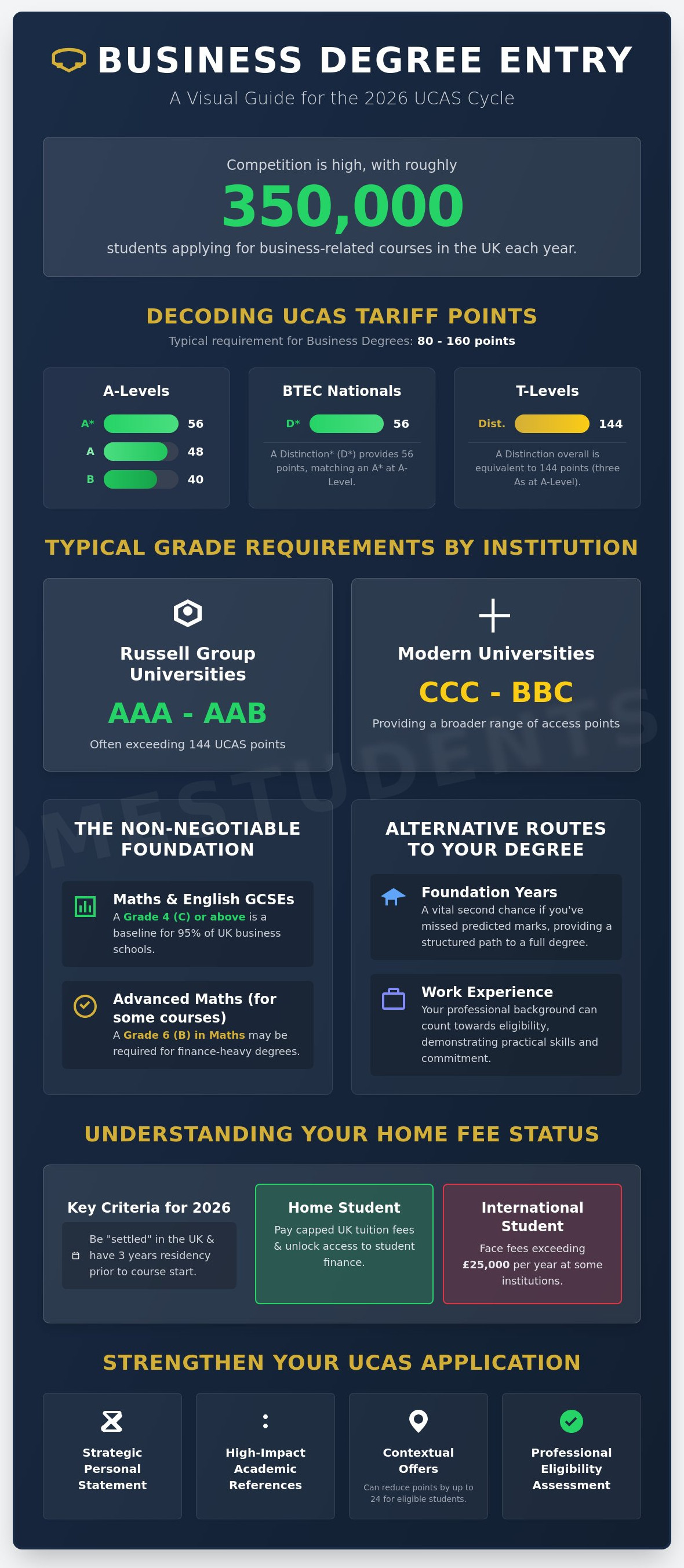
What if your predicted A-Level grades aren't the only way to secure a seat in a top-tier lecture theatre? If you're feeling overwhelmed by the upcoming 2026 UCAS cycle, you aren't alone. It's common to feel that a single lower-than-expected result might derail your entire career path before it begins. You likely already know that understanding business degree entry requirements can feel like a full-time job, especially when you're trying to calculate how your specific qualifications translate into the UCAS tariff system. With roughly 350,000 students applying for business-related courses in the UK each year, the competition is high, but the routes to entry are more flexible than you might think.
We're here to turn that confusion into a concrete plan of action. You'll gain a clear understanding of the grade boundaries for the UK's leading institutions and discover how alternative pathways, such as foundation years, can provide a vital second chance if you've missed your predicted marks. We'll also explain how your professional background can count towards your eligibility. This guide breaks down the essential criteria for the 2026 intake, giving you the tools to submit your application with total confidence and professional precision.
Key Takeaways
- Master the UCAS Tariff system to understand exactly how your current qualifications translate into the points required for a 2026 start.
- Compare A-Level and BTEC business degree entry requirements to determine which institutions align with your predicted grades and career goals.
- Explore alternative pathways, such as foundation years and work experience, designed for students seeking a non-traditional route into higher education.
- Gain actionable insights into strengthening your application through strategic personal statements and securing high-impact academic references.
- Learn how a professional eligibility assessment can streamline your journey and help you navigate the complexities of UK university admissions with confidence.
Understanding the Basics of Business Degree Entry Requirements in 2026
Understanding business degree entry requirements is the first step toward securing your future in the UK corporate world. These requirements are the minimum academic and personal standards you must meet to qualify for a university place. In 2026, these criteria serve as a practical roadmap for your application process. While traditional grades remain the cornerstone, the admissions landscape is changing. Universities are looking for a broader profile. This shift means your extracurricular achievements and life experiences are becoming as influential as your final exam results. A Business studies overview highlights how the subject bridges theory and practice, which is why admissions tutors now value practical insights alongside your UCAS points.
What are UCAS Tariff Points?
The UCAS Tariff system converts various qualifications into a single numerical score. This allows universities to compare an applicant with A-Levels to one with a T-Level or BTEC. For 2026 entry, business degree entry requirements typically fall between 80 and 160 points. Most institutions provide a clear breakdown of how they value different grades:
- A-Levels: An A* earns 56 points, an A earns 48, and a B earns 40.
- BTEC Nationals: A Distinction* provides 56 points, matching an A* at A-Level.
- T-Levels: A Distinction overall is equivalent to 144 points (three As at A-Level).
If you're applying to a Russell Group institution, expect the requirement to sit at the higher end of this scale, often exceeding 150 points. However, many universities now provide "contextual offers." These schemes reduce the point requirement by up to 24 points for students from under-represented backgrounds or specific postcodes, ensuring that talent isn't overlooked due to external circumstances.
The Importance of Home Fee Status
Your fee status determines whether you pay the capped UK tuition rate or the significantly higher international fees. To qualify as a "Home Student" in 2026, you generally need to be "settled" in the UK and have lived here for the three years prior to your course start date. This status is vital because it unlocks access to government-backed funding. If you're a local applicant, your eligibility for student finance birmingham depends entirely on this classification. Proving your residency through settled status or British citizenship ensures you can secure the tuition fee loans and maintenance grants necessary to fund your degree. Without this confirmation, you might face fees exceeding £25,000 per year at some institutions. Navigating these rules requires precision, but confirming your status early gives you a clear advantage in the application cycle.
Academic Qualifications: A-Levels, BTECs, and T-Levels
UK universities set their own benchmarks, so business degree entry requirements vary significantly across the country. If you're targeting Russell Group institutions for the 2026 intake, you'll likely need grades between AAA and AAB. More modern universities often offer places starting at CCC or BBC, providing a broader range of access points for students with different academic backgrounds. You should always check the UCAS entry requirements for business to see how specific institutions weight your predicted grades against their typical offers.
Don't overlook your GCSEs during the application process. Regardless of your Level 3 results, Grade 4 (C) in both Maths and English remains a non-negotiable baseline for 95% of UK business schools. Some competitive, finance-heavy courses might even ask for a Grade 6 (B) in Maths to ensure you're ready for the quantitative modules in accounting and data analysis.
A-Level Subject Choices
You don't actually need to study Business at A-Level to get onto a degree. Admissions tutors value "facilitating subjects" like Maths, Economics, or English Literature because they prove you can handle complex data and write critical reports. If you're mixing academic and vocational subjects, most universities accept this, provided you meet the total UCAS point threshold. If you're unsure if your current subject mix meets the criteria, you can request an expert assessment to clarify your options.
Vocational and Technical Pathways
BTEC Extended Diplomas are now a standard route into higher education. If you're looking at degree courses in Birmingham, you'll find that institutions like Birmingham City University or Aston frequently accept BTEC grades ranging from DDD to MMP. For 2026 applicants, the Business and Administration T-Level is a powerful alternative. This qualification includes a 45-day industry placement, which gives you a competitive edge during the application process by mapping directly to management degree modules.
- International Baccalaureate (IB): Typical offers range from 32 to 38 points, often requiring specific scores in Higher Level Maths or English.
- Access to Higher Education Diplomas: Ideal for those returning to study after a break, usually requiring 60 credits with at least 45 at Level 3.
- T-Levels: A Distinction in the Business T-Level is often viewed as equivalent to AAA at A-Level by many admissions teams.
The 2026 admissions cycle will see an even greater emphasis on these diverse pathways. Universities are increasingly looking for a "work-ready" mindset, meaning that your business degree entry requirements might be met through a combination of traditional exams and practical, vocational experience. This shift ensures that the system stays accessible to students from all educational backgrounds.
Alternative Entry Routes: Foundation Years vs. Work Experience
If your previous academic results don't reflect your current potential, you have several options to secure your future. Standard business degree entry requirements often focus on A-levels or BTECs, but UK universities recognise that talent exists outside of traditional exam halls. You can bridge the gap between your current qualifications and university expectations through structured pathways or professional history.
The Benefits of a Foundation Year
A foundation year acts as a "Year 0" designed to prepare you for the rigours of higher education. It's an ideal choice if you've been out of education for a while or missed your predicted grades. Most institutions set entry thresholds between 48 and 64 UCAS points for these programmes, which is significantly lower than the 112 to 128 points required for direct entry. This route allows you to build academic confidence while securing your place on a full degree. If you're looking to start a business management degree birmingham, an integrated foundation year ensures your funding is secured for the entire four-year duration through Student Finance England.
You should distinguish between an integrated foundation year and a standalone Access to Higher Education Diploma. An integrated year is part of your degree from day one, meaning you're a university student immediately. An Access course is a separate Level 3 qualification usually taken at a local college. Both are valid, but the integrated route often provides a more seamless transition into the university environment and culture.
Mature Student Entry Requirements
If you're aged 21 or over at the start of your course, you fall into the mature student category. Admissions teams for these applicants look beyond historical GCSE or A-level results. They want to see how your career history translates into academic capability. You'll need to provide a professional CV and a personal statement that highlights your leadership, teamwork, and problem-solving skills. According to the UCAS business and management subject guide, demonstrating practical industry knowledge can be just as valuable as formal qualifications in the eyes of many admissions tutors.
Our business management degree for mature students guide explains how to leverage your professional background to secure a place. Universities value the perspective you bring to the classroom. Your life skills aren't just buzzwords; they're evidence of your ability to manage time and meet deadlines. To succeed, you should focus on these key elements in your application:
- Professional references: A letter from a current or former employer can validate your work ethic.
- Accredited training: Include any industry-specific certifications or internal management training you've completed.
- Transferable skills: Detail your experience with budget management, staff supervision, or project delivery.
By focusing on these alternative routes, you can meet the business degree entry requirements even without a traditional academic background. Universities are increasingly flexible, seeking students who demonstrate a genuine commitment to their professional development.
Strengthening Your UCAS Application for Business Management
Meeting the minimum business degree entry requirements secures your place in the initial screening pile, but it doesn't guarantee an offer. To stand out among the 185,000 applicants who typically apply for business-related courses in the UK each year, you must demonstrate a blend of academic rigour and practical intuition. Admissions tutors look for candidates who understand that business isn't just a classroom subject; it's a way of viewing the world through a strategic lens.
The Personal Statement: Your Competitive Edge
Your personal statement is the only part of the UCAS form where you speak directly to the university. Instead of stating you are a "natural leader," you must prove it with evidence. If you worked a part-time retail job during 2024 or 2025, describe how you managed stock levels or handled difficult customer interactions to improve service. These are real-world applications of strategic thinking and supply chain awareness that tutors value highly.
Tutors look for commercial awareness. You should mention specific industry trends, such as the impact of automation on UK logistics or how shifting interest rates affect consumer spending. Avoid clichés like "ever since I was young" or "I want to be the next big entrepreneur." These phrases are overused and fail to show your unique perspective. Focus on what you've read in the Financial Times to show you're ready for undergraduate-level analysis. You'll need to demonstrate that you can connect global events to local business impacts.
Managing the Application Timeline
Timing is as critical as your grades. For the 2026 entry cycle, the UCAS "equal consideration" deadline is expected to be 29 January 2026. Missing this date means universities aren't obligated to look at your application if their course is already full. If you find yourself without offers after this date, UCAS Extra opens in late February 2026, allowing you to add another choice before Clearing begins in July.
You'll also need to prepare your documentation early. Ensure you have your GCSE certificates, valid ID, and residency proof ready for an expert assessment of your home student status. Securing a strong reference is equally vital. If you're a mature student, a professional reference from a manager can be more impactful than an old academic one, provided they highlight your analytical skills and reliability.
For courses at top-tier institutions, you might face a formal interview. These usually involve discussing a recent business news story or solving a logic puzzle to test your grit under pressure. Preparing for these scenarios ensures you remain calm and professional. You must show that you can think on your feet and defend your opinions with data.
If you feel overwhelmed by these steps, we can help you secure your university place with professional guidance on every aspect of your application.
How UK Home Students Simplifies Your University Entry
Navigating the path to university doesn't have to be a solo effort. UK Home Students provides a steady hand to help you clear the hurdles of the 2026 admissions cycle. We understand that meeting business degree entry requirements involves more than just having the right grades; it's about presenting your potential in a way that admissions tutors value. Our role is to turn confusion into clarity by providing a structured roadmap for your academic journey.
If you've lived in the UK for at least three years, you may be eligible for significant support that makes higher education more accessible. We act as your advocate, projecting the image of an expert who knows the inside track of the system. By breaking down dense information into manageable, bite-sized pieces, we ensure you never feel overwhelmed by the technical nature of university admissions.
Our Expert Consultancy Service
We bridge the gap between your current skills and the expectations of UK universities. If you've been out of formal education for several years, our team identifies flexible learning programmes that provide the necessary foundation for success. We offer full support with the UCAS application process, ensuring your personal statement reflects your strengths and professional experiences. We also provide specialised assistance with student finance, helping you secure the maintenance loans and tuition fee grants you're entitled to.
If you're already looking ahead to postgraduate study, we assist with the complexities of entering a masters degree birmingham. Our service is entirely free for qualified UK home students. We operate as your dedicated partner, ensuring that your business degree entry requirements are met through a combination of expert assessment and strategic planning. We take the stress out of the bureaucracy so you can focus on your studies.
- Detailed eligibility checks for home student status and settled status.
- Step-by-step guidance through the Student Finance England application.
- Personalised course matching based on your specific career goals.
- Professional review of all application documents to maximise your chances of acceptance.
Start Your Journey Today
Your academic background doesn't define your future. Even if you don't have traditional qualifications, your work history and determination are valuable assets that many universities recognise. We've helped thousands of students secure their places by finding the right entry routes and funding packages. Don't let the complexity of the system hold you back from achieving your potential.
Book your free consultation with our expert advisors today. We'll help you find a programme that fits your lifestyle and career ambitions for the 2026 intake. Taking this first step is the most important move you can make toward a rewarding business career. Let's work together to secure your place and your funding.
Secure Your Place in a 2026 Business Programme
Navigating the 2026 admissions landscape requires more than just meeting basic criteria. You've seen how A-Levels, T-Levels, and BTECs each offer distinct routes into the lecture hall. Whether you're leaning on professional experience or traditional grades, understanding the specific business degree entry requirements for your chosen institution is the first step toward a successful application. Success often depends on how you present your profile to UCAS and how you secure your funding through Student Finance England.
UK Home Students provides expert guidance on flexible degree pathways tailored to your unique background. Our team offers dedicated support with UCAS applications and Student Finance England to ensure you meet the January 2026 deadline without stress. With an established national network of partner universities, we help you find the right fit for your career goals. You don't have to face the complex bureaucracy of the UK education system alone.
Secure your future with an expert assessment from UK Home Students today. We're ready to help you turn your academic ambitions into a reality.
Frequently Asked Questions
What is the minimum UCAS tariff for a business degree?
The minimum UCAS tariff for a business degree typically starts at 80 points for foundation year entries, while top-tier Russell Group universities often require between 144 and 160 points. If you're applying to a mid-ranking institution, you'll likely need to secure between 104 and 120 points. These points are calculated from your A-Levels, BTECs, or T-Levels. Always check the specific business degree entry requirements for your chosen university, as 95% of institutions set their own individual benchmarks.
Can I get into a business degree without A-Level Maths?
You can certainly get into a business degree without A-Level Maths at the vast majority of UK universities. While elite institutions like LSE or Warwick often require a Grade 7 at GCSE or an A at A-Level, roughly 85% of business programmes accept any three A-Level subjects. If you have a Grade 4 or 5 in GCSE Maths, you'll qualify for most courses. This ensures that students from diverse academic backgrounds can still pursue a career in management and finance.
Do universities accept work experience instead of A-Levels?
Many universities accept substantial work experience in place of traditional A-Levels through the APEL (Accreditation of Prior Experiential Learning) route. If you've spent three or more years in a professional or managerial role, you may qualify for entry without standard level 3 qualifications. You'll usually need to provide a comprehensive CV and a professional reference to prove your competency. This pathway is particularly common for those applying to executive or part-time business programmes as mature learners.
What is a foundation year in business management?
A foundation year in business management is a one-year introductory course designed for students who don't meet the initial business degree entry requirements. It acts as a bridge, providing the essential academic skills needed for the full three-year degree. Once you pass this year with the required percentage, usually 40% or 50%, you'll automatically progress to the first year of your chosen degree. It's an excellent way to build confidence if you've been out of education for a while.
Is BTEC Business equivalent to A-Levels for university entry?
A BTEC Level 3 National Extended Diploma in Business is considered equivalent to three A-Levels by 98% of UK universities. A Distinction* Distinction* Distinction* (D*D*D*) grade carries 168 UCAS points, which is the same as three A*s at A-Level. If you're studying a BTEC, you'll find that most admissions tutors value the practical, assignment-based nature of the course. It provides a solid foundation for the more vocational aspects of a university business degree and prepares you for independent study.
What happens if I don't meet my predicted grades for business?
If you don't meet your predicted grades, you can still secure a place through the UCAS Clearing process, which opens every July. In 2024, over 30,000 students found university places through Clearing after missing their original offers. Alternatively, your firm choice university might offer you a "changed course offer" for a foundation year instead. Don't panic, because there are always alternative routes available to help you reach your academic goals through different institutions.
Are there specific entry requirements for mature students?
Mature students, defined as those aged 21 or over at the start of their course, often benefit from more flexible entry criteria. If you don't have recent A-Levels, universities frequently accept an Access to Higher Education Diploma or relevant professional certifications. Around 25% of business students are mature learners who bring valuable life experience to the classroom. Your application will be assessed on your professional background and your potential to succeed, rather than just exam results from several years ago.
How many UCAS points is a T-Level worth in 2026?
In 2026, a T-Level is worth up to 168 UCAS points, matching the weight of three A-Levels. A T-Level Distinction* provides 168 points, a Merit offers 120 points, and a Pass (C or above on the core) gives you 96 points. These qualifications are specifically designed with employers to ensure you have the technical skills needed for the modern workforce. Because T-Levels include a 45-day industry placement, they're highly regarded by admissions tutors for business-related subjects.