

What if you could qualify for a £30,000 starting salary in the booming UK tech sector while only attending university two days a week? Many UK Home Students feel that the path to a computing degree birmingham is blocked by confusing UCAS entry routes or the daunting prospect of a £9,250 annual tuition fee. You likely worry about how your household budget will survive or how you'll manage a full-time study load alongside your current work and family commitments.
We're here to change that narrative and provide the clarity you need. This guide provides a clear roadmap to secure your place for the 2026 intake, ensuring you maximize your maintenance loan and find a course structure that respects your existing schedule. We'll walk through the eligibility criteria for student finance, the simplified application process for university campuses nationwide, and the specific steps to launch your high-growth tech career by 2029.
Key Takeaways
- Understand the professional significance of the "Hons" distinction and how to align your degree specialism with high-growth career paths like software engineering or IT management.
- Navigate the 2026 UCAS entry requirements and discover how a Foundation Year pathway can provide a secure route into university if you lack traditional A-levels.
- Identify your eligibility for Home Student status to qualify for government-backed funding, ensuring you can secure your computing degree birmingham with no upfront tuition costs.
- Learn how to leverage expert university career services and networking workshops to transition seamlessly into lucrative roles such as Cyber Security Analyst or IT Consultant.
What is a BSc (Hons) Computing Degree?
A BSc (Hons) Computing is a versatile undergraduate qualification designed for students who want to master the creation, management, and security of digital solutions. If you're looking for a computing degree birmingham offers a range of pathways that focus on the practical application of software and systems within modern business environments. The "Hons" distinction signifies an Honours degree, which typically involves a significant final-year research project or dissertation. This status is vital for your future academic progression, as most UK universities require an Honours degree for entry into postgraduate Master’s or PhD programs.
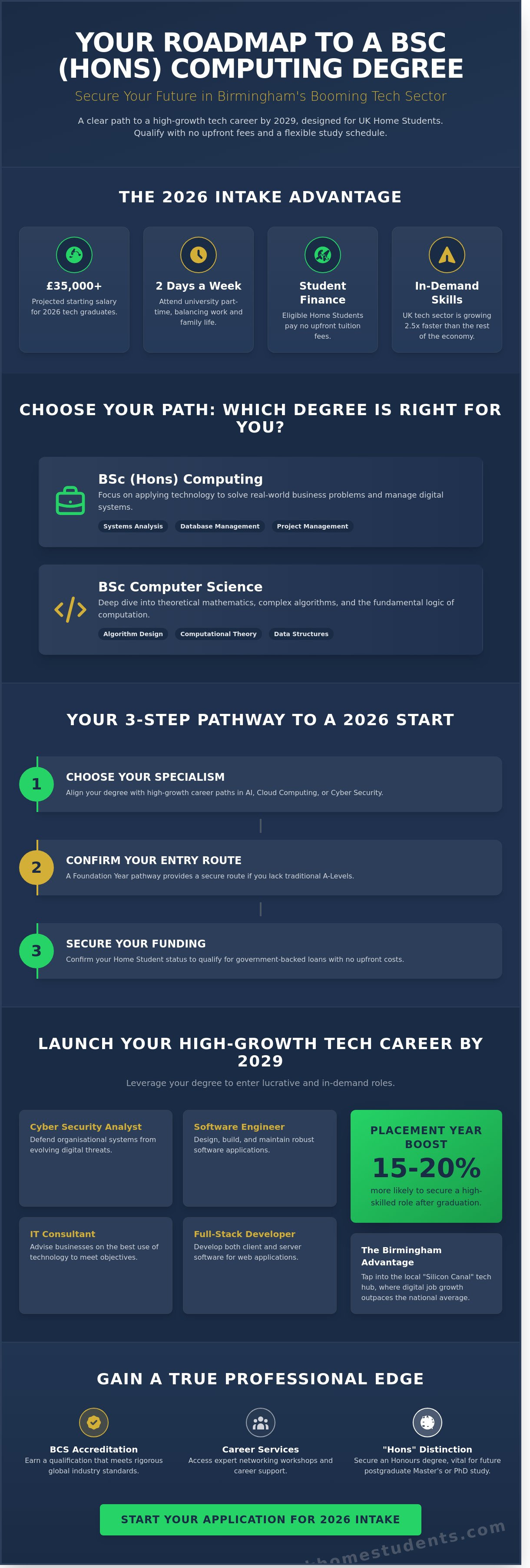
Many students confuse this course with computer science, but the two paths serve different career goals. While computer science is often rooted in theoretical mathematics and complex algorithmic logic, a computing degree focuses on how technology is applied to solve real-world problems. By 2026, the UK tech market will prioritize graduates who possess these applied digital skills. Industry data from the UK Digital Economy Council suggests that the sector is growing 2.5 times faster than the rest of the economy, creating a massive demand for professionals who can implement functional tech strategies immediately.
Core Modules and Skills You Will Acquire
Your curriculum will provide a balance of technical expertise and strategic thinking. You'll study software development, database management, and the fundamentals of cybersecurity to protect organizational data. Employers in 2026 will also look for "soft skills" such as project management and systems analysis, which allow you to bridge the gap between technical teams and business stakeholders. Full-stack development is a core competency in modern curricula. These modules ensure you're prepared for the fast-paced nature of the Birmingham tech hub.
- Software Engineering: Learning to design and maintain robust applications.
- Network Security: Understanding how to defend systems against evolving digital threats.
- Systems Analysis: Evaluating business needs and designing appropriate IT solutions.
The Value of a Computing Qualification in the UK
Securing a formal degree provides a distinct competitive advantage over self-taught developers. While independent learning shows initiative, a degree offers a structured, peer-reviewed portfolio that proves your competency to recruiters. Many programs in the UK are accredited by professional bodies like the BCS, The Chartered Institute for IT. This accreditation acts as a seal of quality, ensuring your education meets the rigorous standards of the global technology industry.
The financial prospects for graduates remain strong. By 2026, average graduate salary expectations for entry-level tech roles in the UK are projected to reach approximately £35,000, with specialized roles in Birmingham's growing "Silicon Canal" often exceeding this figure. Choosing a computing degree birmingham allows you to tap into this local economic growth while gaining a qualification that is recognized worldwide. It's a strategic move that transforms your interest in technology into a professional career with long-term stability.
Choosing the Right Computing Degree Specialism
Selecting a computing degree birmingham requires a strategic approach to your future. The West Midlands tech sector is expanding rapidly. Data from 2024 suggests that digital jobs in the region are growing faster than the national average, creating a high demand for skilled graduates. You'll need to decide whether you want to be a technical architect or a strategic manager before you submit your application.
Computing vs. Software Engineering
A BSc in Computing provides a broad foundation. It focuses on how business systems integrate with IT infrastructure and how data flows through an organisation. This path is often ideal for career changers who want to understand the "big picture" of technology within a corporate environment. In contrast, Software Engineering is a deep dive into the software development lifecycle. You'll spend your time mastering programming languages and system architecture. If you're a technical specialist who enjoys solving complex logic puzzles, this is your route. Understanding the different Career Outcomes for these paths is essential for your long-term success.
By 2026, specialized pathways in AI, Cloud Computing, and Data Analytics will dominate the hiring landscape. Choosing a course that offers these modules ensures you stay competitive. Many Birmingham providers now include a Professional Placement Year. Statistics from the Graduate Outcomes survey consistently show that students who complete a year in industry are 15% to 20% more likely to secure a high-skilled role within six months of graduation. It's a practical way to build a professional network and earn a salary, often ranging from £16,000 to £22,000, while you study.
Flexible Learning: 2-Day Attendance Models
Balancing a degree with existing commitments is a common hurdle for UK Home Students. Several institutions in Birmingham now offer condensed timetables, often referred to as 2-day attendance models. This structure allows you to attend all your on-campus lectures within two specific days each week. The rest of your learning is delivered through blended online platforms. This flexibility is vital if you're working part-time or managing family responsibilities.
You can request a professional assessment to see how these flexible programmes fit your specific circumstances. Always verify the specific attendance requirements before you commit to a UCAS application. This ensures the pace is manageable and that you can maintain your work-life balance without compromising your academic performance. Moving from confusion to clarity starts with choosing a timetable that respects your time.
Entry Requirements: Pathways for Every Student
Securing your place on a computing degree birmingham requires meeting specific criteria, but the 2026 entry cycle offers more flexibility than ever before. Standard UCAS tariff requirements for most Birmingham universities typically fall between 104 and 120 points. This usually means achieving grades of BCC to BBB at A-Level. If you are pursuing a BTEC Extended Diploma, you will generally need a Merit, Merit, Distinction (DMM) profile. These requirements ensure you have the logical foundation necessary to handle programming and data structures.
If you don't hold these traditional qualifications, you can still access higher education through the Access to HE Diploma. This one-year intensive course is designed for adults returning to study. Most computing departments require 45 credits at Level 3, with a focus on mathematics or science-based modules. It is a proven route that prepares you for the rigours of a full degree while fitting around your existing life commitments.
The Benefits of a Foundation Year
A Foundation Year, often called Year 0, acts as a preparatory stage for students who don't meet the initial entry grades or those changing career paths. It builds your academic confidence and introduces technical basics like Python or Java in a supportive environment. You will gain the essential study skills needed to thrive in a university setting without the immediate pressure of Level 4 modules.
Funding is a major advantage here. Student Finance England covers the tuition fees and maintenance loans for the foundation year just as they do for the rest of your degree. You can qualify for the full four years of funding under the standard "length of course plus one year" rule. For a comprehensive list of local options, you should consult our guide on University Courses with Foundation Year Birmingham.
Applying as a Mature Student
You are classified as a mature student if you are 21 or older on the day your course begins. Universities in Birmingham value these applicants because they often bring high levels of dedication and diverse perspectives to the lecture hall. If you have been working in a technical or analytical role, your professional experience can sometimes substitute for formal UCAS points.
- Highlight Transferable Skills: Your personal statement should focus on problem-solving, project management, and time management skills gained in the workplace.
- Demonstrate Motivation: Explain why you are choosing to pivot to a computing degree birmingham now and how your career history supports this transition.
- Evidence of Recent Study: If you've completed any industry certifications like CompTIA or Cisco, include these to prove your technical aptitude.
Admissions tutors look for potential rather than just past exam results. They want to see that you have the resilience to complete a three or four-year programme. Professional maturity often translates into better time management and higher achievement rates, making you a highly desirable candidate for local institutions.
Funding Your Computing Degree Birmingham in 2026
Securing your computing degree birmingham requires a clear financial strategy. Your eligibility for government support hinges almost entirely on your 'Home Student' status. If you've been a resident in the UK for at least three years prior to the start of your course, you'll likely qualify for the most comprehensive funding packages. This status is the primary factor that determines whether you pay the lower domestic tuition rates or the significantly higher international fees.
Tuition Fee Loans are designed to ensure that cost isn't a barrier to entry. You don't pay these fees out of your own pocket while you're studying. Instead, Student Finance England pays the university directly. For a computing degree birmingham, this covers the full cost of your annual tuition. You won't start paying this back until you've finished your studies and your income reaches a specific level.
Maintenance Loans provide the cash you need for daily life. Whether you're paying rent in Selly Oak or buying groceries in the city centre, these funds arrive in three instalments throughout the academic year. The amount you receive is tailored to your specific circumstances, ensuring that students from all backgrounds can focus on their coding projects rather than their bank balances.
By 2026, most new students will be under the Plan 5 repayment terms. You only start contributing once your annual income exceeds £25,000. Your repayments are calculated at 9% of whatever you earn above that specific figure. If you earn £26,000, you only pay 9% on £1,000, which is roughly £7.50 per month. If your salary drops below the threshold, your payments stop automatically.
Maximizing Your Maintenance Loan
Several variables dictate the size of your maintenance loan. Your household income is the biggest factor, but your age and living arrangements also matter. Students over 25 often qualify as independent, which can lead to higher support levels. If you have children or a disability, you could access additional help like the Disabled Students’ Allowance (DSA), which doesn't need to be paid back. For a detailed breakdown of costs in the West Midlands, read our Student Finance in Birmingham guide.
The Application Process for Student Finance England
Timing is everything when it comes to funding. Aim to submit your Student Finance England application by the end of May 2026. This ensures your money arrives in time for your first week of lectures. You'll need to provide your valid UK passport, your National Insurance number, and evidence of your household's income from the previous tax year. A maintenance grant is a non-repayable sum for eligible students. Don't wait for a confirmed university place to start the process; you can update your course details later.
Ready to secure your financial future? Apply for an expert assessment to confirm your funding eligibility today.
Career Outcomes and How to Apply
Earning a computing degree birmingham puts you at the center of the UK’s fastest-growing tech hub outside London. By 2026, the demand for specialized tech talent is expected to reach record levels. Local businesses are actively seeking Cyber Security Analysts to defend digital infrastructures and IT Consultants to guide their transition into AI-driven operations. Your degree isn't just a certificate; it's a gateway to a sector that currently contributes billions to the West Midlands economy.
To maximize your employability, you should engage with your university’s careers service as early as your first year. These departments provide tailored CV workshops that help you translate academic projects into professional achievements. They also host networking events where you can meet recruiters from Birmingham's burgeoning "Silicon Canal" startups and established global firms. Building these connections early ensures you have a competitive edge before you even graduate.
Top Careers for Computing Graduates
- Software Developer: You'll design and build the applications that drive the future of commerce and social interaction.
- IT Project Manager: This role requires leading large-scale digital transformations and managing technical teams within major organizations.
- Data Scientist: You'll use advanced algorithms to turn big data into actionable business strategies, a role that is increasingly vital for 2026 market competitiveness.
The application journey for UK home students follows a specific, structured path through UCAS. You must register on the UCAS Hub, select your preferred Birmingham institutions, and draft a personal statement that highlights your technical curiosity. The standard deadline for 2026 entry is expected to be in late January. It's essential to track your application status regularly and ensure your predicted grades align with the specific entry requirements of your chosen course.
Get Expert Help with Your Application
Managing the bureaucracy of university admissions and student finance can feel overwhelming. Using an educational consultant to vet your application provides a necessary professional advantage. UK Home Students acts as a steady hand, ensuring your "Home" status is correctly identified so you can secure the tuition fee grants and maintenance loans you're entitled to. We provide an expert assessment of your eligibility, reducing the anxiety of the application process. For a broader look at your options in the city, view our Birmingham Degree Courses Guide.
2026 is the perfect time to start your computing degree birmingham. The city's tech infrastructure is expanding, and the demand for skilled graduates has never been higher. Take control of your future by starting your application today. With the right support and a clear plan, you can turn your interest in technology into a high-impact professional career.
Start Your Journey to a Tech Career in Birmingham Today
Birmingham's digital economy is projected to grow significantly by 2026, making it a premier hub for aspiring tech professionals. By choosing a computing degree birmingham, you're positioning yourself at the heart of a city where tech vacancies now account for 12% of all local job openings according to recent UK government data. You'll gain access to specialized skills in high-demand fields like AI and data science while securing your financial future through Student Finance England's maintenance loans and tuition fee grants.
Navigating the 2026 entry requirements and funding applications doesn't have to be overwhelming. If you're ready to transition into higher education, we're here to provide the steady hand you need. Our team offers an expert assessment of your eligibility and direct support with your UCAS and Student Finance applications. Through our partnerships with flexible UK universities, we'll help you find a programme that fits your lifestyle and career goals.
Apply for your Computing Degree with expert guidance today and take the first step toward a rewarding professional future with confidence.
Frequently Asked Questions
What are the typical entry requirements for a computing degree in 2026?
Typical entry requirements for a computing degree in Birmingham in 2026 generally range between 96 and 120 UCAS tariff points. This usually equates to grades CCC or BBB at A-level. You'll also need at least five GCSEs at grade 4 or above, which must include English and Mathematics. Some institutions might accept relevant Level 3 BTEC qualifications as an alternative to traditional A-levels.
Can I study a computing degree part-time or with flexible attendance?
You can certainly study a computing degree part-time or through flexible attendance models in Birmingham. Many local institutions offer blended learning where you attend campus two days a week and complete the rest of your modules online. This structure helps you balance your studies with work or family commitments while still qualifying for pro-rata student finance and maintenance support.
Do I need a background in A-level Maths to study computing?
You don't always need A-level Maths to study a computing degree in Birmingham. While theoretical Computer Science courses often require a grade B or higher in Maths, many BSc Computing programmes focus on practical application. These courses accept A-levels in various subjects or Level 3 BTEC Extended Diplomas in IT, provided you can demonstrate logical thinking and basic numeracy skills.
How much student finance can I get for a computing degree in Birmingham?
If you're a full-time student, you can secure a tuition fee loan of up to £9,250 per year to cover your course costs. For living expenses in Birmingham, the maximum maintenance loan for the 2024/25 academic year is £10,227 for students living away from home. Your specific eligibility depends on your household income and your residency status under Student Finance England regulations.
What is the difference between Computer Science and a Computing degree?
The main difference lies in the level of theoretical mathematics and hardware architecture involved. A Computer Science degree focuses heavily on the underlying logic and algorithm development. In contrast, a computing degree Birmingham providers offer usually emphasizes practical software development, networking, and how technology solves business problems. It's often seen as a more vocational route into the tech industry.
Is it worth doing a computing degree with a foundation year?
A computing degree with a foundation year is highly beneficial if you don't meet the standard UCAS point requirements or have been out of education for several years. It provides a solid introduction to programming and academic writing. Statistics from the Office for Students show that foundation years significantly increase completion rates for students from non-traditional backgrounds, making it a secure path to success.
What kind of jobs can I get with a BSc (Hons) Computing?
Graduates with a BSc (Hons) Computing can secure roles such as Software Developer, IT Consultant, or Cyber Security Analyst. The tech sector in Birmingham is the largest outside London, with over 100,000 people employed in digital roles. You'll be qualified to work in diverse industries ranging from financial services to specialized tech start-ups, often starting with salaries between £25,000 and £35,000.
How do I apply for a computing degree as a mature student?
If you're over 21, you apply for a computing degree Birmingham through the standard UCAS system. Universities often prioritize your professional experience and transferable skills over your previous school grades. You'll need to write a personal statement that highlights your motivation for returning to education. If you don't have recent qualifications, an Access to Higher Education Diploma is an excellent way to qualify.