

What if your student loan isn't actually a debt in the way you've been told? While a typical bank loan demands repayment regardless of your salary, the student loan repayment uk system functions more like a graduate contribution that only triggers when you earn above a specific threshold. If you feel a sense of dread looking at interest rates or worry that a future mortgage application will be rejected because of your balance, your concerns are completely valid. It's easy to feel lost when the rules seem to change with every new academic cycle.
We're here to shift that narrative from anxiety to empowerment. You'll master the complexities of the 2026 system and discover why these payments are far more manageable than the headlines suggest. This guide provides a clear breakdown of monthly costs for Plan 2 and Plan 5 borrowers, explains exactly how lenders assess your affordability, and gives you the confidence to secure your future without financial fear.
Key Takeaways
- Understand why your repayments are based on your actual income rather than the total balance, ensuring your monthly budget remains manageable.
- Navigate the updated 2026 thresholds for Plan 2 and Plan 5 to accurately calculate your expected student loan repayment uk obligations.
- Gain clarity on why financial experts view student debt as a 'graduate tax' and how this affects your credit score and future mortgage applications.
- Learn how to manage your account effectively during career changes or self-employment to ensure you stay compliant with Student Finance regulations.
- Discover how a personalised assessment can help you secure the maximum maintenance loans and grants available to support your academic journey.
Understanding the UK Student Loan Repayment System
The UK student loan system is a government-backed funding structure designed to ensure higher education remains accessible to all home students. It functions differently from a standard commercial bank loan. Instead of fixed monthly instalments based on the total amount you've borrowed, your student loan repayment uk is strictly linked to your income. This means your debt is managed as a percentage of your earnings, providing a built-in safety net if your salary fluctuates or if you're between jobs.
Two main organisations manage this process to keep it seamless for the borrower. The Student Loans Company (SLC) handles the administration of your account, while HMRC collects repayments directly from your salary through the Pay As You Earn (PAYE) system. If you're self-employed, you'll manage this through your annual self-assessment. Your total balance typically consists of two parts: Tuition Fee Loans, which the SLC pays directly to your university, and Maintenance Loans, which are paid into your bank account to help with your daily living costs.
Which Repayment Plan Are You On?
Identifying your specific plan is vital because it dictates your interest rates and your repayment threshold. If you started your course between 1 September 2012 and 31 July 2023, you're on Plan 2. For those who began their studies from September 2023 onwards, the government introduced Plan 5. While Plan 1 and Plan 4 exist for older students or those from Northern Ireland and Scotland, most current undergraduates in England will be on Plan 2 or 5. You can easily verify this by logging into your Student Finance portal to check your original loan agreement. This ensures your student loan repayment uk is calculated using the correct legal framework for your graduation year.
When Does Repayment Actually Start?
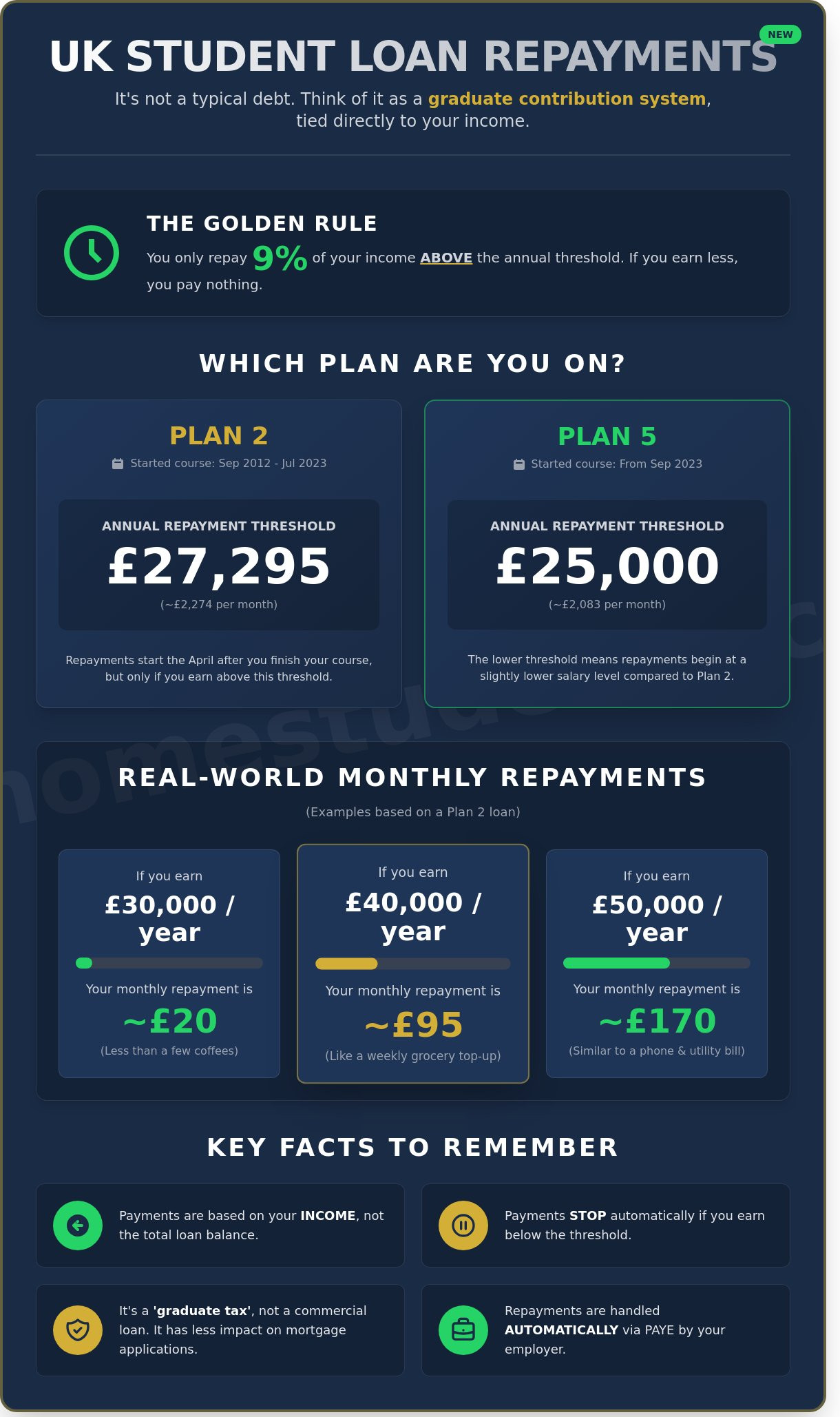
You won't pay a single penny back until the April after you finish or leave your course. This "grace period" allows you time to secure employment and find your feet. Even after this date, repayments only trigger if your income exceeds the minimum threshold for your specific plan. For Plan 2, this is currently £27,295 per year, while Plan 5 graduates start paying once they earn over £25,000. If you leave your course early or study part-time, these rules still apply. For part-time students, repayments usually begin the April four years after the course started, provided your income is high enough. If your salary ever drops below the threshold, your payments stop automatically, protecting your financial stability.
Calculating Your Monthly Repayments and Thresholds
Understanding your student loan repayment uk obligations starts with grasping the concept of the "repayment threshold." You don't pay back a penny until your income exceeds a specific limit set by the government. For the 2026 period, these thresholds depend on when you started your course. If you started between 2012 and 2023, you're likely on Plan 2, with a threshold of £27,295. Students starting from September 2023 onwards are on Plan 5, which carries a lower threshold of £25,000.
Your repayments are calculated as 9% of whatever you earn above these figures. It's vital to remember that this calculation applies to your gross pay, which is your salary before tax or National Insurance is deducted. However, the money actually leaves your bank account from your take-home pay. This makes the impact feel more direct on your monthly budget. For the most accurate and up-to-date figures, you should consult the official government guidance on student loan repayment to see how specific changes might affect your personal circumstances.
Repayment Examples for 2026
The threshold is the salary floor below which no payments are required. This system ensures that if your income drops or you're between jobs, your financial burden automatically eases. If you're an employee, these student loan repayment uk deductions happen automatically via the PAYE (Pay As You Earn) system. You don't need to set up bank transfers; your employer handles the math before your salary reaches your account.
To help you visualise the monthly impact, consider these scenarios for a Plan 2 borrower:
- £30,000 Salary: You earn £2,705 over the threshold, resulting in a payment of approximately £20 per month.
- £40,000 Salary: You earn £12,705 over the threshold, leading to a monthly deduction of roughly £95.
- £50,000 Salary: You earn £22,705 over the threshold, which equals a monthly cost of about £170.
Postgraduate Loan Repayments
If you've pursued a Master's or Doctoral degree, your repayment structure changes slightly. Postgraduate loans are repaid at a rate of 6% for earnings over £21,000. This threshold is lower than undergraduate plans and generally stays fixed for longer periods. If you have both an undergraduate and a postgraduate loan, these deductions are cumulative. This means a total of 15% of your income above the respective thresholds will be deducted from your pay.
Managing multiple loan types can feel complex, but it's part of a structured path toward your career goals. If you're unsure which plan applies to you, getting an expert assessment of your student status can provide the clarity you need to plan your financial future with confidence.
The 'Graduate Tax' Perspective: Reframing Student Debt
Calling the UK student finance system a "loan" is technically accurate but functionally misleading. For the vast majority of graduates, your student loan repayment uk operates much more like a 9% graduate tax than a standard bank debt. Unlike a car loan or a personal credit line, you don't pay back a fixed monthly amount. Your contributions are tied strictly to what you earn, not what you owe. If your income drops below the threshold, your payments stop instantly without any penalties or "missed payment" marks on your record.
A common concern is whether this debt prevents you from securing a mortgage or affects your credit score. It doesn't. Student loans do not appear on your credit report. While mortgage lenders will look at your monthly take-home pay to assess affordability, the loan itself isn't viewed as a financial red flag. It's simply another deduction from your payslip, similar to National Insurance or pension contributions.
The system also includes a built-in "expiry date" that provides long-term peace of mind. For those on Plan 2 (starting university between 2012 and 2023), any remaining balance is cancelled after 30 years. For those on Plan 5 (starting from September 2023), the write-off occurs after 40 years. Because interest rates can seem high, many students worry about the total balance growing. However, because the debt is cancelled regardless of the size of the balance, the interest rate only truly matters to the highest earners who might actually pay the full amount back.
Student Loans vs. Commercial Bank Loans
The primary difference between these two forms of borrowing is the safety net. If you lose your job or take a career break, you don't have to worry about debt collectors or bailiffs. The system is designed to protect those working in essential but lower-paid sectors, such as Health and Social Care. You only contribute when you're financially able to do so. To see exactly how much you'll be expected to pay at different salary levels, you should check the official government guidance on repayment thresholds.
- No Default Risk: Your credit rating remains untouched even if you don't pay back a single penny for years due to low earnings.
- Automatic Deductions: Most repayments happen via PAYE, so you don't have to manage the administration yourself.
- Income-Linked: You only pay 9% of your income above the threshold, ensuring you always keep the bulk of your earnings.
Should You Ever Pay Back Your Loan Early?
Financial experts, including those following the "MSE approach," generally advise against overpaying your student loan. Since the debt is wiped after 30 or 40 years, any extra money you put in now might be wasted if the loan was going to be cancelled anyway. Only the top 25% of earners are likely to clear their full balance plus interest before the write-off period ends. If you're returning to education later in life, your repayment window might be even shorter. Our guide on student loan for mature students explains how these rules apply specifically to older learners and their unique financial timelines.
Managing Your Repayments in Changing Circumstances
Your career path and living situation will likely evolve over the years. It's your responsibility to keep the Student Loans Company (SLC) informed to ensure your student loan repayment uk status remains accurate and compliant. If you change employers, your new payroll department usually handles deductions automatically via the PAYE system. However, if you move house, you must update your contact details via your online account immediately to avoid missing critical correspondence regarding your balance.
For those working for themselves, the process moves away from monthly payroll. You'll manage repayments through your annual HMRC Self Assessment tax return. HMRC calculates 9% of your income above the relevant threshold after you've submitted your figures. It's vital to set aside funds throughout the year to cover this lump sum payment, which is typically due by 31 January. Failing to account for this can lead to unexpected financial pressure when your tax bill arrives.
You might be eligible for a refund if you've overpaid your loan. This frequently occurs if your annual income was below the threshold but you had a high-earning month with bonuses, or if deductions continued after your balance was cleared. In 2023, data indicated that thousands of graduates were owed refunds for these specific reasons. You can request a refund by contacting the SLC directly, provided you have your P60 and relevant payslips as evidence of the overpayment.
Repaying While Living Overseas
If you plan to live abroad for more than three months, you must notify the SLC. They'll ask you to complete an Overseas Income Assessment form to determine your new repayment schedule. Thresholds aren't fixed; they're adjusted based on the cost of living in your specific country. For instance, the threshold for a graduate in Australia will differ from one in Poland. You can manage your account and make payments in local currency through the online portal. Ignoring this requirement leads to fixed monthly "arrears" charges and higher penalty interest rates, which can significantly increase your total debt.
Mature Students and Career Changes
Returning to education as a mature student requires a strategic look at your existing debt. While having a previous loan doesn't automatically bar you from new funding, it can limit your options for certain degree courses. Many home students find success by targeting subjects with specific government incentives, such as nursing, social work, or teaching, where second-degree funding is more accessible. If you're planning a career pivot, identifying which pathways qualify for "Equivalent or Lower Qualification" (ELQ) exemptions is essential to secure your tuition fee grants and maintenance loans.
Contact our expert advisors today to secure your funding for a second degree.
How UK Home Students Simplifies Your Academic Journey
Navigating the complexities of the UK higher education system often feels like a full-time job. If you're worried about how your student loan repayment uk will look in the future, or how to fund your studies today, you aren't alone. We act as your dedicated advocate, transforming a confusing bureaucratic process into a clear, manageable path toward your degree. Our team focuses on bridging the gap between financial anxiety and academic success by providing expert guidance on securing the maximum funding you're entitled to receive.
We provide a personalised assessment of your specific situation. This ensures you understand exactly which maintenance loans and grants you qualify for before you even submit an application. By identifying your eligibility for support early, we help you avoid the common pitfalls that lead to delayed funding or rejected applications. Our support extends beyond finance; we help you find the right flexible course that fits your lifestyle, ensuring your academic journey is sustainable from day one.
- Maximum Funding: We ensure you access every pound of maintenance support available to your specific demographic.
- Eligibility Clarity: Our experts break down complex rules regarding settled status and residency.
- Application Support: We assist with UCAS and Student Finance England to ensure your data is accurate.
- Flexible Learning: We match you with institutions that offer schedules compatible with work and family life.
Our Expert Assessment Process
We take the guesswork out of the Student Finance England application. If you've lived in the UK for several years but aren't sure of your status, our advisors provide the clarity you need. We specialise in helping mature students understand their unique funding pathways, which often differ significantly from those of school leavers. By handling the intricate requirements of paperwork and evidence submission, we allow you to focus entirely on your studies. You won't have to spend hours on hold or decoding complex government jargon because we provide the "inside track" on the system.
Secure Your Future Today
Professional advice is a vital step before you commit to a long-term academic or financial obligation. Understanding the long-term impact of a student loan repayment uk requires a clear view of your future earnings and the current interest regulations. We invite you to start your journey with a free consultation from our team. We'll review your circumstances and help you qualify for the best possible support package. For a deeper dive into the specific opportunities available in your area, read our student finance guide for more details. Your future is too important to leave to chance; let us help you secure it with confidence.
Taking Control of Your Financial Future in 2026
Navigating the student loan repayment uk landscape requires a clear understanding of your specific plan. For students entering the system in 2026, the Plan 5 threshold is set at £25,000 until April 2027. You'll contribute 9% of earnings above this amount, which functions more like a graduate tax than a standard bank loan. This structure ensures your repayments remain affordable and proportional to your success. If you're a mature student or navigating complex eligibility rules, professional support makes the difference between confusion and confidence.
UK Home Students offers expert guidance on UK Home Student status and specialises in mature student university placement. Our team provides comprehensive support for Student Finance England applications to ensure you secure the funding you deserve. We act as your advocate, turning intricate regulations into a clear path forward. Don't let bureaucracy stand in the way of your degree. You've got the ambition; let us provide the expertise to help you reach the finish line with total peace of mind.
Secure your expert student finance assessment with UK Home Students today
Frequently Asked Questions
Is the student loan repayment deducted before or after tax?
Your student loan repayment uk is deducted from your gross salary before you receive your take-home pay, but after Income Tax and National Insurance are calculated. This means your loan repayments don't reduce the amount of tax you owe to HMRC. If you're an employee, your company handles this through the PAYE system, so the money leaves your account automatically each payday. This ensures you stay compliant without any manual intervention.
Can I get a mortgage with a student loan in the UK?
You can certainly secure a mortgage while repaying a student loan. Lenders don't treat this like a credit card or personal loan debt, though they do include the monthly cost in their affordability assessments. Because the repayment reduces your monthly net income, it might slightly lower the maximum amount a bank is willing to lend you based on their standard 4.5 times salary multiplier. Most graduates find it doesn't prevent them from buying a home.
What happens to my student loan if I never earn enough to pay it back?
If your income never reaches the specific repayment threshold for your plan, you won't pay back a single penny. For example, if you're on Plan 2 and earn £25,000, you're below the £27,295 limit and no deductions occur. The debt remains on your record but doesn't affect your credit score. It'll eventually be cancelled after the fixed term expires, meaning you're protected if your career path leads to lower-paid roles.
How much interest is added to my student loan in 2026?
In 2026, the interest rate on your loan will be determined by the Retail Price Index (RPI) from March 2025. For Plan 2 students, the rate is usually RPI plus up to 3%, while Plan 5 interest is strictly tied to RPI. The government often applies a Prevailing Market Rate cap, which in late 2023 limited interest to 7.9% to protect graduates from high inflation. You can check your specific rate via the online repayment portal.
Do I have to pay back my student loan if I move to another country?
You're legally required to continue your student loan repayment uk even if you move to another country. You'll need to complete an Overseas Income Assessment form so the Student Loans Company can calculate your new monthly instalments based on your foreign salary. Each country has a specific threshold; for instance, the repayment limit in Australia differs from the UK to reflect local living costs. Failure to update your details can result in penalty interest rates.
Is the student loan balance written off after a certain number of years?
Most student loans in the UK are written off entirely after a set period, regardless of how much you've paid back. If you started university between 2012 and 2022 on Plan 2, your balance is cancelled 30 years after you first became eligible to repay. For those starting Plan 5 courses from September 2023, the write-off period has been extended to 40 years. This ensures that the debt doesn't follow you for your entire life.
Can my employer see how much student debt I have?
Your employer cannot see your total student debt balance or the specific details of your original loan. When you start a new job, you simply tell them your plan type on a starter checklist. HMRC then sends them a notification to start deductions, but this only includes the plan number and not the five-figure sum you might actually owe. Your financial privacy is maintained throughout your professional career as the company only sees the deduction amount.
What should I do if my income drops below the repayment threshold?
If your income drops below the weekly or monthly threshold, your repayments will stop automatically. For those on Plan 2, this happens if your weekly earnings fall below £524. You don't need to contact the Student Loans Company to pause payments if you're a PAYE employee, as the HMRC system detects the change in your salary and stops the deductions immediately. If you're self-employed, your liability is adjusted when you file your annual Self Assessment tax return.