

What if your choice of degree had less to do with your past grades and more to do with securing your financial stability in the 2026 job market? It's a natural fear that picking the wrong subject will lead to a career dead end or thousands of pounds in wasted tuition fees. You likely feel the pressure to get this right, especially if you're managing non-traditional entry requirements or balancing your studies with existing family commitments. Understanding how to choose a university course shouldn't feel like a bureaucratic maze; it should be the first step toward your professional empowerment.
We've developed this expert-led checklist to help you move from confusion to absolute clarity. You'll learn how to align your personal passions with career-ready degrees while ensuring you meet the eligibility criteria for the 2026/27 academic year. We will walk you through the essential steps to build a shortlist of courses, verify your settled status for home fee purposes, and maximize your maintenance loan. This guide provides the inside track you need to approach your UCAS application with total confidence and a clear career trajectory.
Key Takeaways
- Identify how to align your personal passions with career-ready degrees through a professional self-assessment phase designed for the 2026 cycle.
- Master the process of how to choose a university course by comparing different academic pathways, including the benefits of a Foundation Year "fresh start."
- Navigate the complexities of Student Finance England by verifying your "Home Student" eligibility to secure essential tuition and maintenance loans.
- Ensure long-term career value by using "Discover Uni" data and professional accreditations to forecast your graduate salary and employability.
- Build a strategic UCAS shortlist using the "Safe, Realistic, and Ambitious" method to maximize your chances of securing a university place.
How to Choose a University Course: The Self-Assessment Phase
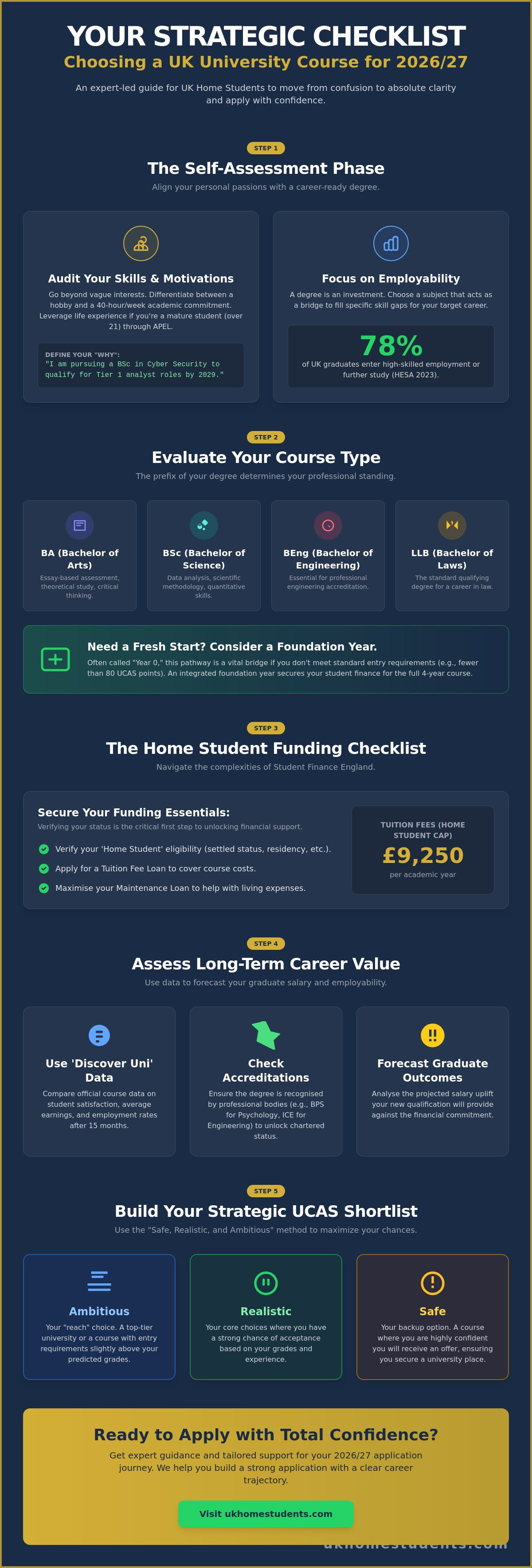
Deciding how to choose a university course is a strategic operation rather than a simple process of elimination. It involves aligning your academic interests, career aspirations, and personal circumstances with a specific degree programme that offers the best return on investment. For the 2026 application cycle, self-reflection has become the non-negotiable first step. With the UK job market evolving rapidly, you can't afford to choose a course based on vague interest alone. You need a data-driven approach to your own potential.
The debate between passion and employability often feels like a binary choice, but long-term success requires a middle ground. HESA data from 2023 shows that 78% of UK graduates enter high-skilled employment, yet those who choose subjects solely for the salary often report lower levels of career satisfaction. You must audit your current skills to identify specific gaps. If you're targeting a career in Fintech but lack quantitative analysis skills, your degree choice should act as the bridge to fill that void. Understanding the university application process across different regions helps highlight how focused the UK system is on subject-specific mastery from day one.
Identifying Your Core Motivations
You need to be honest about why you're applying for the 2026 intake. Are you studying for immediate career progression, a total career pivot, or personal enrichment? Define your "why" in a single sentence to act as your north star: "I am pursuing a BSc in Cyber Security to qualify for Tier 1 analyst roles by 2029." This clarity is vital. It's also the time to differentiate between a hobby and a full-time academic commitment. Loving historical documentaries is excellent, but it doesn't always translate to the 40 hours of weekly archival research required for a History degree.
The Mature Student Perspective: Leveraging Life Experience
If you're over the age of 21, your previous work history is a significant advantage that can influence both your course choice and entry eligibility. Many UK institutions use Accreditation of Prior Experiential Learning (APEL) to recognise professional skills, potentially waiving standard A-Level requirements. However, you must evaluate the opportunity cost of returning to education. With tuition fees for home students currently capped at £9,250 per year, the financial commitment is substantial. You'll need to balance this against the projected salary uplift your new qualification will provide. Transitioning back to a classroom environment as a "home student" involves a psychological shift, but your real-world experience often makes you a more disciplined and effective learner than those entering straight from college.
Evaluating Course Types: Foundation Years, Degrees, and Flexible Learning
Understanding the UK degree hierarchy is the first step in learning how to choose a university course. You aren't just picking a subject; you're picking a level of intensity and a specific career path. Most students start at Level 4, which is the first year of a standard degree, but your route depends on your current qualifications. The prefix of your degree determines your future professional standing. A BA (Bachelor of Arts) typically involves essay-based assessment and theoretical study. A BSc (Bachelor of Science) emphasizes data analysis and scientific methodology. For specialized careers, an LLB is the standard for law, while a BEng is essential for those seeking professional engineering accreditation. Choosing the right prefix ensures your qualification is recognized by industry bodies when you graduate in 2026 or beyond.
Foundation Year Entry Pathways
If you don't meet the standard UCAS point requirements, university courses with foundation year uk offer a vital bridge. These programmes, often called "Year 0," provide the academic grounding needed for a full degree. Integrated foundation years are part of a four-year course. This is beneficial because your funding is secured for the entire duration through UK Government Student Finance. Standalone foundation years are separate, which can sometimes complicate your long-term funding eligibility. If you have fewer than 80 UCAS points or have been out of education for several years, this pathway is your most reliable route to a top-tier qualification.
Mode of Study: Full-Time, Part-Time, and Blended
In 2026, the traditional five-day campus schedule is no longer the only option. Blended learning combines digital lectures with on-campus seminars, allowing you to balance study with other life commitments. Many modern universities now offer "compressed" schedules. This means you might only attend campus two days a week. If you have childcare responsibilities or a full-time job, these flexible degrees are essential. You must assess the "contact hours" in the course specification before you commit. A course with 12 hours of weekly contact time requires a different lifestyle compared to one with 25 hours. If you're still unsure how to choose a university course that fits your schedule, you can request an expert assessment to clarify your options. This ensures you select a mode of study that supports your personal circumstances rather than working against them.
- Full-Time: Usually 12-20 hours of contact time per week.
- Part-Time: Typically doubles the duration of the degree but halves the weekly workload.
- Blended: A mix of at-home digital learning and mandatory in-person workshops.
- Evening/Weekend: Specifically designed for working professionals.
The Essential Home Student Funding & Eligibility Checklist
You cannot effectively decide how to choose a university course without first understanding the financial framework supporting your studies. For the 2026/27 academic year, qualifying as a Home Student is the difference between paying the capped tuition fee of £9,250 and facing international rates that often exceed £25,000. Your eligibility for Student Finance England (SFE) funding hinges on specific criteria that go beyond your passport. Home Student status is determined by residency, not just citizenship.
When you build your 2026 funding checklist, you must distinguish between the two primary types of support. The Tuition Fee Loan is paid directly to your university to cover your teaching costs. In contrast, the Maintenance Loan is paid into your bank account in three installments to cover rent and food. Your choice of course also dictates your access to specific pots of money. If you choose healthcare or social work, you might access the NHS Learning Support Fund, which provides a non-repayable grant of at least £5,000 per year.
Securing Your Maintenance Loan and Grants
Assessing your eligibility for a maintenance loan requires a detailed look at your household income. If your household earns under £25,000, you'll typically qualify for the maximum loan amount. For students with children, the Childcare Grant covers up to 85% of your weekly costs, while the Parents' Learning Allowance offers up to £1,915 per year in non-repayable support. Always check if your university offers 'hardship funds' or 'widening participation' bursaries. These are hidden gems that don't appear on your standard SFE application but can provide an extra £1,000 to £3,000 annually.
Navigating the 'Home Student' Residency Rules
To secure uk home student status, you must satisfy the '3-year rule'. This requires you to have been 'ordinarily resident' in the UK for the full three years immediately before your course starts on September 1st. A common misconception is that EU nationals with pre-settled status automatically get full funding. In reality, you often need to prove five years of residency or show you're a migrant worker to access maintenance loans. If you've spent time living or working abroad, SFE may flag your application for a residency review. Obtaining an expert assessment of your status before you submit your UCAS forms prevents the stress of a last-minute funding rejection. Understanding these rules is a vital step in learning how to choose a university course that fits your actual budget.
Assessing Long-Term Value: Career Outcomes and Professional Accreditation
Choosing a course isn't just about the next three years; it's about the next thirty. When you're deciding how to choose a university course, the financial return on investment is a critical metric. You shouldn't guess your future earnings when official data is readily available. The "Discover Uni" website provides official statistics on graduate salaries 15 months after finishing a course. For instance, you might find that a specific Engineering degree at one university leads to an average starting salary of £32,000, while the same subject elsewhere averages £26,000. These figures help you ground your decision in economic reality.
Beyond the salary, you must audit the "Industry Links" of any prospective department. A syllabus that hasn't changed since 2022 won't prepare you for the 2026 job market. Check if the department hosts regular guest lectures from industry leaders or offers "sandwich years" with established UK firms. According to High Fliers Research, over 30% of entry-level jobs at the UK’s leading graduate employers are filled by students who previously had internships or placements with those companies. If a course doesn't offer a direct bridge to the workplace, you're starting the race several steps behind your peers.
Career Path Deep-Dives
You need to distinguish between broad degrees and vocational ones. For example, a business management degree offers a versatile foundation for roles in marketing, HR, or consultancy. Conversely, a specialized Accounting degree is a fast-track for those certain they want to pursue a Chartered status. If you're leaning toward humanities, focus on the "transferable skills" like critical analysis and communication, which 75% of employers value as much as technical expertise. To get the truth about a course, find alumni on LinkedIn. Ask them if the modules actually prepared them for their current roles. Most are happy to give you an unfiltered perspective.
Accreditation and Professional Recognition
Professional accreditation is a non-negotiable factor for many careers. If you're looking at Finance, check for ACCA or CIMA exemptions. If you're entering Health and Social Care, ensure the course is approved by the Health and Care Professions Council (HCPC). Studying a non-accredited course in these fields could mean you're unable to register professionally after graduation, effectively wasting your tuition fees. You should also verify the university’s Teaching Excellence Framework (TEF) rating for 2026. A "Gold" rating indicates that the institution consistently delivers outstanding teaching and outcomes for its students. Most top-tier courses now use Industry Advisory Boards, where real-world employers help shape the curriculum to ensure it meets current hiring needs.
Finalising Your Choice: The Application Journey for UK Students
Once you've narrowed down your options, the focus shifts to the mechanics of the UCAS application. You'll need a tactical shortlist to maximise your chances of success. This involves selecting five courses using a "Safe, Realistic, and Ambitious" strategy. Your ambitious choice should be a university where entry requirements sit slightly above your predicted grades. Your realistic options should align perfectly with your profile, while your safe choices provide a guaranteed backup. This balanced approach is a critical final step in learning how to choose a university course that secures your future.
Your personal statement must bridge the gap between your current skills and your chosen degree. Admissions tutors at UK universities look for specific evidence of academic curiosity. Dedicate at least 80% of your statement to your interest in the subject itself. Avoid common mistakes like quoting famous figures or using clichés like "since I was young," which often lead to immediate dismissal by competitive departments. Instead, focus on specific modules or academic texts that shaped your perspective. This demonstrates that you've moved beyond the surface level of how to choose a university course and truly understand the curriculum.
The UCAS Timeline for 2026
Success depends on hitting strict deadlines. Missing a cut-off can delay your career by an entire year. Follow this 2026 roadmap to stay on track:
- September 2025: UCAS applications open. Start drafting your personal statement and requesting academic references.
- January 29, 2026: The equal consideration deadline. Most undergraduate applications must be submitted by 6:00 pm to be guaranteed a review.
- February to July 2026: If you don't hold any offers or have declined them, you can use UCAS Extra to apply for remaining vacancies one by one.
- August 13, 2026: A-Level results day. If your grades don't meet your firm offer, you'll enter the Clearing process to find available spots at other institutions.
If you miss the January deadline, don't panic. Applications are still accepted until June 30, though many popular courses will already be full. Navigating UCAS Extra or Clearing requires a cool head and quick decision-making to secure a place that still aligns with your long-term goals.
The Value of Expert Guidance
The UK higher education system is complex, especially regarding eligibility criteria for tuition fee grants and maintenance loans. If you've lived outside the UK or have a non-traditional residency background, determining your "Home" student status is vital for your funding. UK Home Students provides a steady hand through these intricate requirements. We act as a knowledgeable mentor, helping you navigate the bureaucracy of Student Finance and UCAS with confidence.
For busy adult learners, our professional consultancy offers a hassle-free route to enrollment. We help you identify the right path and ensure your documentation is flawless before submission. This level of support shifts the narrative from confusion to clarity, giving you a competitive advantage in a crowded field. We ensure you qualify for the maximum support available while managing the heavy lifting of the application process.
Take the Next Step Toward Your 2026 Degree
Deciding how to choose a university course is one of the most significant financial and professional investments you'll make. You've now explored the essential steps, from evaluating professional accreditations that boost employability to understanding the specific eligibility criteria for Student Finance England. Whether you're a mature student returning to education or a school leaver, your success depends on matching your personal goals with the right academic pathway. Navigating the 2026 UCAS cycle requires a clear strategy and a firm grasp of your funding options, including tuition fee grants and maintenance loans. You don't have to manage this complex process alone. Our team provides direct support for mature and non-traditional students, ensuring you meet all regulatory requirements while maximizing your academic potential. Through our direct partnerships with accredited UK universities, we provide the steady hand you need to secure your place. Take the first step toward your professional goals today with confidence.
Start your journey to a UK degree with a free expert assessment
Your future is within reach, and we're here to help you secure it.
Frequently Asked Questions
How do I know if I qualify for 'Home Student' fee status in 2026?
You generally qualify for Home Student status if you're settled in the UK and have lived here for at least three years before your course begins on 1 September 2026. This status ensures you pay capped tuition fees, currently £9,250 per year, rather than the higher international rates. If you hold settled status under the EU Settlement Scheme or have Indefinite Leave to Remain, you're likely eligible for this lower fee bracket and UK government funding.
Determining your status can be complex if you've lived abroad or hold specific visa types. We recommend an expert assessment of your residency history to confirm your eligibility for a tuition fee grant and maintenance loan. Securing the correct status is the most vital step when you sit down to decide how to choose a university course that fits your budget.
Can I change my university course after I have already started?
Yes, you can often switch courses within the first two to three weeks of your first term if the department has available space. If you decide to change later in the year, you might need to restart your first year in the following September. You must notify Student Finance England immediately because changing your degree path can impact your total years of funding eligibility.
What is the difference between a Foundation Year and an Access to HE Diploma?
A Foundation Year is a four-year degree route where the first year is taught directly by your chosen university to prepare you for Level 4 study. In contrast, an Access to HE Diploma is a Level 3 qualification usually delivered at a Further Education college over one year. While 20,000 students use Access courses annually to enter university, a Foundation Year keeps you within the same institution for the duration of your studies.
How many university courses can I apply for at once through UCAS?
You can apply for a maximum of five courses on your initial UCAS application for the 2026 cycle. If you're applying for medicine, dentistry, or veterinary science, you're restricted to four choices in those specific fields, leaving one extra slot for a different subject. This limit is designed to help you focus your research when learning how to choose a university course that aligns with your professional goals.
Will I get a maintenance loan if I study a part-time degree?
You can receive a maintenance loan for a part-time degree if your course intensity is at least 25% of a full-time equivalent. This means if a full-time degree takes three years, your part-time version must be completed within 12 years to remain eligible for support. The amount you receive is pro-rata based on your intensity of study, so a student at 50% intensity receives half the maximum loan amount.
What should I do if I don't meet the entry requirements for my dream course?
You should immediately look at UCAS Clearing, where over 30,000 course places become available every August for students who missed their grades. Many universities also offer "integrated foundation years" with lower entry requirements, such as BCC at A-Level instead of ABB. These pathways provide a guaranteed route into the full degree once you pass the initial year, ensuring your academic journey stays on track.
How do university league tables actually work and should I trust them?
League tables like the Complete University Guide or The Guardian rank institutions using data from the National Student Survey (NSS) and graduate employment statistics. They often weight student satisfaction and "spend per student" heavily, which can skew results depending on the methodology used. You should use them as a starting point but focus more on specific subject rankings rather than the overall institutional position.
Is it better to choose a broad subject or a very specialised degree?
Choosing a broad subject like Business or History is better if you want to keep your career options open across multiple industries. Specialised degrees, such as Marine Biology or Cybersecurity, are ideal if you have a defined career path and want to gain technical expertise early. Data shows that 80% of graduate employers don't mind what your degree subject is, provided you achieve a 2:1 or higher.