

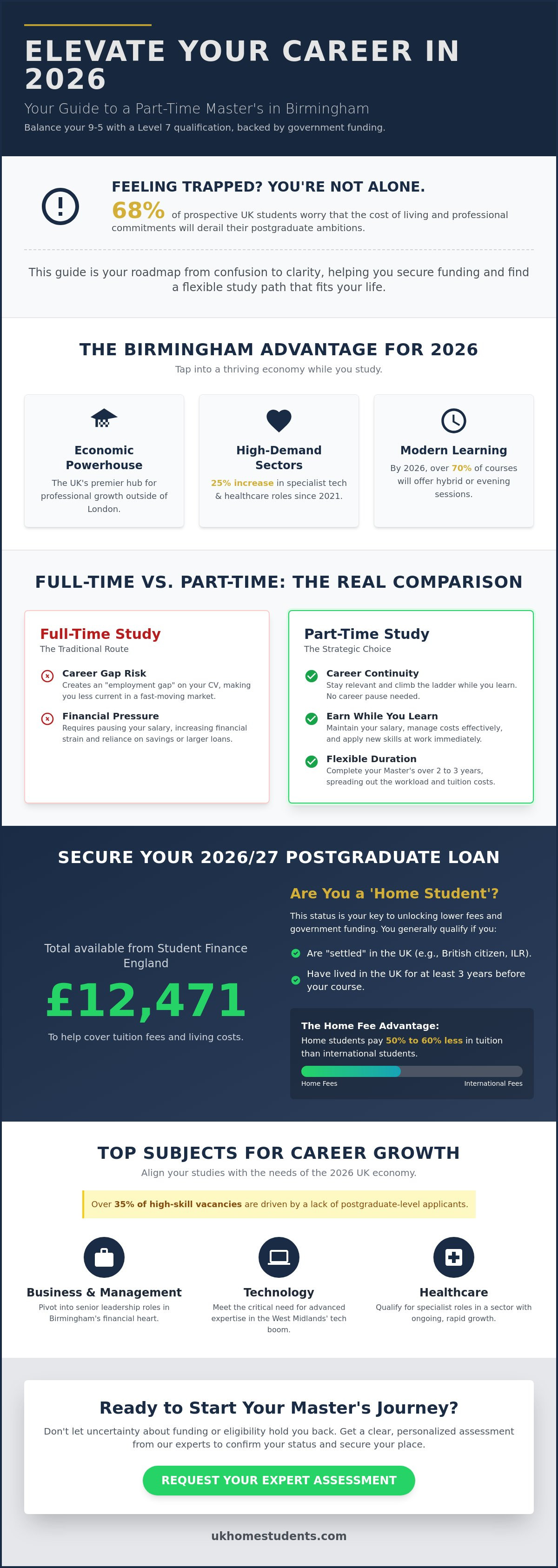
What if you could elevate your career with a Level 7 qualification without sacrificing your monthly salary or your 9-5 stability? Most professionals in the West Midlands feel trapped between the desire for a promotion and the fear of taking on unmanageable debt. If you're currently working in the city, you likely worry that a part time masters birmingham will clash with your professional commitments or that you'll fail to meet the complex eligibility criteria for government support. It's a common concern, especially as the cost of living continues to impact postgraduate decisions for 68% of prospective UK students according to recent Higher Education Policy Institute data.
We're here to help you move from confusion to clarity. This guide provides the expert assessment you need to secure the £12,471 Postgraduate Loan and balance your studies with your career. We'll examine flexible course options across the city's top institutions and simplify the Student Finance England application process. You'll gain a clear roadmap to qualify for funding and find a study pattern that respects your existing schedule. From verifying your settled status to choosing the right university, we've got you covered.
Key Takeaways
- Discover how a part time masters birmingham provides the flexibility to balance professional growth with the city's thriving industries in health, tech, and business.
- Identify the high-demand sectors and Level 7 qualifications that are set to drive career growth and facilitate successful career pivots in the 2026 UK economy.
- Understand the practical differences between full-time and part-time study, including how to manage your contact hours over a flexible two-to-three-year duration.
- Learn how to navigate the specific eligibility criteria and calculate the total Postgraduate Student Loan amount available for the 2026/27 academic year.
- Master the application process by tailoring your personal statement and gathering the right mix of professional and academic references to secure your place.
Why Choose a Part-Time Master’s in Birmingham in 2026?
Birmingham has solidified its position as the UK’s premier destination for professional growth outside of London. As we move into 2026, the city’s economy continues to thrive, particularly within the West Midlands’ tech and healthcare sectors which have seen a 25% increase in specialist roles since 2021. Choosing to pursue a part time masters birmingham allows you to integrate a high-level academic qualification into your existing life without pausing your career momentum.
A part-time Master's degree in the United Kingdom is a Level 7 qualification that typically spans two to three years. In Birmingham, universities have adapted to the needs of the 2026 workforce by shifting toward sophisticated hybrid and weekend learning models. This evolution means you spend less time commuting to campus and more time engaging with digital resources and collaborative seminars. For UK Home Students, this flexibility is paired with a significant financial advantage that makes advanced education more accessible than ever.
The Benefits of Flexible Postgraduate Learning
Opting for a part-time schedule isn't just about convenience; it's a strategic financial and professional decision. You can maintain a steady income, which is vital for managing living costs in a major city. The benefits include:
- Immediate Application: You can apply academic theories to your professional role the very next day, providing instant value to your employer.
- Financial Management: You spread the cost of your tuition over several years, reducing the need for large upfront payments.
- Career Continuity: You avoid the "employment gap" often associated with full-time study, staying relevant in Birmingham's fast-moving job market.
By 2026, over 70% of postgraduate programs in the city are expected to offer "block teaching" or evening sessions. This ensures that your part time masters birmingham fits around your 9-to-5 commitments rather than competing with them.
Identifying Your Home Student Status
Your fee status is the most critical factor in determining the affordability of your Master’s. If you meet the criteria for UK Home Student status, you qualify for tuition rates that are often 50% to 60% lower than those charged to international applicants. Generally, you must be "settled" in the UK and have lived here for at least three years prior to the start of your course to qualify.
Securing this status unlocks access to the postgraduate master's loan from Student Finance England, which can provide over £12,000 toward your studies. If you are unsure about your eligibility, you should consult the UK home student status guide to verify your position. Understanding these regulations early allows you to maximize your funding options and secure your place in Birmingham’s competitive academic environment with confidence.
Top Part-Time Master’s Subjects for Professional Growth
Choosing to pursue a part time masters birmingham requires aligning your academic goals with the shifting needs of the 2026 UK economy. As the West Midlands continues its trajectory as a leading regional hub, specific sectors are demonstrating a critical need for advanced expertise. If you're looking to future-proof your career, focusing on sectors with high vacancy rates is a strategic move. Recent data suggests that over 35% of vacancies in high-skill roles are currently driven by a lack of applicants with postgraduate-level qualifications.
Securing your place in a top-tier program is the first step toward closing this gap. To manage the costs, most UK home students apply for the Postgraduate Master's Loan, which provides essential support for tuition and living expenses. If you're unsure about your eligibility for this funding or how it applies to your specific residency status, you can request an expert assessment to clarify your position before you submit your application.
Business and Management Pathways
Business and Management remains the primary choice for professionals seeking a career pivot or a promotion into senior leadership. Birmingham's status as a major financial heart of the UK makes it an ideal location for these studies. You can choose between a broad MSc in Business Management or a more specialized MBA. These programs often feature evening or weekend blocks to suit those working 9-to-5 roles. For a detailed breakdown of local options, read our MBA Birmingham guide. The true value of a Birmingham-based cohort lies in professional networking, as you'll be studying alongside managers from many of the city's 44,000 active businesses.
Health, Social Care, and Computing
The demand for advanced practitioners in the West Midlands is at a record high. With the NHS Long Term Workforce Plan aiming to significantly increase training places by 2028, a Master’s in Health and Social Care is a robust investment. These degrees align with national professional standards, allowing you to move into specialist or consultative roles within the public sector.
The tech industry in Birmingham is also expanding. If you're balancing a corporate role or freelance work, flexible computing Master’s degrees offer modules in AI, data science, and cybersecurity. These courses are designed for the 2026 market, where roughly 80% of all high-growth jobs require advanced digital skills. A part time masters birmingham in these fields ensures you remain competitive while maintaining your current income.
- Health: Focus on Advanced Clinical Practice or Public Health to meet local trust requirements.
- Computing: Prioritize Data Analytics or Cyber Security to tap into the city's growing tech quarter.
- Flexibility: Most institutions now offer hybrid learning models, combining campus sessions with digital modules.
Full-Time vs. Part-Time Master’s: The Real Comparison
Choosing between a full-time and part-time route is the first major hurdle for many postgraduate applicants. A full-time Master of Arts (MA) or Master of Science (MSc) is typically a 12-month sprint. It requires a commitment of roughly 35 to 40 hours per week, split between lectures and independent research. In contrast, opting for a part time masters birmingham allows you to spread this workload over two or three years. This extension reduces your weekly academic commitment to approximately 15 to 20 hours, making it a viable path for those with professional or family responsibilities.
When weighing up your options, understanding the pros and cons of studying a part-time master's helps you align your degree with your existing commitments. One of the primary differences lies in contact hours. While a full-time student might be on campus four days a week, a part-time student often attends only one or two days. The "hidden" benefit here is the gift of time. You have more space to reflect on complex theories and apply them to real-world scenarios before your next seminar.
Your Student Finance England (SFE) application also changes based on this choice. For the 2024/25 academic year, the postgraduate loan is worth up to £12,471. If you study part-time, SFE doesn't pay this in a single year. Instead, they divide the total amount equally across the duration of your course. If your course lasts three years, you'll receive your funding in three annual installments. It’s a steady way to manage your tuition fees without the pressure of a massive upfront debt.
Managing Your Study-Work Balance
Success in a part-time program depends on a predictable schedule. Most Birmingham institutions offer flexible structures, such as evening lectures or intensive "block" teaching where you attend campus for three consecutive days once a month. You'll use digital learning platforms like Canvas or Blackboard to access materials outside of these hours. It's vital to have an honest conversation with your employer early on. Ask about "study leave" policies. Many UK companies provide 2 to 5 days of paid leave annually for exams or dissertation writing, which can be the difference between burnout and success.
The Long-Term ROI of Part-Time Study
The return on investment for part-time study is often higher when you account for your "opportunity cost." By not taking a career break, you maintain your salary and continue accruing years of professional experience. You aren't just gaining a certificate; you're building a dual-track resume of work and study. Gradual learning also leads to better knowledge retention. You can start finding a master’s course in Birmingham that matches your specific career goals and offers the right duration for your lifestyle.
Securing Your 2026 Postgraduate Student Loan
Financing your part time masters birmingham doesn't have to be a source of stress. The UK government provides a non-means-tested Master’s Loan designed as a contribution toward your tuition fees and living costs. For the 2026/27 academic year, you should follow a structured approach to ensure your funding is in place before your first seminar begins.
- Step 1: Verify your eligibility. You must be under the age of 60 on the first day of your first academic year. Generally, you need to have been a UK resident for at least three years prior to the course start date.
- Step 2: Calculate your total loan. While the exact 2026/27 figures will be confirmed closer to the date, the 2024/25 maximum was £12,471. You can expect this figure to be adjusted for inflation by the time you enroll.
- Step 3: Understand pro-rata payments. Because you're studying part-time, your loan is paid in equal installments across the duration of your course. If your Master’s lasts two years, you'll receive 50% each year; if it lasts four years, you'll receive 25% annually.
- Step 4: Submit your application. Use the Student Finance England (SFE) portal. You don't need a confirmed university place to start your application, so it’s best to apply as soon as the window opens in June 2026.
Eligibility Criteria for Home Students
The most critical regulation is the "one Master’s" rule. You generally cannot access this funding if you already hold a Master’s degree or a higher qualification, such as a PhD. This applies even if your previous qualification was self-funded or obtained abroad. Residency is also vital; you must have settled status or be a UK/Irish citizen. For a detailed breakdown of the financial math, see our postgraduate student loan guide.
Repayment Terms and Interest Rates
Repaying your loan is based on what you earn, not what you owe. You'll pay back 6% of your income over the current threshold of £21,000 a year. This happens alongside any undergraduate loan repayments, but it's calculated as a separate deduction. Interest rates are typically set at the Retail Price Index (RPI) plus 3%. It's essentially a "no win, no fee" system; if your income drops below the threshold, your payments stop automatically. This provides a significant safety net while you pursue your part time masters birmingham.
To ensure you've ticked every box for your specific situation, get a professional assessment of your funding options before you submit your final university application.
How to Apply and Start Your Master’s Journey
Securing your place on a part time masters birmingham requires a strategic approach that goes beyond simple form-filling. Most institutions in the city, such as the University of Birmingham or Aston University, offer two primary entry points: the traditional September start and an increasing number of January intakes. If you're targeting a 2026 start, you should aim to have your documentation ready at least four to six months in advance. This lead time is vital for coordinating your references. You generally need two: one academic and one professional. If you've been in the workforce for several years, your professional reference carries significant weight, as it proves your current competency and discipline.
Deadlines are strict, especially for courses with high competition or those eligible for specific government bursaries. While some programmes offer rolling admissions, applying early ensures you have enough time to secure your postgraduate loan from Student Finance England. Missing a deadline by even a few days can delay your career progression by an entire academic year, so keeping a calendar of institutional cut-off dates is essential for success.
Crafting a Strong Personal Statement
Your personal statement is your interview on paper. It's the most influential part of your application because it provides context that your CV cannot. For part-time applicants, the focus shifts from past grades to current potential. Admissions tutors want to see how your career experience aligns with the curriculum. You need to prove you have the resilience to balance a demanding career with high-level study. Don't just say you're organised; provide a specific example of a project you led while managing other commitments. This evidence shows you're ready for the intensity of a part time masters birmingham and that you can contribute practical insights to the seminar room.
Hassle-Free Support for Birmingham Students
The bureaucracy of university portals can be confusing. UK Home Students acts as your advocate, providing an expert assessment to ensure your application is airtight. We help you navigate whether a university uses its own direct portal or the UCAS Postgraduate system, which varies by institution. Our consultants vet your eligibility for Home status and funding, removing the guesswork from the process. We turn a complex administrative hurdle into a clear, manageable path. To ensure you haven't missed a single step in your preparation, review the final checklist on our Masters Degree Birmingham Pillar.
- Expert assessment of your professional and academic eligibility.
- Step-by-step guidance through direct university application portals.
- Verification of Home student status for tuition fee purposes.
- Strategic advice on balancing work commitments within your application.
Start Your Birmingham Postgraduate Journey Today
Securing a part time masters birmingham degree in 2026 allows you to advance your career without pausing your professional income. You can currently access the Student Finance England postgraduate loan, which provides up to £12,471 for students starting in the 2024/25 academic year, to help manage your tuition and living costs. By choosing a part-time route, you gain the flexibility to apply new skills in the workplace immediately while studying in one of the UK’s most vibrant academic hubs.
Navigating the complex eligibility criteria for funding and admissions doesn't have to be a source of anxiety. Our team provides specialized support for mature and working students, ensuring you understand the specific requirements for your situation. Through our partnerships with leading UK universities, we provide expert guidance on Student Finance England eligibility to help you maximize your funding and secure your place.
Get a Free Expert Assessment for Your Master’s Application
Your academic goals are achievable with the right professional intervention. We look forward to helping you turn your career ambitions into a reality.
Frequently Asked Questions
Can I get a maintenance loan for a part-time Master’s in Birmingham?
You won't receive a separate maintenance loan for a part-time Master’s; instead, you'll get a single Postgraduate Master’s Loan. This lump sum is paid directly to you in three installments per year. For the 2025/26 academic year, the maximum loan amount is expected to rise above the previous £12,471 limit. You're responsible for managing this payment to cover both your tuition fees and your daily living expenses.
How many days a week is a part-time Master’s course?
Most part-time Master’s courses in Birmingham require one to two days of on-campus attendance per week. This schedule is designed to help you balance your degree with a 37.5-hour work week or family commitments. Universities like Aston or Birmingham City University often cluster lectures on specific days or offer evening seminars. You should also plan for 15 to 20 hours of independent study each week to keep up with the curriculum.
Is there an age limit for the UK postgraduate loan in 2026?
You must be under the age of 60 on the first day of the first academic year of your course to qualify for the loan. This rule is strictly applied by Student Finance England to ensure the debt is repayable within a standard working life. If you turn 60 during your studies, your payments won't stop as long as you were eligible when you started. There's no lower age limit, provided you meet the residency and qualification criteria.
Can I switch from full-time to part-time study mid-course?
You can usually switch from full-time to part-time study if your university department approves the change. This requires a formal notification to the registrar and an update to your Student Finance profile. Your loan payments will be recalculated to reflect the extended duration of your degree. It's vital to inform the funding body immediately to avoid an overpayment, as they'll deduct any excess funds from your future installments.
Do I need a specific undergraduate grade to apply for a part-time Master’s?
Most universities require at least a 2:2 honours degree to apply for a part time masters birmingham. However, if you have five or more years of relevant professional experience, many admissions tutors will consider your application even with a lower grade. You'll likely need to provide a strong personal statement and a professional reference to prove your readiness for Level 7 study. Always check the specific faculty requirements before you submit your application.
Are part-time Master’s degrees viewed differently by employers?
Employers view part-time Master’s degrees as equal to full-time qualifications and often value the time-management skills you've demonstrated. Completing a degree while working shows a high level of discipline and a clear commitment to your career progression. According to Graduate Labour Market Statistics, postgraduates in the UK earn an average of £6,500 more per year than those with only an undergraduate degree. Your ability to apply new theories to your workplace in real-time is a significant advantage.
Can I get funding if I already have a Master’s degree from abroad?
You generally won't qualify for UK postgraduate funding if you already hold a Master’s degree or a higher qualification from overseas. Student Finance England follows the "equivalent or lower qualification" rule, which means they only fund your first Master’s level course. If your previous degree is evaluated by UK ENIC as being below Level 7, you might still be eligible. It's best to get an expert assessment of your transcripts before you start the application process.
When is the deadline to apply for a part-time Master’s starting in 2026?
The deadline for a part-time Master’s starting in September 2026 varies by university, but most recommend applying by 31 July 2026. While many courses offer rolling admissions, popular programmes in Birmingham can reach capacity as early as March. For funding, you can apply for your postgraduate loan up to nine months after the first day of your course. Securing your place early gives you the best chance to navigate the financial evidence requirements without stress.